Recommended resources
The freely available resources this lesson will direct you to.
Hello! Welcome to the third lesson in our "Foundational Climate Physics" module.
Introduction
In our first two lessons, we established a foundational piece of the climate puzzle. We calculated that without an atmosphere, Earth's effective temperature would be a frigid 255 K (-18°C). By comparing this to the actual average surface temperature of 288 K (15°C), we quantified the natural greenhouse effect as a 33 K warming.
So far, we have treated the atmosphere as a simple, uniform "blanket." Today, we'll look inside that blanket. Our learning outcome is to: Relate the molecular structure of key greenhouse gases (e.g., H₂O, CO₂, CH₄) to their ability to absorb infrared radiation, and rank these gases by their contribution to the total greenhouse effect.
This lesson delves into the fundamental physics and chemistry that drive the greenhouse effect. Given your background in physics and chemistry at A-level, this will be a deeper application of concepts like molecular bonds, vibrations, and electromagnetic radiation to the specific context of atmospheric science. We will move from the macroscopic (a 33 K warming) to the microscopic (how a single molecule interacts with a photon) and back again.
1. The Molecular Dance: Why Some Gases Trap Heat
The atmosphere is about 99% nitrogen (N₂) and oxygen (O₂). If these gases were effective at trapping heat, the Earth would be far hotter than it is. The greenhouse effect is driven by gases that are present in trace amounts. Why are these trace gases so special? The answer lies in how they interact with infrared (IR) light.
Molecules are not static; their atoms are in constant motion, vibrating and rotating. Absorbing a photon of IR radiation—the type of longwave energy Earth radiates to space—causes a molecule to vibrate more energetically. However, this absorption can only happen if a specific quantum mechanical condition is met.
The following video provides an excellent and intuitive explanation of this mechanism.
But HOW Does Carbon Dioxide Trap Heat?
This video from the 'Reactions' channel breaks down precisely why molecules like CO₂ and H₂O can absorb infrared radiation while N₂ and O₂ cannot.
Please watch the sections from 1:18 to 10:37. As you watch, focus on the core principle it develops: How IR photons transfer energy to molecules, causing vibrations. The concept of a dipole moment. The critical rule: for a molecule to absorb IR, its vibration must cause a change in its dipole moment. How this rule applies to symmetric molecules (O₂, N₂) versus asymmetric or complex molecules (H₂O, CO₂).
The Key Principle: A Changing Dipole Moment
As the video explained, the interaction between the oscillating electric field of an IR photon and a molecule is key.
- Symmetric diatomic molecules like N₂ and O₂ have a zero dipole moment. When they vibrate, the symmetry is maintained, and no dipole moment is created. Thus, there is no electric "handle" for the IR photon to grab onto. They are transparent to IR radiation.
- Asymmetric molecules like water (H₂O), which is bent, have a permanent dipole moment that changes as the molecule vibrates.
- Symmetric linear molecules like carbon dioxide (CO₂) have no permanent dipole moment at rest. However, certain vibrational modes, like the bending or asymmetric stretching modes, break this symmetry, creating a temporary, oscillating dipole moment.
This allows these molecules to absorb IR photons at specific frequencies corresponding to the vibrational energies. To reinforce this fundamental rule, please read the following short text.
The Spectra of Molecules- Infrared
This excerpt from the Chem LibreTexts online textbook provides a concise, written summary of the dipole moment selection rule.
Please read the single section titled 'Requirement for Infrared Absorption: Changing Dipole Moment'. It clearly articulates the physical principle we are discussing.
2. The "Fingerprints" of Greenhouse Gases
Each greenhouse gas absorbs IR radiation only at specific wavelengths, determined by its unique structure and allowable vibrational modes. These absorption patterns act like molecular "fingerprints."
Let's look more closely at the vibrational modes of CO₂.
How Carbon Dioxide Absorbs Earth's IR Radiation
This article from GEO ExPro provides a more technical look at the specific vibrational modes of the CO₂ molecule and their corresponding absorption wavelengths.
Please read the section titled 'The CO₂ Molecule’s Absorption Lines'. Pay close attention to the diagram showing the four vibrational modes and the text explaining which ones are 'infrared active' and why.
As you read, you saw that CO₂ has two key IR-active vibrations:
- Asymmetric Stretch: Absorbs at ~4.26 μm.
- Bending Mode (degenerate): Absorbs at ~15 μm.
The 15 μm absorption band is particularly important because it falls right near the peak of Earth's outgoing thermal radiation, allowing CO₂ to effectively block a significant portion of the energy trying to escape to space.
The image below shows the absorption fingerprints for several important atmospheric gases.
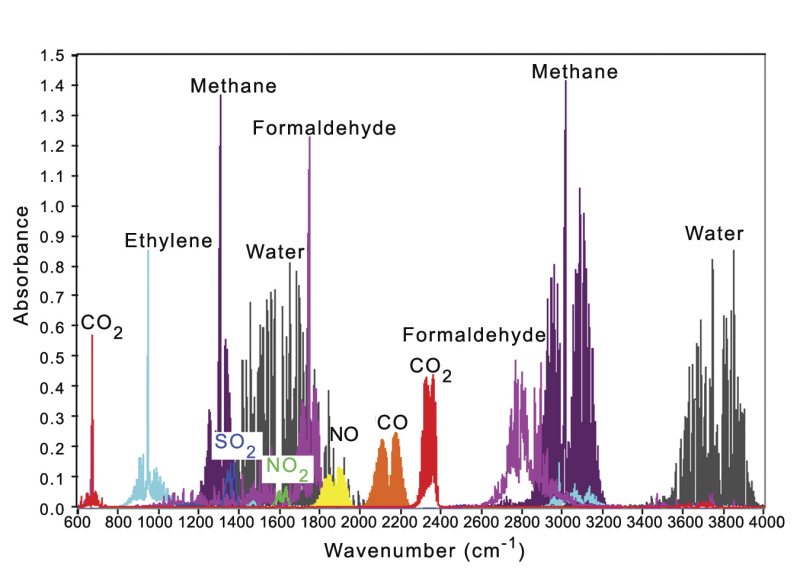
Take a moment to analyze the graph. Notice how water vapor (H₂O) has very broad and strong absorption bands across large portions of the spectrum. CO₂ has its distinct, powerful bands. Methane (CH₄) and Nitrous Oxide (N₂O) also absorb in specific regions, some of which overlap with water vapor, while others fall into the "atmospheric window"—a region of the spectrum where IR radiation would otherwise escape freely.
3. Ranking the Contributors
Now we can address the second part of our learning outcome: ranking the gases by their contribution to the total 33 K greenhouse effect. A gas's total impact depends on two factors: its molecular ability to absorb IR radiation (its "per-molecule" strength) and its concentration in the atmosphere.
How Carbon Dioxide Absorbs Earth's IR Radiation
The same GEO ExPro article also provides a clear ranking of the main contributors to the natural greenhouse effect.
Please read the section 'Infrared Spectroscopy of Gas Molecules', focusing on the final paragraph and the accompanying figure ('Absorption spectra of various gases...'). This will give you the quantitative breakdown.
Based on this and other sources, we can summarize the contributions to the natural greenhouse effect as follows:
- Water Vapor (H₂O): By far the most important greenhouse gas, responsible for about 50% of the total effect. Its high concentration and broad absorption bands make it a powerful heat-trapping agent.
- Clouds: These are liquid water droplets or ice crystals, not water vapor. They have a very strong effect on radiation, contributing about 25% to the total greenhouse effect. (They also reflect sunlight, which is a cooling effect—we will explore this duality in a later module).
- Carbon Dioxide (CO₂): The second most important gaseous contributor, responsible for about 20% of the effect. Its role is crucial because it absorbs where water vapor doesn't, and its atmospheric lifetime is very long.
- Other Greenhouse Gases (CH₄, N₂O, O₃, etc.): These contribute the remaining ~5%. While their contribution to the natural greenhouse effect is small, their per-molecule warming potential can be very high, making their increase due to human activity a significant concern.
So, the ranking is clearly: Water Vapor > Carbon Dioxide > Other trace gases.
4. A Deeper Look: Saturation and Band Broadening
A common question arises: if the main CO₂ absorption band at 15 μm is already absorbing nearly all the radiation at that specific wavelength, how can adding more CO₂ cause more warming? This is often referred to as the "saturation" argument.
The physics is more subtle. The following video explains this nuance beautifully.
I Misunderstood the Greenhouse Effect. Here's How It Works.
Physicist Sabine Hossenfelder explains why the 'saturation' argument is a misunderstanding of how radiative transfer works in the atmosphere.
Please watch from 9:42 to 13:02. Focus on how increasing CO₂ concentration affects the width of the absorption 'ditch' in the outgoing spectrum, and the concept of the effective emission altitude.
As the video explains, even if the center of the absorption band is saturated, adding more CO₂ molecules does two things:
- Broadens the absorption band: It increases absorption in the "wings" of the band, capturing wavelengths that were previously escaping.
- Raises the emission altitude: It makes the atmosphere more opaque, forcing the final emission of IR to space to occur from higher, colder atmospheric layers. Since the amount of radiation emitted depends on temperature (Stefan-Boltzmann law, ), colder layers radiate less energy away, reducing the planet's cooling efficiency.
This is a crucial concept that we will build upon in the next module when we discuss radiative transfer in more detail.
Conclusion
In this lesson, we journeyed into the molecular world to understand the physical basis of the greenhouse effect.
Key Takeaways:
- Greenhouse gases absorb infrared radiation because their vibrational modes induce a change in their molecular dipole moment, a condition not met by the symmetric N₂ and O₂ molecules.
- Each greenhouse gas has a unique absorption "fingerprint" based on its molecular structure. CO₂'s 15 μm absorption band is critical as it sits near the peak of Earth's outgoing thermal radiation.
- The primary contributors to Earth's natural greenhouse effect are water vapor (~50%), clouds (~25%), and carbon dioxide (~20%).
- Even if the central CO₂ absorption band is saturated, adding more CO₂ still enhances the greenhouse effect by broadening the absorption bands and raising the effective altitude of emission.
Preview of the next lesson:
We have now identified the key actors (the gases) and the mechanism (IR absorption). We are ready to build a more quantitative model. In the next lesson, we will construct a simple one-layer atmospheric model. This will allow us to use the principles we've learned today to derive an equation for the Earth's surface temperature that explicitly accounts for the atmosphere's ability to absorb and re-radiate energy, moving us one step closer to a physically realistic climate model.