Recommended resources
The freely available resources this lesson will direct you to.
Introduction
Welcome to the final lesson of our course on attention and focus management. Over the past few weeks, we have journeyed from the fundamental neuroscience of attention to the practical strategies of defending your focus. In our last lesson, you designed the first version of your weekly work template, a concrete plan to balance deep work, shallow work, and recovery.
However, a static plan, no matter how well-conceived, rarely survives contact with reality. Your work, priorities, and energy levels will change. The true key to a sustainable system is not a perfect initial design, but a mechanism for continuous improvement.
Today, we will build that mechanism. Our learning outcome is to create a simple feedback loop to review and iterate on your personal productivity system. This lesson is the capstone of the course, providing the engine that will keep your system running, adapting, and improving long after you've finished these modules. We will explore why a feedback loop is essential from a systems thinking perspective, learn a practical method for conducting a weekly review, and understand the neuroscience that makes self-assessment effective.
1. From a Collection of Tactics to a Coherent System
Your productivity methods—timeboxing, calendar blocking, a weekly template—are the individual components of your system. But what makes them a system rather than just a collection of tools? The answer lies in the connections between them, specifically, a feedback loop.
To understand this crucial concept, let's turn to systems thinking.
Debug Your Productivity with Systems Thinking
This article, 'Debug Your Productivity with Systems Thinking' by Cliff Guren, provides an excellent high-level framework for our final topic. It explains why a feedback loop is the element that transforms a set of disconnected tasks into a functioning, intelligent system.
Please read the first two main sections: Introducing Systems Thinking: Focus on the definition of a system (elements, interconnections, purpose) and what differentiates it from a mere 'bunch of stuff.' Applying Systems Thinking to Personal Productivity Systems: Pay close attention to the diagrams and the explanation of how a feedback loop connects your goals, tasks, and schedule, preventing backlogs and stress. Note the author's conclusion about the central role of a 'regular (weekly) feedback loop.'
As the article argues, without a feedback loop, your plans and your reality will drift apart. You might have a great weekly template, but if you don't periodically assess how it's working, it will quickly become obsolete. A feedback loop makes your system dynamic and responsive.
We can visualize this process with a simple model.
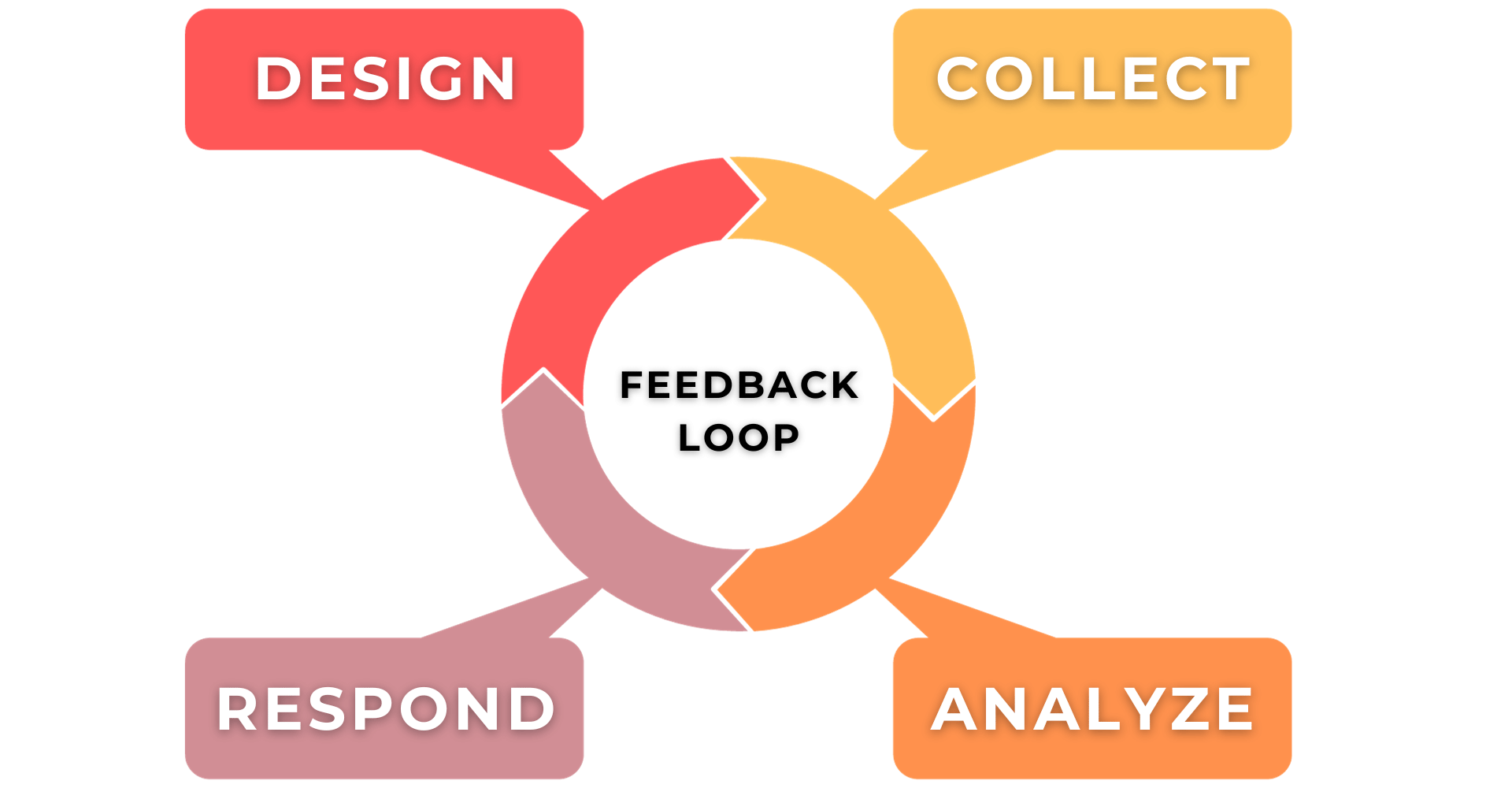
The weekly review is the heart of the "Analyze" and "Respond" stages. It's the dedicated time you set aside to run this loop, ensuring your system evolves with you.
2. The Mechanics of a Weekly Review
Now that we understand why a review is critical, let's look at how to conduct one. The goal is to "close open loops," a term from David Allen's Getting Things Done. An open loop is any commitment or idea that is taking up mental bandwidth because it hasn't been properly processed and stored in a trusted system. The weekly review is your process for systematically closing these loops.
From Chaos to Clarity: My 4-Step Weekly Review System
Productivity expert Tiago Forte offers a clear, actionable 4-step process for a weekly review. This provides an excellent starting point for building your own ritual.
Watch the video from the beginning up to 07:09. Forte breaks the weekly review into four parts, which you can remember with the mnemonic 'Every Commitment Needs Tracking': Email (02:38): Notice the goal isn't to answer emails, but to process them into tasks, notes, or archives. Calendar (04:02): Pay attention to how he looks both backward (for follow-ups) and forward (for preparation). Notes (04:35): See how he processes fleeting ideas into a more permanent system, ensuring they aren't lost. Tasks (05:34): This is the crucial final step where you clarify, prioritize, and realistically select your focus for the upcoming week.
Forte's method provides a concrete workflow for gathering your data. You can think of it as the "Collect" phase of your feedback loop. Another helpful framework comes from Jeff Su, who taught a similar system at Google.
The Productivity System I Taught to 6,642 Googlers
In this video, Jeff Su outlines a 'Core Workflow' of Capture, Organize, Review, and Engage. His emphasis on the 'Review' step reinforces its importance.
Please watch two short clips from this video: Why Systems Matter (02:51 - 03:59): He provides a powerful rationale for why we need systems, quoting James Clear: 'We do not rise to the level of our goals. We fall to the level of our systems.' The Review Step (05:16 - 06:38): Focus on his point that capturing information is useless if you never look at it again. The review is about processing your 'information inboxes' and turning them into action.
Both Forte and Su highlight the same core truth: the review is the non-negotiable step that makes the whole system work. It ensures nothing gets lost and allows you to consciously direct your efforts for the week ahead, rather than reacting to whatever is loudest.
3. The Neuroscience of Effective Self-Review
Knowing you should do a weekly review and actually doing it consistently are two different things. Many people avoid it because it feels like a chore, or worse, an exercise in self-criticism. This is a normal human reaction.
Your interest in neuroscience provides a key to overcoming this barrier. Even self-assessment can trigger the brain's threat response.
The Neuroscience of Feedback: How to Build a Brain-Friendly...
This article, 'The Neuroscience of Feedback,' explains why evaluation—even self-evaluation—can feel threatening and how to make it 'brain-friendly.' The principles apply directly to how you conduct your personal weekly review.
Please read the following sections, thinking about how you can apply these principles to your own self-review: Why Feedback Triggers a Threat Response: Understand the role of the amygdala and how feedback can threaten our psychological needs. Normalize Real-Time... Feedback: Note how frequency reduces the 'shock factor' and makes feedback less threatening. Reinforce What’s Working...: Focus on how positive reinforcement activates the brain's reward system (dopamine) and strengthens desired behaviors. Invite Self-Reflection to Increase Ownership: Pay close attention to how asking reflective questions activates the prefrontal cortex (the thinking brain) and reduces defensiveness.
By applying these neuroscientific principles, you can design a review process that feels productive and motivating, not punitive. Here’s how to translate them into your personal feedback loop:
- Frame with Questions, Not Judgments: Instead of thinking "I was unproductive on Wednesday," ask "What challenges arose on Wednesday?" This shifts you from a threat state (amygdala) to a problem-solving state (prefrontal cortex).
- Reinforce the Positive: Actively look for what went well. Did you protect a deep work block? Did you stick to your shutdown ritual? Acknowledging wins releases dopamine, which reinforces those behaviors and makes you more likely to repeat them.
- Be Specific and Action-Oriented: Vague self-criticism ("I need to be more focused") is unhelpful and stressful. Specific observation ("My morning deep work block was interrupted by Slack notifications") leads to a specific action ("I will turn off Slack during my next morning block").
- Make it a Ritual: By doing the review at the same time every week (e.g., Friday afternoon or Monday morning), you normalize it. The brain learns that this is a safe, predictable, and productive activity, reducing anticipatory anxiety.
This weekly review template gives an idea of what this might look like in practice.

4. Your Turn: Design Your Weekly Review Ritual
Now it's time to design the first version of your own weekly review process. The goal is to create a simple, repeatable ritual that you can commit to.
Take 5-10 minutes to answer the following questions.
My Weekly Review Ritual (V1)
-
Timing & Location: When and where will I conduct my 30-minute weekly review? (Be specific, e.g., "Friday at 4:00 PM in my office.")
- Action: I will now add this as a recurring event to my calendar.
-
Inputs: What sources will I review to gather data on my week?
- (e.g., My calendar, my task manager, my digital notes inbox, my V1 weekly template)
-
Key Reflection Questions (The "Analyze" Step): What 3-5 questions will I ask myself?
- e.g., What was my biggest win this week? What did I accomplish?
- e.g., What was the biggest challenge? Where did my system or template break down?
- e.g., What did I learn?
- e.g., Based on my goals, what is the single most important priority for next week?
-
Output (The "Respond" Step): What is the concrete outcome of my review?
- e.g., A short list of 1-3 top priorities for the coming week.
- e.g., One specific adjustment to my weekly template (V2, V3, etc.).
Conclusion and Course Wrap-Up
Congratulations on completing the course. Today, you have designed the most critical component of a sustainable productivity system: the feedback loop.
Key Takeaways:
- A productivity system requires a feedback loop to adapt and improve. Without it, it's just a brittle collection of tactics.
- The weekly review is the engine of this feedback loop, allowing you to close open loops, process inputs, and consciously plan your week.
- By designing your self-review using principles from neuroscience, you can make it a motivating, brain-friendly process that focuses on learning and iteration, not judgment.
Over the last few weeks, you have built a complete personal productivity system from the ground up. You started by understanding your core attention systems, used that knowledge to analyze your work challenges, learned to prioritize and schedule your time with intention, designed your environment to defend your focus, and now, you've created a process to ensure your system continues to serve you for the long term.
Remember that this is a practice, not a destination. There will be weeks where your system works perfectly and weeks where it falls apart. The goal is not perfection, but persistent, gentle iteration. By consistently engaging with this feedback loop, you are cultivating the skill of self-awareness and the habit of intentional action—the true foundations of sustainable productivity.