Recommended resources
The freely available resources this lesson will direct you to.
Welcome back! Over the past few lessons, we've built a solid, hands-on understanding of how to implement the three main Depth-First Search traversals—preorder, inorder, and postorder—using an explicit stack. This was a deep dive into the mechanics of tree iteration.
Now, we'll take a step back to address a fundamental question in algorithm design: when should you use an iterative DFS, and when is the classic recursive approach better? Today's lesson focuses directly on comparing these two methods, specifically analyzing their differences in space usage and the practical risk of stack overflow. Mastering this trade-off is crucial for making smart implementation choices during coding interviews, where you might be asked to justify your choice or even solve a problem without using recursion.
The Tale of Two Stacks
At the heart of the comparison between recursive and iterative DFS lies the concept of a stack. Both approaches use a stack to keep track of the traversal path, but they do so in very different ways.
- Recursive DFS uses the implicit function call stack. This stack is managed by the programming language's runtime environment to handle function calls. Every time your recursive function calls itself, a new "stack frame" is pushed onto the call stack.
- Iterative DFS uses an explicit stack. This is a data structure (like a
listin Python or aDeque) that you create and manage yourself within a single function.
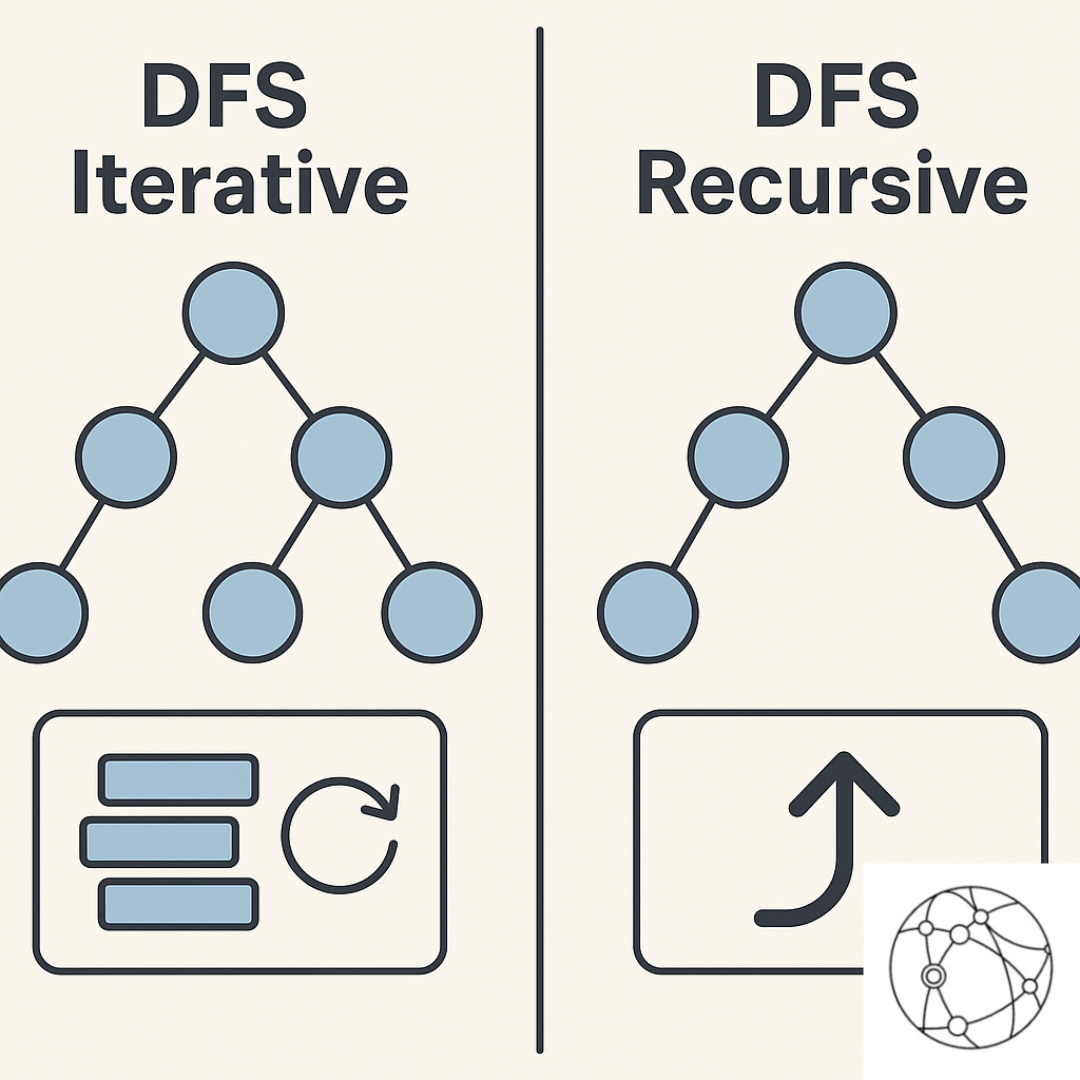
To understand the implications, let's first see the function call stack in action.
Under the Hood: The Function Call Stack
When a recursive function like dfs(node) is called, the system needs to save its current state (local variables, parameters, and the return address—where to resume execution after the call finishes) before jumping into the new call. This saved state is a "stack frame."
The NeetCode video below provides an excellent, simplified simulation of how this works for an inorder traversal. As you watch, notice how each recursive call to a child node adds a new layer to the "stack," and returning from a call removes that layer.
Iterative & Recursive - Binary Tree Inorder Traversal - Leetcode 94 - Python
This video visually demonstrates how the recursive call stack operates.
Watch the segment from this detailed simulation. The narrator uses node values to represent the stack frames, giving a clear intuition for how the runtime keeps track of the traversal path.
The key takeaway is that the call stack is a finite resource managed by the operating system and language runtime, not by your code directly. This has significant consequences.
Comparing Space Usage and Stack Overflow Risk
Now let's directly compare the two methods on the criteria from our learning outcome.
Space Complexity
In terms of asymptotic space complexity, both methods are identical. The space required is proportional to the maximum depth of the stack during the traversal.
- For a balanced binary tree of nodes, the height is approximately . The maximum number of nodes on the stack at any time is the height of the tree. Therefore, the space complexity is .
- For a completely unbalanced (skewed) tree, which resembles a linked list, the height is . In this worst-case scenario, the traversal must go all the way down to the deepest leaf, placing every node along the path onto the stack. The space complexity becomes .
The NeetCode video briefly explains this worst-case scenario.
Iterative & Recursive - Binary Tree Inorder Traversal - Leetcode 94 - Python
This short clip explains why worst-case space usage is O(N).
Watch from this explanation to see the example of a skewed tree.
So, if their asymptotic space complexity is the same, what's the practical difference? It comes down to where that memory is allocated.
Stack Overflow Risk
This is the most critical distinction.
-
Recursion (Call Stack): The function call stack is a fixed-size memory region. Its size is relatively small (e.g., in Python, the default recursion limit is often around 1000 calls). If you run a recursive DFS on a deep tree (like a skewed tree with 2000 nodes), you will exhaust this limited space. The program will crash with a stack overflow error (in Python, this is a
RecursionError). -
Iteration (Explicit Stack): The explicit stack you create in your code is allocated on the heap. The heap is a much larger pool of memory used for dynamic allocation. It is limited only by the total available system memory. Therefore, an iterative solution can handle trees of arbitrary depth without causing a stack overflow. It might theoretically run out of memory on an astronomically large tree, but it is far more robust for deep structures.
The following article gives a great summary of this specific point.
Recursion vs. Explicit Stack in DFS | by Utkarsh Goyal - Medium
This article clearly lays out the advantages and disadvantages of each approach.
Focus on the subsections "Disadvantages" under Recursion and "Advantages" under Explicit Stack. This directly contrasts the stack overflow risk with the safety of using heap memory.
Other Important Trade-offs for Interviews
While space and stack overflow are the primary concerns, you should also be aware of other trade-offs when choosing an implementation.
| Feature | Recursive DFS | Iterative DFS |
|---|---|---|
| Code Simplicity | High. The code is often shorter, more elegant, and closely mirrors the recursive definition of a tree. | Low. Requires manual stack management, making the code more verbose and complex. |
| Control | Low. The traversal flow is controlled by the function call mechanism. It's hard to pause or modify. | High. You have full control over the stack, allowing for advanced techniques (e.g., pausing, custom ordering). |
| Performance | Slight Overhead. Each function call incurs a small performance cost for managing the stack frame. | Potentially Faster. Can be slightly more efficient by avoiding function call overhead, but usually not by much. |
| Debugging | Harder. A bug might be deep inside a long chain of calls. The state is implicit in the call stack. | Easier. The state is explicit in your stack data structure, which you can print and inspect at any step. |
This article from MIT's OCW provides further perspective on making this choice.
6.101 Fall 2022: Recursion and Iteration
This reading provides practical advice on choosing between recursion and iteration.
Read the section When To Use Recursion and When To Use Iteration. It reinforces the idea of starting with a simpler recursive solution and converting it to iterative only if you encounter issues like recursion depth limits.
Conclusion
You now have a complete picture of the trade-offs between iterative and recursive DFS. This understanding allows you to make a reasoned, professional choice based on the problem's constraints.
Key Takeaways:
- Recursive DFS is simple and elegant, leveraging the implicit function call stack. Its main weakness is the risk of a stack overflow on deep data structures due to the limited size of the call stack.
- Iterative DFS is more robust, using an explicit stack on the virtually limitless heap. It avoids stack overflow but at the cost of more complex and verbose code.
- While both have the same asymptotic space complexity (), the practical memory limits make iteration the safer choice for potentially deep trees or in environments with strict recursion limits (common in competitive programming).
- For typical interview problems involving balanced trees of moderate size, a recursive solution is often perfectly acceptable and faster to implement correctly.
In our next lesson, we will put this knowledge to practical use. We'll solve a classic problem—validating a Binary Search Tree—using an iterative inorder traversal, demonstrating how the properties of a specific traversal can be harnessed to solve problems efficiently.