Recommended resources
The freely available resources this lesson will direct you to.
- This ML Design Interview strategy got me into Metawww.youtube.com
- Most People FAIL RAG Interview Questions (Say This Instead) 2026www.youtube.com
- Generative AI System Design Interview (examples, tips, prep)igotanoffer.com
- Generative AI System Design Interview: A Step-by-Step Guidewww.systemdesignhandbook.com
Welcome to the final module of your course! Over the past several weeks, you've moved from basic API calls to designing advanced RAG systems, autonomous agents, and robust security protocols. You've built a strong foundation in the practical, hands-on skills required to engineer production-grade AI applications. Now, it's time to learn how to showcase that expertise in a high-stakes interview.
This lesson marks a shift from pure implementation to strategic communication. We will tackle the first learning outcome in our "Cracking the AI Engineer Interview" module: learning a structured framework to deconstruct and answer generative AI system design questions. Think of this as the mental scaffolding that will allow you to confidently navigate any open-ended design prompt, ensuring you cover all critical aspects and impress your interviewers.
The Challenge of the GenAI System Design Interview
As a software engineer, you're familiar with system design interviews. However, designing systems with Generative AI introduces unique challenges that go beyond traditional concerns of databases, caching, and load balancing.
Interviewers are looking for a specific set of skills. Let's start by exploring what those are.
Generative AI System Design Interview: A Step-by-Step Guide
This guide from the System Design Handbook clearly outlines what FAANG+ companies are looking for in these specialized interviews. It provides the "why" behind the framework we'll be learning.
Please read the section titled What FAANG+ companies are testing. As you read, notice how the evaluation criteria—LLM awareness, modular thinking, cost-consciousness, and safety—differ from a standard software engineering interview.
As you can see, interviewers are testing your ability to reason about non-deterministic outputs, high inference costs, and novel security vulnerabilities. Without a plan, it's easy to get lost in technical details or miss a crucial aspect of the design. This is why a structured framework is not just helpful, but essential.
A successful interview is less about having a single "correct" answer and more about demonstrating a clear, logical thought process. Let's watch a short video from an engineer at Meta who explains why a system is crucial for managing the interview itself.
This ML Design Interview strategy got me into Meta
This video from MLEpath, titled "This ML Design Interview strategy got me into Meta", emphasizes the importance of structure, communication, and time management. While its focus is on ML design, the core principles are directly applicable to GenAI interviews.
Watch the section from the introduction to the problem-solving approach. Pay close attention to the speaker's points about insufficient understanding, confusing the interviewer, and poor time management being the primary reasons candidates fail.
The key takeaway is that having a repeatable plan helps you control the interview's pace, build a shared understanding with the interviewer, and ensure you deliver a complete, well-reasoned solution within the allotted time.
The 5-Step Framework for Answering GenAI System Design Questions
To navigate these interviews effectively, we'll adopt a proven 5-step framework. This structure will serve as your guide from the moment the prompt is given until your final summary.
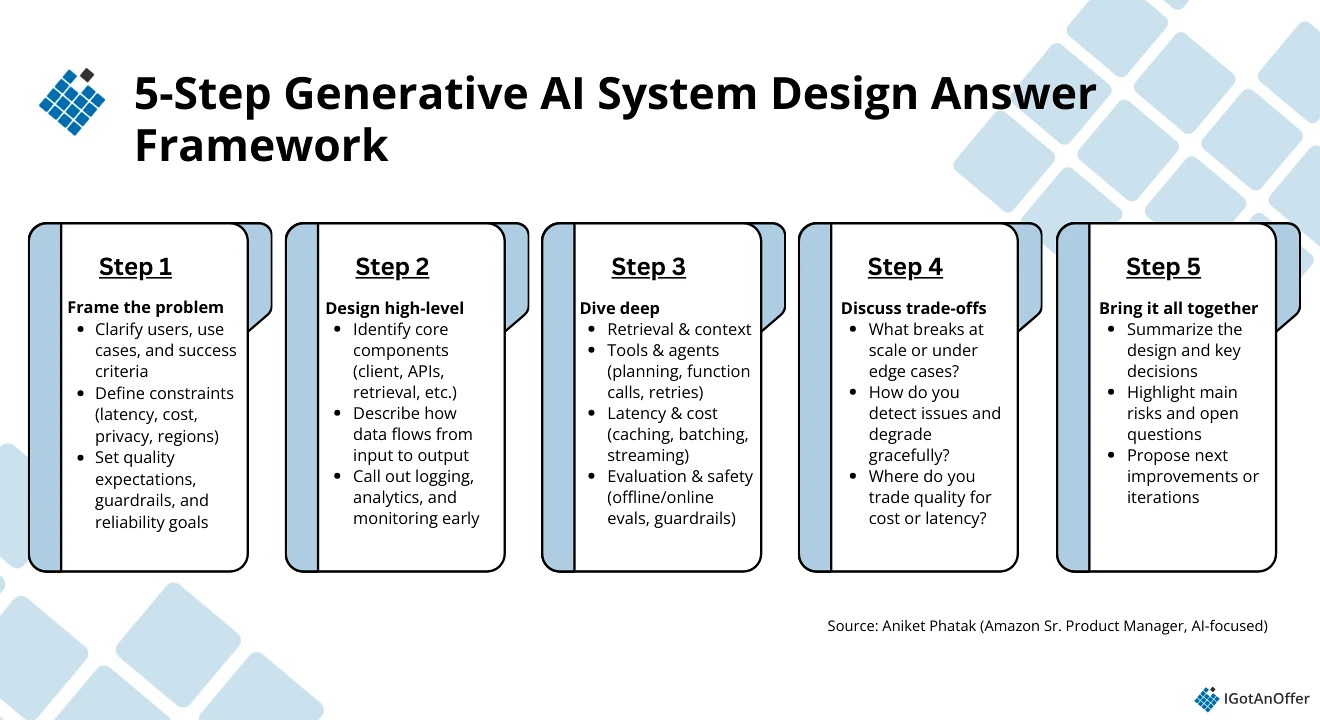
Let's break down each step in detail. For this, we'll use two excellent articles that provide both the high-level structure and the detailed substance for each stage.
Generative AI System Design Interview (examples, tips, prep)
This guide from IGotAnOffer.com, created with input from an AI-focused Amazon Senior PM, provides the clear 5-step framework we will use as our foundation.
First, read the overview of the framework under the section Learn an answer framework. Then, carefully read the detailed breakdown of each of the five steps, starting from Step 1: Frame the problem down to the Step 5: Conclusion. This will give you the core structure.
Now that you have the skeleton of the framework, let's add the flesh. We will use the comprehensive guide from the System Design Handbook to explore what goes into each of these five steps in more detail.
Step 1: Frame the Problem (Clarify Requirements)
This is the most critical step. As you just read, you need to clarify users, use cases, and success criteria. You must transform an ambiguous prompt like "Design an AI code assistant" into a concrete set of engineering requirements. Don't be afraid to make and state assumptions.
Your experience as a software engineer is a major asset here. You're already trained to think about functional and non-functional requirements. For GenAI, you simply extend this to include LLM-specific constraints.
Generative AI System Design Interview: A Step-by-Step Guide
This guide provides an excellent, detailed walkthrough of the clarification phase, including specific questions to ask.
First, read Step 1: Clarifying the use case to understand how to probe for functional requirements and feedback signals. Next, study the table of non-functional requirements and the surrounding text in the section Non-functional requirements. These questions about latency, context, consistency, scale, and security are your essential checklist. Finally, read the sections on data and retrieval expectations and how to perform a back-of-the-envelope calculation in Step 2. This demonstrates cost-consciousness early on.
Step 2: Design High-Level
Once requirements are clear, you sketch the main architectural components. The goal here is breadth, not depth. You want to present a bird's-eye view of the system before diving into any single part. This is where your modular thinking shines.
The core components will look familiar from your work in this course: an orchestrator, a retriever, a prompt builder, and post-processing steps.
Generative AI System Design Interview: A Step-by-Step Guide
This section provides a clear diagram and breakdown of a typical high-level GenAI architecture.
Read Step 3: High-level architecture, paying close attention to the diagram and the "Component breakdown." You don't need to memorize this, but you should understand the role of each component (e.g., API Gateway, LLM Orchestrator, Retriever).
Step 3: Dive Deep
With the high-level design on the whiteboard, the interviewer will likely ask you to go deeper into one specific area. Or, you can proactively suggest one. This is your chance to demonstrate deep, practical knowledge of a key subsystem.
Common deep-dive topics include:
- Retrieval-Augmented Generation (RAG): How do you chunk documents? What vector database would you use? How do you handle data freshness? (Modules 2 & 3)
- Agentic Workflows: How does the agent use tools? How do you manage state and memory? How do you handle errors and loops? (Module 4)
- Safety and Security: How do you prevent prompt injection? How do you validate outputs? (Module 7)
We will practice these deep dives in subsequent lessons. For now, understand that this is the part of the interview where you connect your high-level diagram to the concrete implementation patterns you've learned.
Step 4: Discuss Trade-offs
This is where you demonstrate seniority. Every design decision has trade-offs, and your ability to articulate them is a key signal to the interviewer. There is rarely a single "right" answer, but there is always a well-reasoned one.
You should be constantly discussing trade-offs throughout the interview, but it's good practice to dedicate a specific portion to it. Consider:
- Cost vs. Latency vs. Quality: Using GPT-4o vs. a smaller, open-source model like Llama 3. Your experience with different LLM APIs is relevant here.
- RAG vs. Fine-tuning: When would you choose one over the other? (This directly addresses a key part of your learning goals).
- Security vs. Functionality: How might a strict "sandwich" defense for prompt injection limit the system's capabilities? (Connects to our previous lessons).
- Build vs. Buy: Using a managed vector database service like Pinecone vs. self-hosting FAISS.
Step 5: Bring it all together (Conclusion)
In the final minutes, zoom back out. Summarize your design, restate the key decisions and trade-offs you made, and briefly touch on future improvements. This shows you think about the entire product lifecycle, not just the initial build.
Generative AI System Design Interview: A Step-by-Step Guide
This final section of the guide offers excellent advice on how to conclude the interview strongly.
Read Step 9: Wrap-up and future scaling. Note the suggestions for future work, like implementing an A/B testing framework or an RLHF loop. These are excellent points to mention to show forward-thinking.
Conclusion
In this lesson, you've learned a structured, 5-step framework for deconstructing and answering Generative AI system design questions. This framework is your roadmap to delivering a comprehensive, well-reasoned, and impressive interview performance.
Key Takeaways:
- GenAI interviews are different: They test your ability to handle non-determinism, high costs, and unique safety challenges.
- Structure is your ally: A repeatable framework helps you manage time, cover all key areas, and communicate clearly.
- The 5-Step Framework:
- Frame the Problem: Clarify functional and non-functional requirements, especially LLM-specific ones.
- Design High-Level: Sketch a modular, bird's-eye view of the system's components.
- Dive Deep: Go into detail on a critical subsystem like RAG or agent design.
- Discuss Trade-offs: Articulate the pros and cons of your design choices (e.g., cost vs. latency, RAG vs. fine-tuning).
- Bring it all together: Summarize your design and propose future improvements.
This framework isn't just a list of steps to memorize; it's a way of thinking. By internalizing it, you'll be able to demonstrate not just that you can code an AI application, but that you can architect one—a key distinction for the senior roles you are targeting.
In our next lesson, you will put this framework into practice for the first time by applying it to outline a solution for a common system design problem: a personalized content recommendation engine.