Recommended resources
The freely available resources this lesson will direct you to.
- Y1 37) Economic Systems - Market, Command and Mixed Economieswww.youtube.com
- Economic Systems and Macroeconomics: Crash Course Economics #3www.youtube.com
- How different systems address fundamental economic questionswww.sparkl.me
- [PDF] Handout B: Three major economic systems and their featurescarleton.ca
Hello! Welcome to the fifth lesson in our "Foundations of Economic Thinking" module.
In our last lesson, we explored the principle of comparative advantage and saw how specialization and trade allow individuals and countries to consume beyond their own production possibilities. This demonstrated the power of voluntary, decentralized cooperation. However, for such cooperation to occur on a society-wide scale, there needs to be an overarching framework in place.
This brings us to the topic of this lesson: economic systems. Every society must decide how to organize its economic activity to deal with the fundamental problem of scarcity. An economic system is the set of rules, institutions, and mechanisms that a society uses to answer the basic questions of production and distribution.
By the end of this lesson, you will be able to identify the functions of the main economic systems—market, command, and mixed—and understand the trade-offs inherent in each.
1. The Three Fundamental Economic Questions
Regardless of its level of wealth or political structure, every society must answer three fundamental economic questions. The way it answers them defines its economic system.
To introduce these core questions, let's watch a brief clip.
Economic Systems and Macroeconomics: Crash Course Economics #3
This segment from Crash Course Economics clearly lays out the three essential questions that any economic system must address.
Watch from 00:53 to 01:08. Focus on identifying the three key questions.
As the video explained, these questions are:
- What to produce? (Which goods and services should we make with our scarce resources?)
- How to produce it? (What combination of labor, capital, and land should we use?)
- For whom to produce it? (Who gets to consume the goods and services once they are produced?)
We will now examine how different economic systems provide different answers to these questions.
2. A Spectrum of Systems: Market vs. Command
The two theoretical extremes on the spectrum of economic systems are the market economy and the command economy.
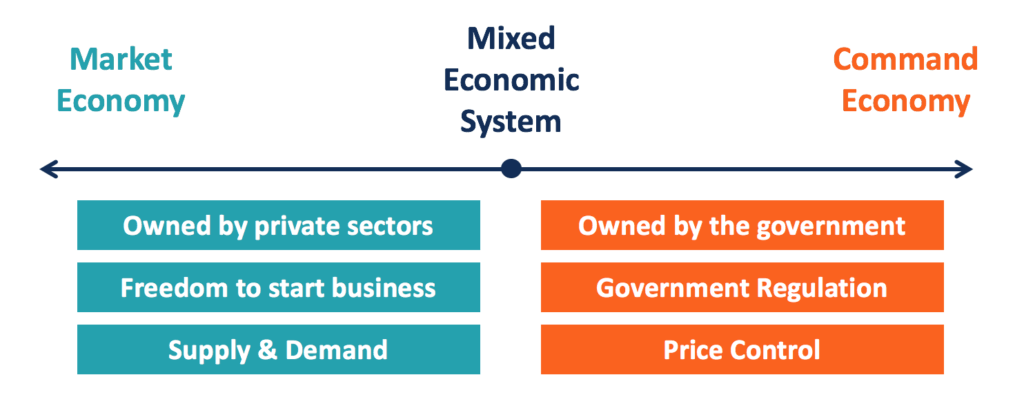
Let's break down these two opposing models.
The Market Economy (Capitalism)
In a pure market economy, economic decisions are decentralized. They are coordinated through the interactions of millions of individuals and privately-owned firms in markets. There is no central authority telling anyone what to do.
- Ownership: The factors of production (land, labor, capital) are privately owned by individuals and firms.
- Answering the 3 Questions:
- What to produce? Is answered by consumers through their purchasing decisions. If people want more of something, its price goes up, signaling to producers to make more. This is known as consumer sovereignty.
- How to produce? Is answered by producers seeking to maximize profit. They will choose the most efficient, lowest-cost production methods to stay competitive.
- For whom to produce? Is answered by purchasing power. Those who can afford to buy the goods and services get them.
The guiding force of a market economy was famously termed the "invisible hand" by Adam Smith. He argued that individuals pursuing their own self-interest (e.g., firms seeking profit, consumers seeking value) are unintentionally led to promote the overall good of society.
Economic Systems and Macroeconomics: Crash Course Economics #3
Let's watch another clip from the Crash Course video that explains how this 'invisible hand' works in a free market system.
Watch from 02:17 to 04:07. Pay attention to how the pursuit of profit and consumer choice interact to allocate resources efficiently.
The Command Economy (Centrally Planned)
In a pure command economy, economic decisions are centralized. The government owns the factors of production and a central planning authority makes all key economic decisions.
- Ownership: The factors of production are publicly owned by the state.
- Answering the 3 Questions:
- What to produce? Is answered by the central planning authority based on what it believes society needs.
- How to produce? Is also determined by the government's plan, which dictates production methods and assigns labor.
- For whom to produce? Is decided by the state, which aims to distribute goods and services in an equitable manner.
Economic Systems and Macroeconomics: Crash Course Economics #3
Now, let's see how the Crash Course video describes the mechanics of a planned economy.
Watch from 01:16 to 02:17. Note the distinction made between the theories of communism/socialism and the practical application in a command economy.
3. A Detailed Comparison: Strengths and Weaknesses
Now that we have the basic models, let's dive deeper into a systematic comparison of the advantages and disadvantages of each system. No system is perfect; each involves significant trade-offs, particularly between efficiency and equity.
The following video provides an excellent, feature-by-feature comparison of market and command economies.
Y1 37) Economic Systems - Market, Command and Mixed Economies
This detailed video from EconplusDal compares the two systems across many dimensions, including incentives, quality of goods, efficiency, and how they handle various economic issues.
Watch from 01:21 to 09:54. As you watch, try to create your own mental list of the main pros and cons for each system.
To consolidate this detailed comparison, please review the following handout. It presents the core differences in a clear, tabular format that is excellent for study and review.
Handout B: Three major economic systems and their features
This handout from Carleton University provides a concise table comparing command, market, and mixed economies on key features like allocation, ownership, planning, incentives, and income equality.
Read the entire one-page PDF. Focus on the table and how it organizes the characteristics we've just discussed.
4. The Reality: Mixed Economies
As you've likely gathered, the pure market and pure command economies are theoretical benchmarks. In the real world, nearly all economies are mixed economies, combining elements of both systems. They rely primarily on markets and private enterprise but also feature a significant degree of government intervention.
The key question for any country is not whether to have government involvement, but how much and in what areas. Even the most market-oriented economies need a government to:
- Establish and enforce the rule of law (property rights, contracts).
- Provide public goods like national defense and infrastructure.
- Correct market failures such as pollution.
- Promote social goals like equity and economic stability.
Economic Systems and Macroeconomics: Crash Course Economics #3
This final clip explains why all modern economies are mixed and how the 'right' amount of government intervention is a continuous debate.
Watch from 04:07 to 05:40 and then from 08:54 to the end. This will summarize why governments are necessary even in market systems and reinforce that all countries fall on a spectrum.
Countries can be placed along the spectrum based on the degree of government intervention. For example:
- United States, Singapore: Lean heavily towards the market end.
- Sweden, France: Have larger social welfare systems and more regulation, placing them more towards the center.
- China, Vietnam: Have unique "market socialist" systems, transitioning from command economies by introducing significant market elements while retaining strong state control.
- North Korea, Cuba: Remain closest to the command economy model.
Conclusion
In this lesson, we have examined the fundamental frameworks that societies use to organize economic life.
Here are the key takeaways:
- Every economic system must answer three questions: What, How, and For whom to produce.
- A market economy answers these questions through decentralized interactions of individuals and firms, driven by self-interest and price signals. It tends to be efficient and innovative but can lead to inequality.
- A command economy answers these questions through centralized government planning. It can aim for equity but often suffers from inefficiency, lack of choice, and poor incentives.
- In reality, all modern nations have mixed economies, blending market mechanisms with government intervention. The debate over the ideal "mix" is at the heart of political and economic discourse.
The choice of where to be on this economic spectrum is not just a technical decision; it is deeply rooted in a society's values. This leads us directly to our next topic. We will explore the crucial distinction between positive economics (describing what is) and normative economics (arguing for what ought to be). Understanding this difference is essential for analyzing economic policy and debates about which economic system is "best."