Recommended resources
The freely available resources this lesson will direct you to.
Hello! Welcome to our final lesson in the "Foundations of Economic Thinking" module.
Over the past six lessons, we've built a foundational toolkit for economic reasoning. We started with the core problem of scarcity, which forces us to make choices and incur opportunity costs. We learned that rational decisions are made at the margin and that specialization and trade can make everyone better off. We've also explored different economic systems and, most recently, learned to distinguish between objective (positive) and subjective (normative) statements.
This lesson focuses on a concept that ties all of these ideas together: incentives. Understanding incentives is arguably the key to "thinking like an economist." It's the engine that drives the choices of individuals, the strategies of firms, and the outcomes of government policies.
By the end of this lesson, you will be able to explain the powerful role that incentives play in shaping the behavior of individuals and firms.
1. What Are Incentives?
At its core, the concept is simple. Incentives are rewards that encourage an action or penalties that discourage an action. They are the reason we do most of the things we do. Your salary is an incentive to go to work. A sale at a store is an incentive to buy. A failing grade is an incentive to study.
To see just how profoundly incentives can alter behavior, let's start with a classic historical example.
This video from Marginal Revolution University defines incentives and presents a powerful case study about the transportation of convicts to Australia, showing how a simple change in incentives had life-or-death consequences.
Watch the video from the beginning until 01:38. Pay close attention to how the sea captains' behavior changed once their payment was tied to the outcome (prisoners arriving alive) rather than the input (prisoners boarding the ship).
As the video memorably states, "Economy beat sentiment and benevolence." This doesn't mean people are inherently selfish, but it does show that their actions are highly responsive to the incentive structure they face.
In economics, we can categorize incentives to better understand them.
Economics in Action: The Power of Incentives
This academic paper, 'Economics in Action: The Power of Incentives,' provides a structured overview of the different types of incentives and their roles. We'll focus on the section that classifies them.
Please read section '5.1 The Role of Incentives in Economic Decision-Making,' focusing on the subsections '5.1.1 Types of Incentives,' '5.1.2 Incentives in Microeconomics,' and '5.1.3 Incentives in Macroeconomics.' This will give you a clear framework for thinking about the different forms incentives can take.
The key distinction is between monetary incentives (wages, prices, profits, fines) and non-monetary incentives (social status, recognition, satisfaction, sense of duty). While economists often focus on monetary incentives because they are easier to measure, non-monetary ones are also powerful drivers of human behavior.
2. How Incentives Shape Individual Behavior
In a previous lesson, we discussed marginal analysis—the process of comparing the additional benefits and additional costs of a choice. Incentives work by changing those marginal benefits or marginal costs.

Prices as Incentives
The most common incentive we respond to daily is price. A price is a signal wrapped in an incentive.
- When the price of a good rises, it provides an incentive for consumers to buy less of it and for producers to supply more.
- When the price of a good falls, it provides an incentive for consumers to buy more and for producers to supply less.
This simple response to price incentives is the foundation of the laws of supply and demand, which we will explore in detail in the next module.
The Labor-Leisure Trade-off
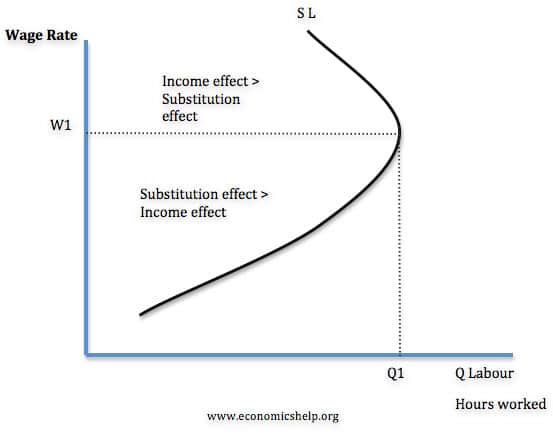
Let's consider a more complex example: your decision to work. The primary incentive to work is the wage. A higher wage increases the opportunity cost of not working (i.e., taking leisure), which encourages you to work more. Economists call this the substitution effect.
However, there's a competing effect. As your income rises, you can afford to "buy" more of everything you enjoy, including leisure time. At a certain point, you might decide you've earned enough and would rather have more free time than more money. This is the income effect.
When the income effect outweighs the substitution effect, a peculiar thing can happen: higher wages can lead to fewer hours worked. This creates what is known as the backward-bending supply curve of labor.
3. How Incentives Shape Firm Behavior
For firms in a market economy, the primary incentive is profit. This single, powerful incentive directs a firm's decisions: what to produce, how much to produce, and which technology to use. A firm will undertake an activity if it increases profit and avoid it if it reduces profit.
However, a firm is not a single person; it's a collection of people—owners, managers, and employees—who may have their own competing incentives. This can lead to a classic issue known as the Principal-Agent Problem.
This problem arises when a "principal" (e.g., shareholders) hires an "agent" (e.g., a CEO) to act on their behalf, but the agent's incentives don't perfectly align with the principal's.
Your background as an IT analyst in a corporate environment will likely make this concept very familiar. Watch the following video for a clear explanation.
What is Agency Cost | What is Agency Problem | Principal Agent Conflict
This video from COA Academy explains the principal-agent problem using the common example of shareholders and management. It clearly outlines the conflict of interest and discusses the solutions used to realign incentives.
Please watch the video from 00:09 to 03:56. Pay attention to (1) the definition of the principal and agent, (2) why their incentives might conflict, and (3) the two main solutions: monitoring and aligning interests (e.g., with stock options).
As you saw, solving the principal-agent problem involves structuring contracts and compensation to make sure that when agents act in their own self-interest, they are also advancing the interests of the principals.
4. Unintended Consequences: The Peril of Poorly Designed Incentives
Because incentives are so powerful, getting them wrong can lead to disastrous and unexpected outcomes. Policymakers and managers often create rules with good intentions, only to find that people respond to the incentives in unforeseen ways that undermine the original goal. This is sometimes called the "cobra effect."
To explore some real-world examples of how incentives can go wrong, let's turn to a short reading.
This article from Econlib provides several fascinating examples of how incentives can create unintended consequences.
Please read the beginning of the section titled 'In the News and Examples.' Specifically, read the introduction and the subsection 'Slavery, Snakes, and Switching: The Role of Incentives in Creating Unintended Consequences.'
The example of slave redemption is a sobering illustration of this principle. By creating a financial incentive to "redeem" slaves, well-meaning charities inadvertently increased the demand for slaves, potentially encouraging more slave raids and making the overall problem worse. This highlights the critical importance of carefully considering all the potential behavioral responses before implementing a policy based on incentives.
Conclusion
This lesson, and this entire module, has been about learning to see the world through an economic lens. The concept of incentives is at the heart of that perspective.
Here are the key takeaways:
- Incentives are rewards and penalties that motivate behavior. People, firms, and even governments respond to them in predictable ways.
- Prices are the most common economic incentive, signaling information about scarcity and guiding the decisions of buyers and sellers.
- For individuals, incentives affect decisions like what to buy, how much to work, and how much to save. These decisions often involve trade-offs, like the one between labor and leisure.
- For firms, the profit incentive directs production and innovation. However, misaligned incentives within a firm can lead to the principal-agent problem.
- Designing effective incentives is difficult. A poorly designed incentive structure can lead to unintended consequences that may be worse than the original problem.
You have now completed the first module and have a solid grasp of the foundational principles of economic thinking. You are ready to start applying these principles to build and analyze economic models.
Our next module is "Supply, Demand, and Market Equilibrium." We will take the concepts of choice, cost, and incentives and use them to build the most fundamental model in all of economics. We will begin by looking at the buyer's side of the market, exploring exactly how consumer responses to price incentives form the demand curve.