Recommended resources
The freely available resources this lesson will direct you to.
Hello! In our last lesson, we focused on the "how" of AI governance by mapping familiar IT governance controls to their new AI counterparts. We established that your existing expertise is the foundation for building a robust AI governance program.
Today, we shift our focus from the processes to the people who execute them. This lesson directly addresses the learning outcome: Outline key roles and responsibilities unique to an AI governance structure (e.g., AI Ethics Board, Model Risk Owner). We will explore the new and adapted roles that organizations are creating to manage AI risk, providing a clear picture of the human infrastructure required for effective governance.
1. The Accountability Gap: Why Specific Roles are Crucial
In traditional IT, accountability is usually well-defined. For AI, the lines can blur, leading to a dangerous "accountability gap." Before we define the specific roles, let's understand why simply saying "everyone is responsible for ethical AI" is an ineffective strategy.
What is Responsible AI? A Guide to AI Governance
This video from IBM Technology, "What is Responsible AI?", opens by highlighting the common and problematic answers when organizations are asked who is accountable for AI.
Watch the first part of the video from the accountability problem. The speaker effectively dismantles the ideas that "no one" or "everyone" can be held accountable for responsible AI outcomes.
As the video points out, if everyone is accountable, then no one truly is. The unique, high-impact risks of AI necessitate clearly defined roles and responsibilities. This is the fundamental driver for creating the governance structures we will discuss today.
2. The AI Governance Structure: Where Do These Roles Fit?
Before we detail individual roles, it's useful to visualize how they fit within the broader enterprise. AI governance doesn't exist in a vacuum; it integrates with and extends the IT and data governance frameworks you're already familiar with.
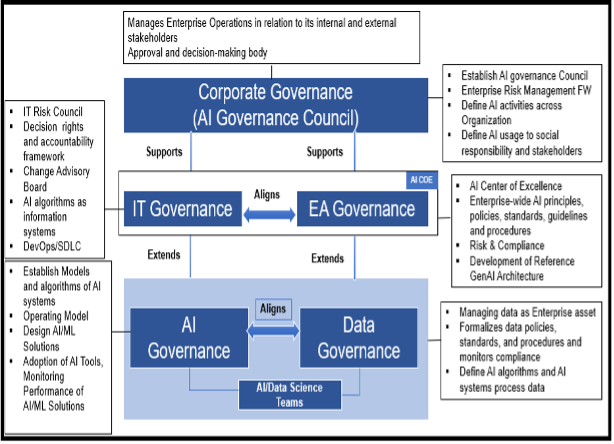
This image illustrates a key principle from our last lesson: AI governance augments, not replaces, existing structures. The roles we are about to discuss operate within a framework like this, ensuring that AI-specific activities align with enterprise-wide objectives and risk management practices. An organization might centralize these roles under a single leader or distribute the responsibilities, but this integrated structure is the goal.
3. Key Roles and Responsibilities in AI Governance
Now, let's dive into the specific roles. While some are new, many are extensions of existing functions, which is where your IT governance experience provides a significant advantage.
This article from ModelOp provides a comprehensive overview of the key roles emerging in the AI governance landscape.
Please read the section titled "Key AI Governance Roles." It starts with the Chief Information Officer (CIO) and ends with AI Security Specialists. As you read, notice how the responsibilities are divided among strategic, operational, and specialist functions.
The article you just read outlines a comprehensive team. Let's categorize these roles to better understand how they function together, drawing parallels to your IT governance background.
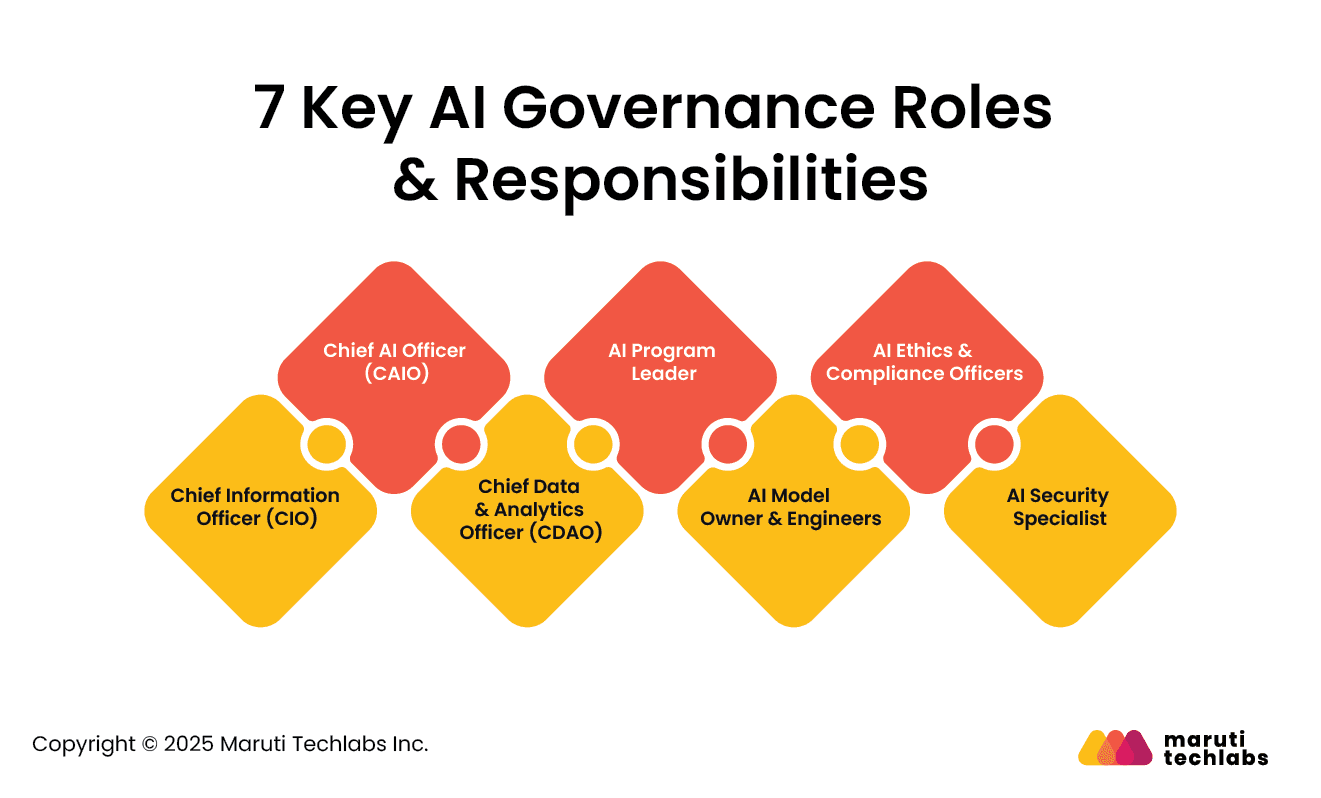
We can group these roles into three main categories:
A. Strategic & Executive Roles (Existing Roles with Expanded Remit)
These are often existing C-suite or senior leadership roles whose scope expands to include AI.
- Chief Information Officer (CIO): As the article notes, the CIO is a natural leader for AI governance, ensuring new AI systems integrate with enterprise architecture and that AI governance aligns with the broader IT governance framework. This is the bridge from your world to the new one.
- Chief Data & Analytics Officer (CDAO): Since AI is fueled by data, the CDAO's role is critical. They are responsible for the data governance that underpins AI, ensuring data quality, managing data science teams, and establishing metrics.
B. Dedicated AI Leadership Roles (New & Specialized)
The unique challenges of AI have spurred the creation of entirely new executive roles.
- Chief AI Officer (CAIO): This is emerging as the primary executive accountable for AI strategy, implementation, and risk management. As noted in the article, the US federal government's mandate for agencies to appoint CAIOs is a major driver of this trend, signaling its importance in the private sector as well.
- Responsible AI Program Leader: This is a more operationally focused leadership role, responsible for the day-to-day implementation of the responsible AI framework, conducting risk assessments, and managing ethics and compliance programs.
C. Operational & Specialist Roles (The Hands-On Team)
These roles are responsible for the direct management and oversight of AI systems.
- AI Model Owner: This is a direct counterpart to a "System Owner" or "Application Owner" in traditional IT governance. The Model Owner is accountable for a specific model's performance, compliance, and overall lifecycle, from deployment to retirement.
- AI Ethics and Compliance Officer: This role is the bridge between the technical teams and the legal/regulatory landscape. They conduct bias assessments and ensure compliance with regulations like the EU AI Act.
- AI Security Specialist: As we distinguished in the last lesson, this role focuses on protecting AI systems from external threats (e.g., adversarial attacks, data poisoning), complementing the governance roles that focus on internal risks like bias and fairness.
4. Governance by Committee: Boards and Cross-Functional Teams
Beyond individual roles, AI governance relies heavily on cross-functional committees to ensure diverse perspectives are included in decision-making. The learning outcome specifically mentions the AI Ethics Board, which is a key component of this structure.
AI Ethics Board and Governance Committee - Agility at Scale
This article from Agility at Scale clearly defines and distinguishes between the key committees involved in AI governance.
Read the first two sections: "What Is an AI Ethics Board and Governance Committee?" and "Core Responsibilities of an AI Governance Committee." Pay close attention to the distinct functions of each body.
The article clarifies the complementary nature of these two critical bodies:
-
AI Governance Committee: This is the operational body. It's an internal committee composed of the roles we just discussed (e.g., CAIO, CDAO, legal, risk). Its job is to translate high-level principles into enforceable policies, review high-risk projects, and manage the day-to-day governance processes. This is where the work gets done.
-
AI Ethics Board: This is typically an advisory body. Its purpose is to provide guidance, oversight, and ethical expertise. As the article notes, these boards are most effective when they include a mix of internal stakeholders and external experts (e.g., academics, ethicists, civil society representatives) who can challenge internal assumptions and prevent organizational groupthink.
For someone with your background, it's also vital to distinguish these from a Data Governance Committee. An existing Data Governance Committee ensures data is high-quality, secure, and properly sourced. The AI Governance Committee uses this foundation to ask the next set of questions: "Is the model trained on this data fair? Is its decision-making process transparent? Does the output create a discriminatory impact?" They are separate but deeply connected functions.
Conclusion
In this lesson, we have populated the organizational chart for AI governance, moving from abstract processes to the specific people and committees responsible for them.
Here are the key takeaways:
- Clear accountability is non-negotiable. The risks of AI are too great for diffuse or ambiguous responsibility.
- The AI governance team is a hybrid. It combines expanded duties for existing roles like the CIO and CDAO with new, specialized roles like the Chief AI Officer (CAIO) and AI Model Owner.
- Individual roles are supported by committee structures. An operational AI Governance Committee enacts policy, while an advisory AI Ethics Board provides crucial ethical oversight, often with the help of external experts.
- These roles directly execute the processes we mapped in the last lesson. The AI Model Owner manages the model lifecycle, the AI Ethics Officer conducts fairness assessments, and the AI Governance Committee oversees the entire AI system inventory.
You now have a complete picture of the foundational layer of an AI governance program: the risks, the processes, and the people. We are now ready to move into the principles that guide their work.
In our next lesson, we will begin Module 2 by defining the core ethical principles in AI: Fairness, Accountability, Transparency, and Explainability (FATE). Understanding these principles is essential, as they form the philosophical bedrock for the regulations and frameworks you will be applying.