Recommended resources
The freely available resources this lesson will direct you to.
- How to Choose the BEST LLM for YOUR Project: A Methodical Guidewww.youtube.com
- Exploring the Latency/Throughput & Cost Space for LLM Inference // Timothée Lacroix // CTO Mistralwww.youtube.com
- LLM Comparison Guide: December 2025 Rankingswww.digitalapplied.com
- The Complete LLM Model Comparison Guide (2025)www.helicone.ai
Welcome to your fifth lesson. In our last session, we built a crucial layer of resilience into our application by implementing error handling with retries and provider fallbacks. This prepared our system to survive the inevitable hiccups of networked API calls. However, a fallback strategy is only as good as the fallback provider you choose. This begs the question: how do you make that choice in the first place?
Today, we move from handling failure to making strategic choices. We will directly address how to compare and select Large Language Models and their providers for production use. As an AI Engineer, you won't be looking for a single "best" model, but rather the right model for a specific task, budget, and user experience. We will dissect this decision-making process along three fundamental axes: capability, latency, and cost. Mastering this trade-off analysis is a core competency that separates prototype-builders from engineers who build scalable, cost-effective AI systems.
The Engineer's Trilemma: Cost, Latency, and Capability
When choosing an LLM, you are constantly navigating a trade-off between three competing factors:
- Capability (or Quality): How "smart" is the model? This includes its reasoning ability, factual accuracy, coding proficiency, creative flair, and specialized features like tool use or multimodality.
- Latency (or Speed): How quickly does the model respond? This is critical for real-time, user-facing applications. We measure this in time-to-first-token (how fast it starts talking) and tokens-per-second (how fast it continues talking).
- Cost: What is the price per token? This is usually measured in dollars per million input and output tokens. For high-volume applications, this can be the single most important factor.
You can rarely optimize for all three simultaneously. The most capable models are often the slowest and most expensive. The fastest models may be less capable. Your job is to find the "sweet spot" that meets your product's requirements.
The video "How to Choose the BEST LLM for YOUR Project" offers an excellent high-level methodology for navigating this complex landscape.
How to Choose the BEST LLM for YOUR Project: A Methodical Guide
This video provides a structured way to think about the overwhelming number of LLM choices available today. It breaks down the evaluation process into clear, manageable characteristics.
Watch from the beginning to understand the problem: the explosion of model choices (general methodology). Next, focus on how to judge raw intelligence using quantitative benchmarks and the limitations of this approach (on your data as well). Then, watch the segment on pricing, which clearly explains the trade-offs between using a provider's API and the often-underestimated cost of self-hosting (for example optimizing for raw intelligence). Finally, understand the relationship between model size, speed, and cost (the right one to use).
Pillar 1: Deconstructing Capability
As the video highlighted, "capability" is not a single number. We need to break it down.
- Quantitative Benchmarks: These are standardized tests that measure performance on specific tasks.
- MMLU (Massive Multitask Language Understanding): Measures broad, general knowledge across 57 subjects.
- GPQA (Graduate-Level Google-Proof Q&A): Assesses deep reasoning ability on difficult questions.
- SWE-bench: Evaluates a model's ability to solve real-world software engineering problems from GitHub issues.
- Qualitative Benchmarks: For subjective tasks like creative writing or chatbot helpfulness, quantitative scores don't tell the whole story. Human preference is key.
- Chatbot Arena Elo Score: This is a crowd-sourced ranking where humans compare two anonymous model outputs and vote for the better one. It's an excellent proxy for perceived quality in conversational tasks.
- Specific Features: Beyond general intelligence, you must consider features critical to your application.
- Context Window: How much text can the model consider at once? (e.g., 128K tokens vs. 1M+ tokens).
- Structured Outputs: Does the model reliably support JSON mode or tool/function calling? This is essential for building agents and predictable workflows, as we saw in a previous lesson.
- Multimodality: Can the model process images, audio, or video in addition to text?
Pillar 2: Understanding Latency
For a software engineer, understanding the drivers of latency is crucial. It's not just a single number; it's a result of complex interactions between hardware, software, and the model architecture itself.
The CTO of Mistral AI, Timothée Lacroix, gives a fantastic technical overview of what drives inference performance. This will provide a solid foundation for your understanding.
Exploring the Latency/Throughput & Cost Space for LLM Inference // Timothée Lacroix // CTO Mistral
This talk goes deep into the mechanics of LLM inference, explaining the core concepts that determine throughput and latency.
First, watch the introduction to the key metrics: throughput, latency, and cost (drives these metrics). Next, watch the core technical explanation of how hardware (FLOPS, memory bandwidth) and model parameters interact. Pay close attention to the concepts of memory-bound vs. compute-bound and the "optimal batch size" (B*) (efficient or not). This explains why simply throwing more users at a model doesn't always work as expected. Finally, watch the summary of the throughput-latency plane, which visualizes how better hardware or better code shifts the performance curve (old Hardware).
The key takeaway is that for many real-time applications with small batch sizes, performance is memory-bound. The speed is limited not by the GPU's processing power (FLOPS), but by how fast it can move the model's weights in and out of memory (memory bandwidth). This is why techniques that reduce the memory footprint, like quantization or Grouped-Query Attention (used by models like Mistral and Llama), can have a huge impact on speed.
Pillar 3: A Nuanced View of Cost
Cost seems simple—dollars per million tokens—but the reality is more complex.
- Input vs. Output Tokens: Output tokens are almost always more expensive than input tokens. This is because generating an output token requires a full "forward pass" of the model, a computationally intensive process. Ingesting input tokens is comparatively cheaper.
- Total Cost of Ownership (TCO): A "cheap" model might be more expensive in the long run if it's less accurate. If it requires more complex prompts, more frequent retries, or leads to more user churn due to poor quality, its TCO is higher than that of a more expensive but more reliable model.
- Proprietary vs. Open-Source: As the
pookievideo pointed out, self-hosting an open-source model is not "free." It shifts the cost from API calls to infrastructure (expensive GPUs), maintenance, and operational complexity. For many use cases, especially when starting out, a pay-per-use API is far more economical.
The Modern LLM Landscape: A Practical Comparison
Now let's bring these three pillars together to analyze the current market. The following article provides an excellent (though fictionalized for December 2025) breakdown of top models.
LLM Comparison Guide: December 2025 Rankings
This guide provides concrete data points and use-case recommendations that exemplify the trade-offs we've been discussing.
Start with the technical specifications and benchmark comparison tables. Note how models lead in different areas (e.g., Claude for coding, GPT for speed). Read the section on pricing and cost optimization. Pay special attention to the "Cost Optimization Strategies" like Model Routing. Review the speed and latency section, which gives concrete response time examples. Finally, study the sections "When NOT to Use Each Model" and "Use Case-Specific Model Recommendations". This is the synthesis that an AI Engineer must perform.
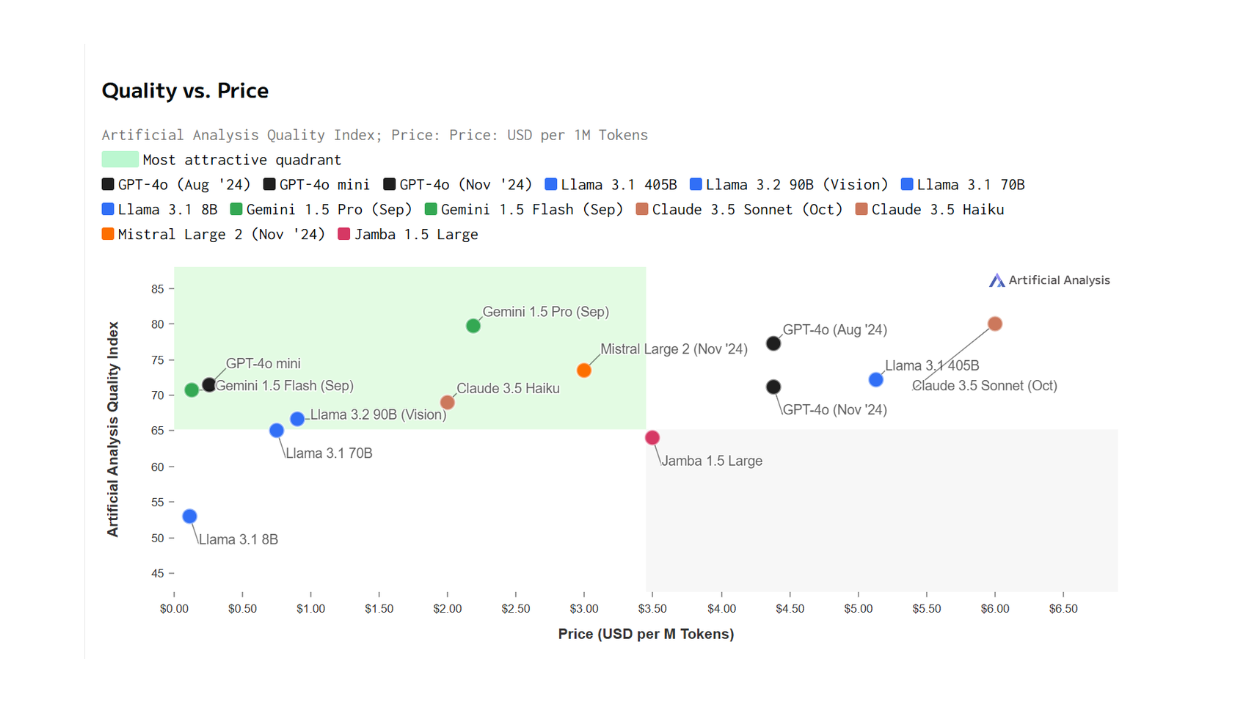
This chart visualizes the Quality vs. Price trade-off for several popular models, clearly showing the "most attractive quadrant" where you get high quality for a reasonable price.
This next image provides a more detailed, tabular comparison across quality (Elo Score), context window, speed, and cost.

Model Creators vs. Inference Providers
An important distinction in the landscape is between the companies that create the models and the platforms that serve them.
- Model Creators: OpenAI, Anthropic, Google, Meta. You can access their models directly via their APIs.
- Inference Providers (and Aggregators): These platforms provide API access to a wide range of models, often focused on open-source ones. Examples include Together AI, Anyscale, Fireworks, and Groq (which you've used), famous for its custom LPU hardware that delivers extremely low latency.
- Cloud Providers: AWS (Bedrock), Google Cloud (Vertex AI), and Microsoft (Azure AI) offer managed access to both proprietary and open-source models with enterprise-grade security and compliance.
The following article from Helicone provides an excellent breakdown of how to choose not just a model, but also a provider.
The Complete LLM Model Comparison Guide (2025)
This guide dives deep into the criteria for selecting both models and the API providers that serve them.
First, review the API Provider Comparison table. This clarifies the different players and their strengths (e.g., Groq for speed, OpenRouter for flexibility). Next, read through the "Choosing the Right Model" section, which details the trade-offs between Proprietary vs. Open Source and General vs. Specialized models. Finally, and most importantly for system design, carefully study the criteria for Choosing the Right API Provider. This covers crucial non-functional requirements like Performance, Security, and Pricing structure that are paramount in production.
System Design Exercise: The Multi-Model Strategy
For your AI Engineer interviews, you'll be expected to apply this knowledge to a system design problem. Let's walk through a common scenario.
Question: "Design an automated customer support system for an e-commerce company. How would you select your LLMs?"
A Structured Answer:
-
Clarify Requirements & Identify Sub-Tasks: A customer support system isn't one task. It's many.
- Task 1: Intent Recognition. Triage the user's initial message. (e.g., "order status," "return request," "product question").
- Task 2: FAQ Answering. Provide answers based on a knowledge base.
- Task 3: Tool Use. Look up specific order details using an internal API.
- Task 4: Complex Troubleshooting. Handle open-ended problems that require reasoning.
- Task 5: Escalation. Hand off to a human agent.
-
Map Tasks to LLM Characteristics:
- Intent Recognition & FAQ: High-volume, simple tasks. Key factors are low cost and low latency. A cheaper, faster model like Claude Haiku, Gemini Flash, or Llama 3 on Groq is perfect. Capability can be moderate.
- Tool Use: The primary need is reliable function calling. Speed is important for a good UX. A mid-tier model known for good tool use, like GPT-3.5-Turbo or a fine-tuned open-source model, would be a good fit.
- Complex Troubleshooting: This is a low-volume, high-value task. The key factor is maximum capability (reasoning). Cost and latency are secondary. This justifies using a top-tier model like GPT-4o, Claude 3 Opus, or Gemini 1.5 Pro.
-
Propose a Multi-Model Architecture (Model Cascade/Router):
- "I would implement a router as the entry point. All user requests first hit a very cheap and fast model (e.g., Claude Haiku) whose only job is to classify the user's intent and extract key entities.
- If the intent is a simple FAQ, we use that same cheap model to generate an answer from a RAG pipeline.
- If the intent requires looking up an order, the router passes the request to a mid-tier model optimized for tool use.
- Only if the intent is classified as 'complex/unknown' do we escalate the request to our most powerful and expensive model, like GPT-4o. This ensures we're only paying premium prices for the small fraction of queries that truly require premium intelligence. This approach can reduce overall costs by 50-80% compared to using a single, powerful model for everything."
This structured, trade-off-aware thinking demonstrates senior-level engineering judgment.
Conclusion
You now have a robust framework for evaluating and selecting LLMs for production systems. This is a dynamic field, and the "best" models will change every few months, but the principles of evaluation will remain constant.
Key Takeaways:
- There is no single "best" LLM. The goal is to find the right fit by balancing capability, latency, and cost.
- Evaluate capability using a mix of quantitative benchmarks (MMLU, SWE-bench), qualitative rankings (Chatbot Arena), and specific feature support (context window, tool use).
- Latency is driven by hardware and model architecture. For real-time apps, performance is often memory-bound, not compute-bound.
- Cost is more than just price-per-token; consider the Total Cost of Ownership, including the costs of low quality.
- Production-grade systems often use a multi-model strategy (a "cascade" or "router") to optimize the cost/performance trade-off, using cheap models for simple tasks and expensive models for complex ones.
In our next lesson, we will explore another powerful method for adapting an LLM to your needs: fine-tuning. We'll define what it is, its primary use cases, and, crucially, how to decide when to fine-tune a model versus when to use advanced prompt engineering or RAG.