Recommended resources
The freely available resources this lesson will direct you to.
Hei! Last time, you read a service message to find out who had to act, what had to be done, and by when. At a public-service counter, you need to make those details clear aloud—and sometimes the first thing you need to find out is which documents the office requires.
In this lesson, you will explain a simple issue in Bokmål, ask about documentation, and check that you have understood the answer. Allow about 40 minutes, including the two short readings. The examples use identification and an application, but the speaking pattern works for many counter visits.
Make the issue clear before asking about documents
At a counter, a short explanation is usually more useful than a long account of everything that happened. Give the staff member three things: what you are trying to do, what is unclear, and what you need to know.
Hei. Jeg skal levere et skjema, men jeg er usikker på hvilke vedlegg dere trenger. Hvilke dokumenter må jeg ha med?
Hello. I’m going to submit a form, but I’m unsure which attachments you need. Which documents must I bring?
The first clause gives the purpose of the visit. Men jeg er usikker på … identifies the problem without making a claim you cannot verify. The final question gives the staff member something specific to answer.
A few words help you ask precisely:
- dokumentasjon — supporting evidence or documentation
- dokumenter — documents
- vedlegg — attachments to an application or form
- legitimasjon — identification
- originalen / en kopi / en bekreftet kopi — the original / a copy / a certified copy
Ask Hvilken dokumentasjon trenger dere? for a broad question about evidence. Ask Hvilke dokumenter må jeg ha med? when you want to know what to bring in person. If the difference between a copy and an original matters, ask that separately; dokumentasjon alone does not settle it.
The image shows a digital ID card on a phone. It is a useful reminder to ask about the accepted form of identification rather than assuming that anything showing your identity will be accepted.
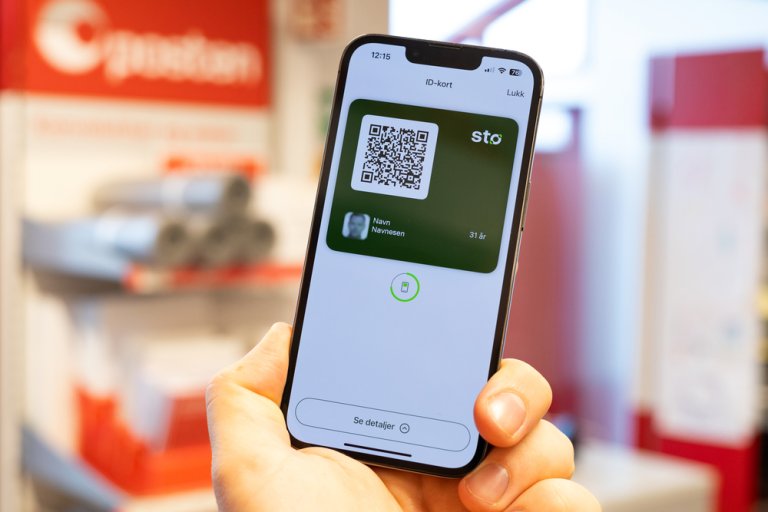
You could ask: Godtar dere digital legitimasjon her, eller må jeg ha med fysisk legitimasjon? — “Do you accept digital ID here, or must I bring physical ID?”
An ID-control case: keep two requirements separate
The Tax Administration’s D-number page provides a realistic reason to speak with a public-service office. Read it selectively, looking for who initiates the process, who receives a document, and what happens if an ID check is required.
Read the Tax Administration’s D-number page to see why a question about “the required documents” may need a more precise follow-up.
In “Hvem kan få d-nummer,” begin at “Du kan ikke søke om” and read who requests it, stopping after the explanation about the case-processing system. Then go to “Bekreftet kopi av legitimasjonen din”: read the ID requirement, from the sentence beginning “Du må som regel sende” through the list of information the ID must contain. In its subsection “Krav til bekreftet kopi,” read what certified means, through the bullet “sendes per post.” Finally, under “Krav om ID-kontroll,” read the ID-check passage, from its opening sentence through the instruction to book an appointment. Focus on which statements are usual requirements and which apply only if an ID check is requested.
The distinction matters in conversation. According to the page, you cannot apply for a D-number yourself; an organization or authority requests one when it needs you to have a Norwegian identity number. The page says you must usually send a certified copy of a passport or national ID card to the organization or authority making that request. It also says that organization may require you to attend an ID check, for which you must book an appointment yourself.
Those are not interchangeable instructions. A certified copy sent to a requesting organization is not automatically the same thing as what you must bring to an ID-control appointment. If your situation involves both, identify which requirement you are asking about:
Jeg har fått beskjed om å møte til ID-kontroll. Hva må jeg ha med til timen?
I’ve been told to attend an ID check. What must I bring to the appointment?Hvem skal jeg sende den bekreftede kopien til?
Who should I send the certified copy to?
Notice also the difference between kan kreve (“may require”) and må (“must”). Do not turn a possible requirement into a rule for everyone.
Have the counter conversation
Here is a model exchange. It is an illustrative conversation, not a statement of the documents required for any particular appointment.
Ansatt: Hei, hva kan jeg hjelpe deg med?
Du: Hei. Jeg har fått beskjed om å møte til ID-kontroll, men jeg er usikker på hva jeg skal ha med.
Ansatt: Gjelder det et d-nummer?
Du: Ja. En virksomhet har bedt om det. Hvilken dokumentasjon trenger dere til kontrollen?
Ansatt: Det må jeg sjekke for saken din. Har du bestilt time?
Du: Ikke ennå. Må jeg bestille time først? Og må jeg ta med original legitimasjon, eller holder det med en kopi?
Ansatt: Jeg kan vise deg hvor du finner kravene for timen.
Du: Takk. Og hvem skal jeg sende en eventuell bekreftet kopi til?
You do not need to memorize the whole exchange. Its reusable structure is:
- State the purpose: Jeg skal … or Jeg har fått beskjed om å …
- State the difficulty: … men jeg er usikker på … (“… but I’m unsure about …”).
- Ask the main question: Hvilken dokumentasjon trenger dere?
- Narrow it down if needed: Må jeg ha med originalen, eller holder det med en kopi?
Holder det med …? is a natural way to ask “Is … sufficient?” It is particularly useful when the staff member says kopi but you need to know whether an ordinary copy is enough. En bekreftet kopi has a more specific meaning than en kopi, so name that distinction when it matters.
If you do not catch the answer, use a targeted repair question rather than starting over:
Beklager, mente du originalen eller en bekreftet kopi?
Sorry, did you mean the original or a certified copy?
Before leaving, confirm the next step in the same way you checked actions and deadlines in written messages:
Så jeg skal bestille time først og sjekke hvilke dokumenter jeg må ha med. Stemmer det?
So I should book an appointment first and check which documents I must bring. Is that right?
Only repeat a document requirement as settled if the staff member has actually confirmed it.
Transfer the pattern to a different counter
A police page about an emergency passport shows how a document list can contain conditions, not just items. Read the list for the language you might use to ask what applies to your own case; you do not need to learn the emergency-passport procedure as a general rule for other services.
Read the police service page as a second example of how to identify what to bring and where a requirement depends on the situation.
Under “Slik søker du om nødpass,” go to step 2, “Dette må du ha med deg når du møter opp.” Read the bring-along list, beginning with “Dokumentasjon for reisen” and ending at “Betaling for nødpasset.” Pay particular attention to the sentence beginning “Hvis du søker om nødpass på flyplass”: it introduces circumstances in which other valid identification is needed. Stop before step 3, “Pris”; the amount is not needed for this lesson.
In that list, dokumentasjon for reisen is travel documentation, gammelt pass is an old passport, and et passfoto i farger is a colour passport photo. The page also mentions payment. Its sentence beginning Hvis … makes part of the identification instruction conditional. At the counter, that is a reason to say what has happened in your case rather than asking only, “What documents do people need?”
For example:
Jeg har glemt passet mitt. Hvilken legitimasjon må jeg ha med i stedet?
I’ve forgotten my passport. What identification must I bring instead?
A good answer to a documentation question identifies not only what is needed, but also which version, for which situation, and where or when to provide it. You can ask those details one at a time:
Må jeg ta det med hit, eller skal jeg sende det inn?
Must I bring it here, or should I submit it?Gjelder det også i min situasjon?
Does that apply in my situation too?
Conclusion
At a public-service counter, begin with a clear purpose and one uncertainty: Jeg skal …, men jeg er usikker på … Then ask Hvilken dokumentasjon trenger dere? Follow up about originals, copies, appointments, or where to send something only when those details matter. Most importantly, keep a confirmed requirement separate from one that may apply to your case.
Next, you will use the same concise structure in a voicemail: give the reason for your call, the relevant details, and a clear request for a callback.