Recommended resources
The freely available resources this lesson will direct you to.
Hei! In the previous lesson, you practised identifying a pharmacy problem and confirming what happens next. In a public emergency, there may be no time for that kind of conversation. The first task is to recognise what action is being requested—leave, stay inside, seek shelter, get information, or call for help.
This lesson focuses on short spoken instructions, signs, and official alerts. Allow about 40 minutes, including the readings and a few minutes to say the key phrases aloud.
Find the action first
An urgent announcement may contain words you do not know. You can still understand its practical meaning if you catch the action, any negation, and the place it applies to. Compare these illustrative announcements:
Forlat bygningen. Bruk nærmeste nødutgang. Ikke bruk heisen.
“Leave the building. Use the nearest emergency exit. Do not use the lift.”
Bli inne. Hold vinduer og dører lukket.
“Stay inside. Keep windows and doors closed.”
The first tells you to move out; the second tells you to remain inside. Do not treat emergency as one instruction that always means “go outside.” The appropriate action depends on the incident and the current instructions.
The words carrying the decision are compact: forlat (“leave”), bli (“stay”), bruk (“use”), and ikke (“do not”). Nærmeste means “nearest,” so nærmeste nødutgang is the nearest emergency exit. In an announcement such as Alle må forlate bygningen (“Everyone must leave the building”), må marks a requirement rather than a suggestion.
A sign may tell you where to go after you have left. This one says MØTEPLASS VED BRANN/EVAKUERING—an assembly point in case of fire or evacuation:
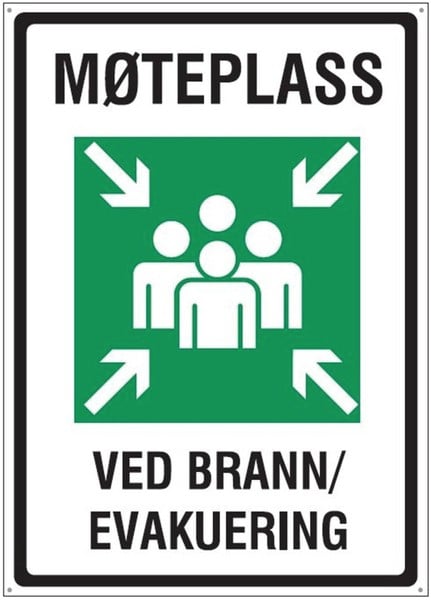
If you hear Gå til møteplassen (“Go to the assembly point”), møteplassen names that gathering place. It is not itself an instruction to re-enter a building or cross a hazardous area; follow the evacuation instructions that apply where you are.
Distinguish information from shelter
Norway’s Directorate for Civil Protection explains how official crisis warnings reach the public. Read the short sections on mobile alerts, sirens, and emergency radio. The crucial distinction is between søk informasjon (“seek information”) and søk dekning (“seek shelter”).
Read “Varsling i kriser” from the Directorate for Civil Protection to connect the warning phrases with the kinds of alert that carry them.
In “Nødvarsel på mobil,” read the mobile-alert explanation. In “Varslingsanlegg,” read the siren patterns; pay particular attention to which pattern means “søk informasjon” and which means “søk dekning.” Finally, in “Beredskapskanalen NRK P1,” read the radio guidance to see where official information can be found.
The siren patterns carry different messages. Three series with a one-minute pause between them mean viktig melding – søk informasjon: there is an important message, and you should find official information about what is happening and what to do. Short bursts for about a minute mean fare for angrep – søk dekning: danger of attack; seek shelter. A continuous sound for half a minute signals that the danger is over. The patterns matter because “get information” and “take cover” are not interchangeable actions.
A mobile nødvarsel (“emergency alert”) can give more specific instructions. Look for the message’s action words rather than relying on its alarming appearance alone. The image below shows a test, not an instruction to take emergency action.
In the pictured message, Dette er en TEST means “This is a test,” and Du trenger ikke gjøre noe means “You do not need to do anything.” In a real alert, read the actual instructions. If you hear a siren telling you to seek information, the reading identifies NRK P1 as an emergency radio channel for official messages.
Recognise when an instruction asks for medical help
Some public instructions concern an injured or suddenly ill person rather than an evacuation. You might hear Ring 113 (“Call 113”) or Ring etter hjelp (“Call for help”). The number is part of the instruction: catching the verb ring without the number is not enough.
Helsenorge distinguishes between the out-of-hours medical service, legevakt, and emergency medical help. Read the contact guidance and the beginning of its list of situations requiring 113. The purpose here is to recognise an urgent message, not to diagnose someone from Norwegian vocabulary.
Ring legevakten på 116 117 for øyeblikkelig hjelp - Helsenorge
Read Helsenorge’s “Legevakt” page for the language used to direct people to medical help.
Under “Når du trenger legehjelp: Hvem skal du ringe?”, read the contact guidance, from its first bullet through the sentence following the list. Then go to “Når skal du ringe 113?” and read the emergency guidance, through the final symptom in its list. Focus on the difference between help that cannot wait and an acute medical emergency.
Ring legevakt 116 117 refers to urgent medical help when the regular doctor is unavailable and the help cannot wait. Ring 113 directs you to emergency medical help when the situation is acute and life-threatening. In the reading, bevisstløshet means “unconsciousness,” and brystsmerter means “chest pain.” You do not need to understand every symptom on the page to recognise an explicit instruction to call 113.
In a crowded setting, you may instead hear someone call out Er det noen som kan førstehjelp?—“Is there anyone who knows first aid?” That is a request for a person with relevant skills. It is different from an instruction addressed to everyone to evacuate or take shelter.
Hold on to the part that changes the action
Urgent messages often repeat themselves, but a short word can reverse their meaning. In these illustrative pairs, notice what you would do differently:
Bruk trappen. — “Use the stairs.”
Ikke bruk trappen. — “Do not use the stairs.”
Gå ut av bygningen. — “Go out of the building.”
Ikke gå ut. Bli inne. — “Do not go out. Stay inside.”
If you miss the rest of an announcement, do not guess whether ikke was present. Pay attention to repeated announcements, posted instructions, or an official alert for clarification. Likewise, Dette er en øvelse means “This is a drill”: identifying that phrase changes how you interpret the situation, although you should still follow the directions given for the drill.
When you listen, a useful mental check is: What is the verb? Is it negated? Where does it apply? In Forlat bygningen, og gå til møteplassen (“Leave the building and go to the assembly point”), those questions give you two distinct actions and their destinations without requiring a translation of every word.
Conclusion
For public safety messages, listen first for the required action: forlat (leave), bli inne (stay inside), søk dekning (seek shelter), søk informasjon (seek information), or ring 113 (call emergency medical help). Then check for ikke, the relevant location, and whether a message is a test or a real alert. Sirens, signs, mobile alerts, and spoken announcements provide different amounts of detail; use the specific instructions available in the situation.
This completes the health and personal-needs module. The next module turns to housing and services, where the emphasis shifts from urgent public instructions to explaining practical problems and understanding arrangements.