Recommended resources
The freely available resources this lesson will direct you to.
Hello! Welcome to the final lesson in our "Foundations of Cinematic Language" module.
In the last lesson, you mastered the art of creating a shooting schedule—the logistical "when" and "where" of your film production. You learned to arrange scenes for maximum efficiency based on locations, cast, and resources. Now, we'll attach a dollar value to that plan.
This lesson addresses the learning outcome: Identify key cost categories and create a preliminary budget for an experimental short film. A budget is far more than a spreadsheet; it's a creative document that defines the scope and constraints of your artistic vision. Given your background in design, you can think of it as the material cost and resource planning for a large-scale project, where every choice has a financial and an aesthetic consequence. For an artist-filmmaker, learning to budget is learning to translate vision into reality.
1. The Anatomy of a Film Budget
Every film budget, from a Hollywood blockbuster to a personal art film, is organized around a similar structure. Costs are typically divided into four main phases: Pre-Production, Production, Post-Production, and Other (like distribution and insurance).
A fundamental concept is the distinction between "Above-the-Line" and "Below-the-Line" costs.

- Above-the-Line (ATL): These are costs agreed upon before production begins. They typically include the key creative team, such as the writer, producer, director, and principal actors. For a self-driven experimental film, these roles are often filled by you, so the "cost" might be zero.
- Below-the-Line (BTL): These are the fixed, tangible costs of making the film. This is the bulk of the budget and includes crew salaries, equipment rentals, location fees, costumes, props, and post-production services.
To see how these categories are populated in a real-world scenario, we'll watch a detailed walkthrough of a standard indie film budget.
How to Make a Budget for Indie Film | FILMMAKING 101
The video 'How to Make a Budget for Indie Film' from The Nerdy Filmmaker channel uses a professional template to break down every conceivable cost. While the example is for a conventional narrative film, the structure and categories are universal. We will watch it in sections to understand the key components.
Watch the following segments to get a feel for the main budget categories: Above the Line (02:31 - 03:48): Understand who falls into this category (writer, producer, director) and why their pay is often handled differently. Cast & Crew Labor (03:48 - 08:05 & 10:27 - 13:20): Observe how actors, art department, and costume/makeup staff are budgeted. Notice the calculation is based on number of people x number of days x daily rate. This is where your shooting schedule directly impacts the numbers. Materials & Rentals (19:33 - 26:34): See how physical items like costumes, props, and all technical gear (camera, lighting, sound) are budgeted. This is another major cost center. Post-Production (26:34 - 31:53): Note the costs for editing, sound design, and color grading. These are essential for finishing your film.
This can feel overwhelming, but the key is to understand the types of things you need to account for, not to memorize every line item.
2. The Experimental Film Budget: A Different Mindset
The budget you just saw is for a standard production. For an experimental filmmaker, the financial landscape and priorities are often radically different. Your work, inspired by artists like Rebecca Horn, is less about narrative efficiency and more about aesthetic exploration, performance, and material honesty.
This means your budget might have unique line items (e.g., "Kinetic Sculpture Fabrication") and completely omit others (e.g., "Dialogue Coach"). The following text explores this mindset.
[PDF] Canadian Avant-Garde Film in the 1990s
The essay 'How to Make an Experimental Film' from the thesis Canadian Avant-Garde Film in the 1990s is a fantastic resource that discusses how financial limitations directly influence artistic technique in non-commercial filmmaking. It affirms that creativity, not money, is the most essential ingredient.
Read the following sections to understand the cost-saving philosophy of experimental cinema: Chapter 2.1: How to Make an Experimental Film (pages 36-37, up to "reduce costs of a film"): Focus on the core idea that money affects the tools you use, and thus your aesthetic approach. It highlights the difference in priorities between industrial and artistic filmmaking. Ways of reducing costs (pages 37-38, from "In all film production..." to "...written into a future film"): This section gives practical advice on minimizing the biggest expenses: materials (props, film stock) and labor (using friends, non-professionals). Avoiding lab and service costs (pages 41-43, from "The necessary services..." to the end of the chapter): This covers strategies like not paying crew, self-processing film, and creating complex soundtracks at low cost.
This philosophy of resourcefulness is timeless. Let's look at a modern example of a filmmaker breaking down his micro-budget, highlighting the trade-offs he made.
How Much I Spent to Make a Short Film | Budget Breakdown
In 'How Much I Spent to Make a Short Film,' the creator gives a transparent breakdown of a sub-$3,000 project. Pay attention to his practical, cost-saving mindset.
Watch these key moments: Cast & Crew (02:28 - 05:01): Notice his justification for low rates and the discussion on finding people willing to work for free to build their portfolio. Props & Wardrobe (08:03 - 09:23): This is a great example of extreme resourcefulness, including returning a purchased costume and having props custom-made for a small fee. Food on Set (10:12 - 12:54): Listen to his crucial point: feeding your cast and crew is the one expense you cannot cut. It's a matter of respect and professionalism.
3. Practical Exercise: Budgeting for an Artistic Vision
Now, let's apply these principles. Below is a template showing a more detailed breakdown. You don't need to use software; a simple list is enough for a preliminary budget.
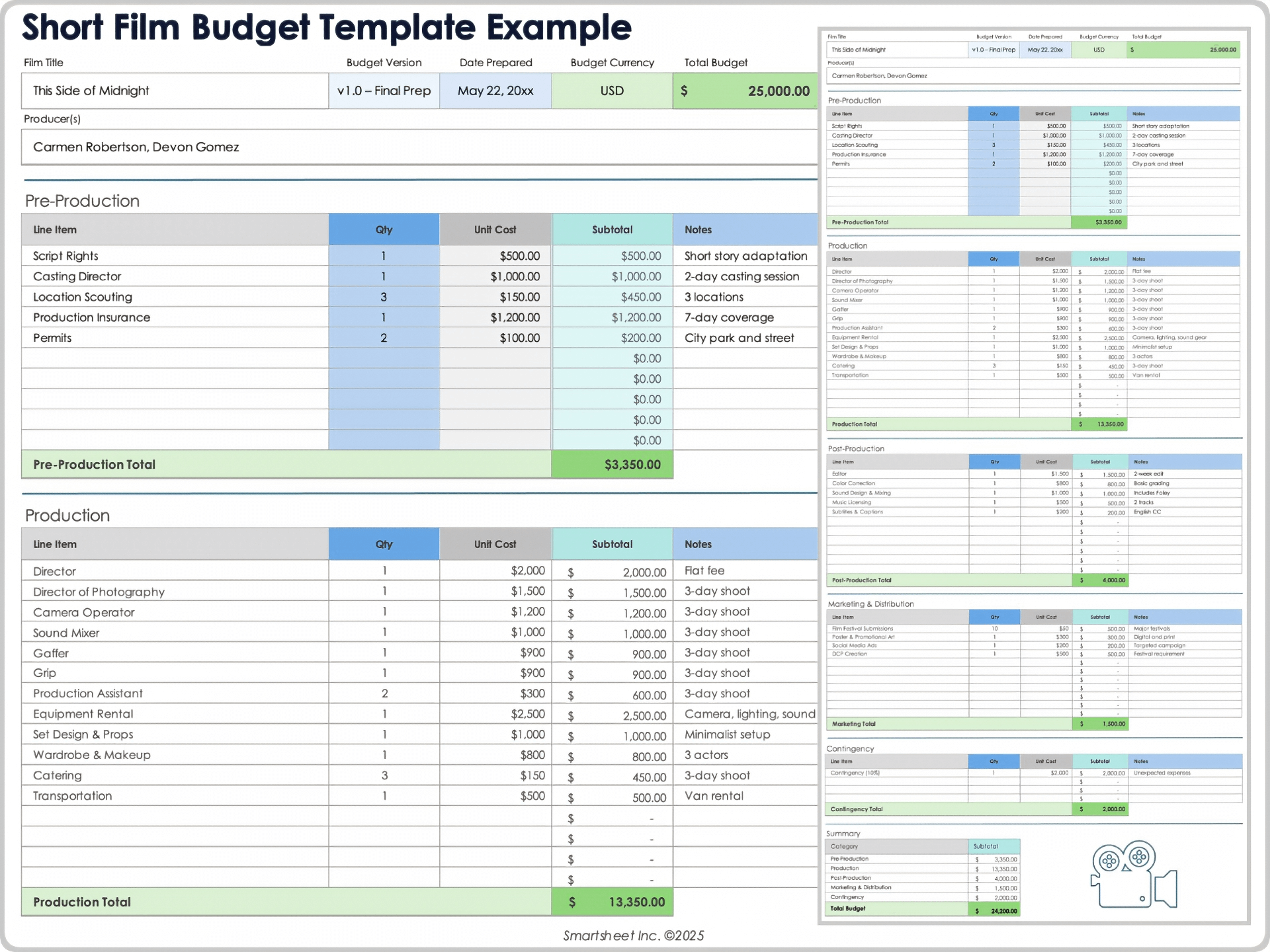
Your Task (20 minutes):
Create a preliminary budget for a short, non-verbal experimental film titled "Shed." The film is inspired by your interest in Rebecca Horn and explores a performer interacting with a wearable sculpture you designed.
Scenario:
- Concept: A 5-minute film showing a performer in a desolate landscape, first constrained by, and then shedding, a mechanical chrysalis-like sculpture.
- Shoot Duration: 2 days (from your previous lesson's planning).
- Cast: 1 Performer (a friend, a dancer you know).
- Crew: You (Director/DP), and 2 friends helping as general crew.
- Location: A remote, barren salt flat (requires a 2-hour drive).
- Key Elements:
- The wearable sculpture (you will fabricate it).
- Your custom-designed costume for the performer.
- You plan to compose the music yourself.
Instructions:
Based on the videos and readings, create a list of key budget categories and the specific line items you would need for this film. You do not need exact dollar amounts. Instead, make an educated guess or simply note the item. For example:
- Pre-Production:
- Materials for Sculpture Fabrication: (e.g., aluminum rods, fabric, small motors) - Estimate $XXX
- Fabric for Costume: Estimate $XX
- Production Insurance: (Essential!) - Research possible cost
- Production:
- Performer Fee: Honorarium/Gift - $XX
- Crew Fee: Pizza and eternal gratitude - $0
- Van Rental (2 days): - Estimate $XXX
- Gas/Mileage Reimbursement: - Calculate distance
- Catering (3 people x 2 days): - $XX per person, per day
- ...etc.
Think specifically about:
- What are the unique costs for this artistic project?
- Where can you apply the cost-saving strategies we've discussed?
For a real-world example of what a simple experimental film budget looks like, you can refer to "Appendix E" in the Canadian Avant-Garde Film PDF (resource LINK, page 63), which shows the actual budget for the author's film.
Conclusion
You have now confronted one of the most practical and powerful aspects of directing: the budget. By understanding how money is allocated, you gain control over your production and learn to make creative decisions within a given set of constraints.
Key Takeaways:
- A film budget is typically broken down into Above-the-Line (key creatives) and Below-the-Line (production execution) costs.
- The main spending categories are Production Labor (cast/crew), Equipment Rentals, Location Costs, and Post-Production Services.
- For experimental filmmakers, budgeting is an act of creative resourcefulness. It involves identifying non-traditional costs and finding innovative ways to save money without compromising the artistic core.
- Your shooting schedule is the primary driver of many budget items, especially labor and rentals.
What's Next?
With a shot list, schedule, and preliminary budget in mind, you have the core components of your production plan. However, how do you communicate this complex vision—the look, the feel, the tone, the artistic references—to your collaborators?
In the next lesson, we will begin the "Designing the Cinematic World" module and learn how to assemble a mood board and director's vision document to communicate artistic intent to collaborators. This will be where you synthesize all your planning into a powerful, persuasive artistic statement.