Recommended resources
The freely available resources this lesson will direct you to.
- The Character of a Film Location — How "Friday Night Lights" Created a Worldwww.youtube.com
- How Hollywood Creates Immersive Worlds | Production Design Explainedwww.youtube.com
- Eventual Horizon - Film on griefmovingimageartists.co.uk
- [PDF] Mark Cousins and the Psychogeographical Essay Filmresearchcommons.waikato.ac.nz
Hello! Welcome back to our work on pre-production planning.
In our last lesson, we explored how to plan lighting to create mood and atmosphere. We saw that light sculpts the space and directs the audience's emotions. Today, we turn our attention to the space itself. The world your film inhabits is not a neutral container; it is a powerful storytelling tool in its own right.
Your goal for this lesson is to learn how to select and plan locations with attention to their expressive and symbolic potential.
For a filmmaker like you, inspired by the deep psychological landscapes of Bergman and the elemental force of nature in Herzog's films, this is a cornerstone of your artistic practice. A location can be a mirror to a character's soul, a physical manifestation of a theme, or a metaphor for an abstract idea.
Let's explore how to find and plan these meaningful spaces.
1. The Location as a Character
The first step is to shift your thinking from seeing a location as a mere backdrop to seeing it as an active character in your film. A well-chosen location can communicate essential information about your characters' lives, social standing, and emotional states without a single word of dialogue.
This video from StudioBinder provides an excellent introduction to this concept, using the television series Friday Night Lights as a case study.
The Character of a Film Location — How "Friday Night Lights" Created a World
The video 'The Character of a Film Location' clearly demonstrates how settings can be used to tell a story just as powerfully as any actor.
Please watch from the beginning to 04:36. Pay close attention to how the filmmakers use different houses to show a class divide, how the scale of a college campus communicates a character's isolation, and how the condition of two different football fields establishes the central conflict of a season.
As the video shows, every choice—from a sprawling, impersonal building to a humble, cluttered home—is an opportunity to reinforce your narrative and themes. The location becomes a silent narrator, constantly informing the audience's understanding of the world and the people within it.
2. Scouting for Symbolism and Metaphor
Once you embrace the idea of a location having character, the process of location scouting becomes a creative act of discovery. You are not just looking for a place that "works"; you are hunting for visual metaphors and symbolic resonance.
Sometimes, the location itself can inspire new creative directions, revealing thematic possibilities you hadn't considered. The following video features insights from a top Hollywood production designer on how this process works.
How Hollywood Creates Immersive Worlds | Production Design Explained
In 'How Hollywood Creates Immersive Worlds,' production designer Guy Hendricks Dyas explains how scouting and design choices are deeply integrated with character and theme in major films.
Watch two key segments: Steve Jobs (02:19 - 05:33): Notice how the discovery of rows of chairs during a location scout led to the visual metaphor of the environment as a computer keyboard. This is a perfect example of finding symbolism in an existing space. Inception (12:36 - 14:45): Pay attention to the reasoning for changing the opening location from a Scottish castle to a Japanese-inspired one. The choice was made to better reflect the character's background and the architectural themes of the film.
This creative process involves being open to what a location offers. As you scout, you are in a dialogue with the environment. It might be the texture of a decaying wall, the way light falls in a forest, or the history embedded in an old building that provides the perfect symbolic layer for your story.
3. The Experimental Approach: Intimacy and Psychogeography
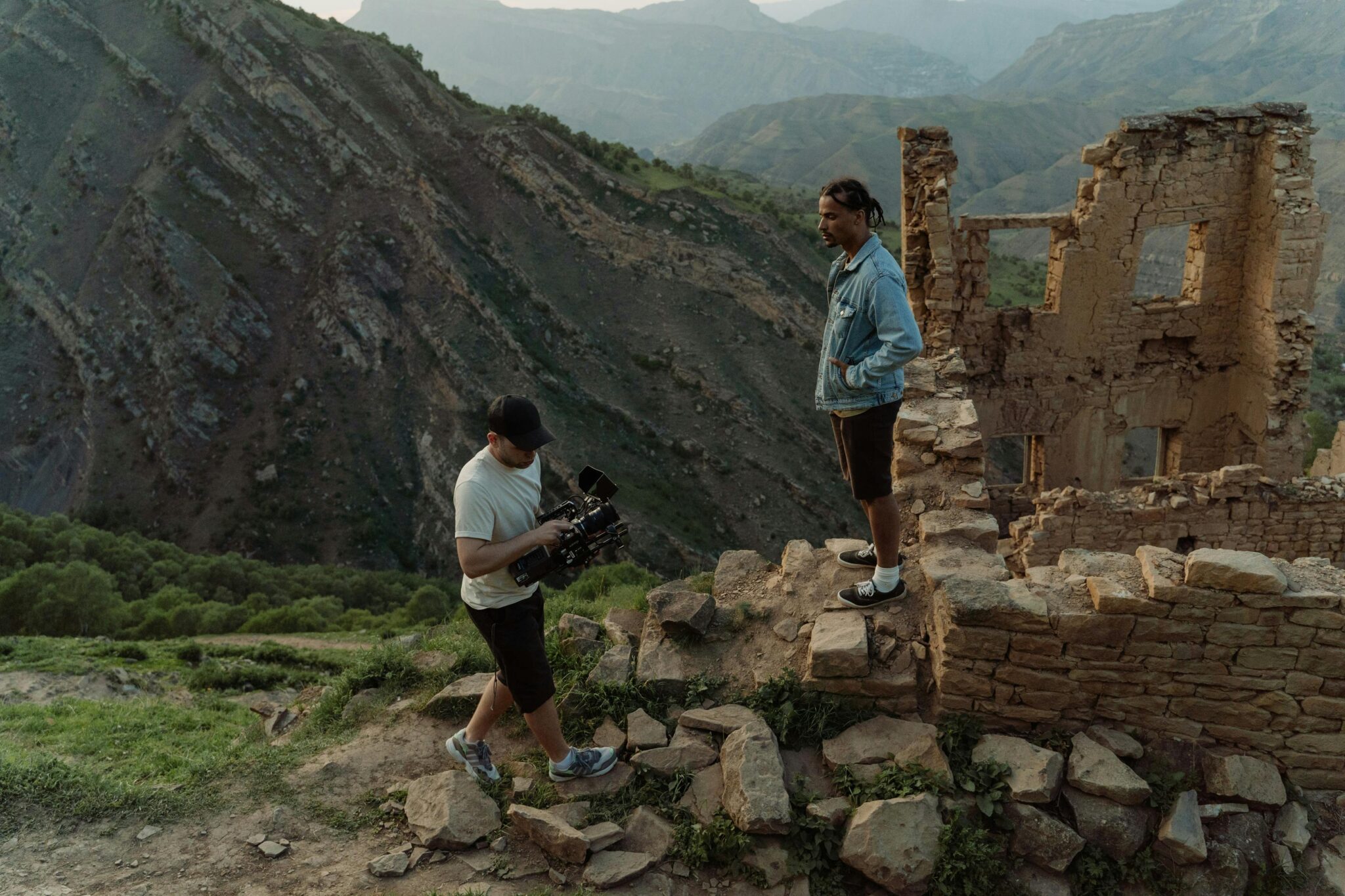
For an experimental filmmaker, the relationship with location can become even more profound. Instead of finding a place to fit a story, the exploration of a place can become the story. This involves a deep, personal, and often intuitive engagement with the environment.
Finding Visceral Intimacy
Your interest in exploring human emotions through nature aligns with filmmakers who use the camera to create an intense, almost physical connection with a location. Let's look at a filmmaker's reflection on this process.
Eventual Horizon - Film on grief
In the article 'Eventual Horizon - Film on grief,' filmmaker Zula Rabikowska describes her process of shooting an experimental film in the Arctic. It's a fantastic model for connecting psychological states to an environment.
Please read the entire short article. Focus on the filmmaker's journey from trying to capture the grand 'horizon' to finding a 'visceral intimacy' with the ice. Note her use of macro lenses and how she conceptually links the textures of ice to the human body, using the location as a direct metaphor for internal states of being.
Rabikowska's process shows how focusing on small, intimate details—the anatomy of an iceberg—can be more powerful than capturing the epic landscape. This approach is perfectly suited to your desire to blend sculpture, performance, and cinema, where the textures of a body, a costume, and a landscape can merge.
The Art of Wandering: Psychogeography
There is a formal name for this practice of exploring a location to map its emotional and psychological effects: psychogeography. A key technique is the dérive, or "drift," where one wanders through a space without a specific goal, paying attention to how the environment makes them feel. Filmmaker Mark Cousins is a key practitioner of this approach.
[PDF] Mark Cousins and the Psychogeographical Essay Film
This academic article, 'Mark Cousins and the Psychogeographical Essay Film,' analyzes how a director uses the 'dérive' as a filmmaking method. This is a more theoretical text, but it provides a powerful framework for your experimental work.
This is a dense text, so focus on two key parts: Introduction and Psychogeography (pages 28-31): Read from the beginning until the start of the 'Filmmaking as Psychogeography' section. Your goal is to understand the core concepts: psychogeography ('the study of the precise laws and specific effects of the geographical environment... on the emotions and behaviour') and dérive ('playful, constructive behaviour and awareness of psychogeographical effects'). Cousins’ Psychogeographical Essay Films (pages 34-37): Read the section titled 'Cousins’ Psychogeographical Essay Films', starting with 'Cousins utilises a “Do-It-Yourself” (DIY) approach...'. This section details how the film What is this Film Called Love? was created spontaneously over three days by wandering through Mexico City. It shows the dérive in action as a filmmaking process.
The concept of the dérive offers a radical, liberating method for an artist. It suggests that you don't need a finished script to start creating. You can begin with a place, a camera, and an openness to the journey, allowing the film to emerge from your interaction with the location.
4. Practical Exercise: Location Mood Board
Let's put these ideas into practice. Imagine you are developing a short, experimental film centered on the theme of "a confrontation with a forgotten memory."
Your Task (15 minutes):
Choose one of the following location types for this theme:
- A dense, overgrown botanical garden or greenhouse.
- An abandoned industrial waterfront with decaying piers and warehouses.
Create a brief written plan for your location. You are not logistics-scouting; you are vision-scouting. Address the following points:
- Symbolic Connection: Why did you choose this location? How does it function as a metaphor for a "forgotten memory"? What specific feelings does it evoke (e.g., suffocation, decay, wildness, emptiness)?
- Key Elements: What specific visual elements within this location would you focus on? (e.g., for the garden: tangled vines, wilted flowers, fog on the glass. For the waterfront: rusted metal, rotting wood, polluted water).
- Filmmaking Approach: Would you use this location as a backdrop for a scripted scene, or would you use an approach inspired by Eventual Horizon or a dérive? Describe how you would explore the space with your camera to discover its story. For instance, would you use macro lenses on textures? Would you follow a meandering path and film what captures your attention?
Conclusion
Today, we've elevated the role of location from a simple setting to a vital, expressive element of cinematic language. You've seen how locations can embody character, provide visual metaphors, and even become the generative source for an entire film.
Key Takeaways:
- Location as Character: A location can tell a story about its inhabitants, revealing their emotions, history, and social context.
- Symbolic Scouting: The process of finding a location is a creative act of searching for spaces that resonate thematically and symbolically with your story.
- Intimate Exploration: For experimental work, focusing on the "visceral intimacy" of a location's textures and details can be more powerful than capturing its full scope.
- Psychogeography & the Dérive: The act of aimless wandering through a space can be a legitimate filmmaking method, allowing the environment to shape the film's structure and mood.
What's Next?
You now have a framework for selecting a location that serves your artistic vision. The next step is to decide how you will capture that location on camera. In our next lesson, we will focus on how to create a detailed shot list that serves the film's overarching visual and thematic concept. We will move from the "where" to the "how," breaking down your scenes into the specific images that will bring your film to life.