Recommended resources
The freely available resources this lesson will direct you to.
- The Best LLM? Google vs OpenAI, Anthropic and DeepSeekwww.youtube.com
- Which LLM Should You Use For Your Business? (Pros & Cons of Each)www.youtube.com
- LLM API Comparison 2026: Pricing, Speed, Features | Every Providerwww.morphllm.com
- LLM Leaderboard - Comparison of over 100 AI models ...artificialanalysis.ai
Hello! In our last lesson, we explored the inherent limitations of Large Language Models, such as hallucinations, knowledge cutoffs, and context window limits. These aren't just abstract technical constraints; they are the very dimensions along which you, as a product builder, must evaluate and choose your tools.
Today, we'll turn those limitations into a practical framework for decision-making. We'll dive into the competitive landscape of LLM providers and learn how to compare the major players—OpenAI, Anthropic, Google, and open-source options from Meta and others. Your goal as an indie hacker isn't to find the single "best" model, but to find the right model for your specific product, balancing its cost, speed, context capacity, and unique strengths. This lesson will equip you with the mental model and resources to make that choice wisely.
By the end of our session, you'll be able to analyze the trade-offs between different LLM APIs and select the most appropriate one for your product idea, a crucial step in building something that is not only functional but also economically viable.
The Four Pillars of LLM Comparison
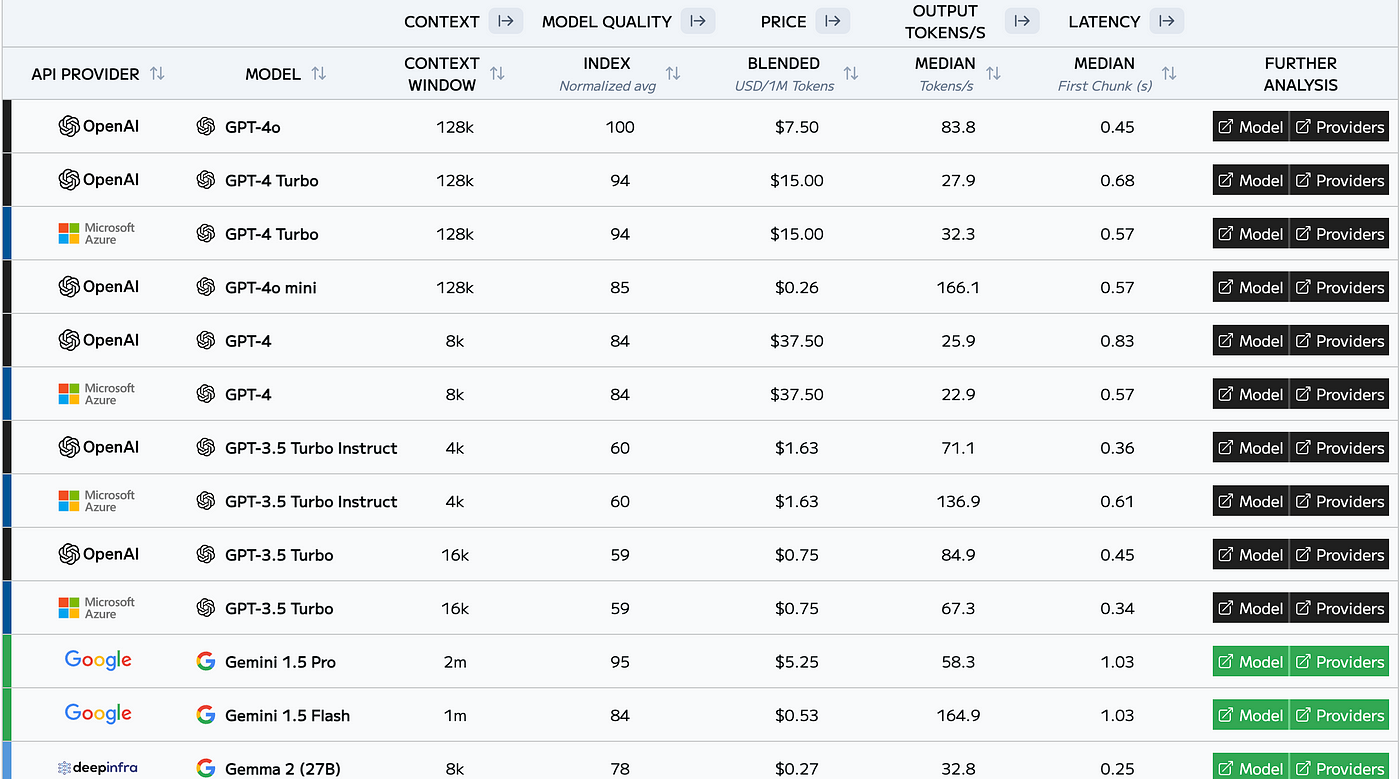
When you're choosing an LLM for your product, you're making a series of trade-offs. The market is a fast-moving, multi-dimensional space, but we can anchor our analysis around four key pillars:
- Cost: Usually measured in dollars per million tokens ($/Mtok). A critical detail is that providers charge different rates for input tokens (your prompt) and output tokens (the model's response). Since output tokens are often more expensive and applications can generate lengthy responses, this is a crucial factor for your bottom line.
- Performance (Speed): This has two main components:
- Latency / Time to First Token (TTFT): How long does it take to get the first word back from the model? This is vital for user experience in interactive applications like chatbots, making the app feel responsive.
- Throughput (Tokens per second): How quickly does the rest of the response get generated after the first token? This determines how fast a long piece of text can be produced.
- Context Window: As we learned, this is the model's "working memory," measured in tokens. A larger context window allows you to process longer documents or maintain longer conversations, but it almost always comes with higher costs and sometimes slower performance.
- Quality & Strengths: This is the most subjective pillar. It's not just about a single "intelligence" score, but about a model's particular talents. Is it a gifted creative writer? A meticulous coder? A master of logical reasoning? Different models from different providers are fine-tuned to excel in different areas.
The table below provides a snapshot of how these metrics are presented in the wild. While the specific models and numbers are from a particular point in time and change rapidly, the columns represent the core trade-offs you'll always be making.
Getting to Know the Contenders
Before we dive into dense pricing tables, let's get a feel for the "personalities" and primary strengths of the major providers. Each has a different philosophy and focus, which is reflected in their models.
Which LLM Should You Use For Your Business? (Pros & Cons of Each)
This conversation from The Next Wave podcast offers an excellent, use-case-driven overview of the main LLM players. The hosts discuss the practical strengths and weaknesses of each model from a user's perspective.
Please watch the following segments to get a qualitative feel for each model: Anthropic (Claude): Start with the discussion on Claude from this section, focusing on its strengths in storytelling and summarization. Google (Gemini): Next, listen to the overview of Gemini's massive context window and its unique features like NotebookLM from this part. Meta (Llama / Open-Source): Understand the role of open-source models by listening to the brief take on Llama from this segment. Grok and Perplexity: Finally, get a sense of specialized models by watching the sections on Grok's real-time access and Perplexity's research focus from this part.
As you can see, the landscape isn't monolithic. We have:
- OpenAI (GPT series): Often seen as the all-around high-performance standard, with newer models pushing the boundaries of reasoning.
- Anthropic (Claude series): Widely regarded as the most "thoughtful" and eloquent writer, with a strong emphasis on safety and excellent performance on coding and document analysis.
- Google (Gemini series): Competes aggressively on price and features, especially with its massive context windows, making it a go-to for long-document processing.
- Meta (Llama series) & Open Source: The choice for developers who prioritize data privacy, control, and the ability to run models on their own hardware. While sometimes a step behind the frontier proprietary models in raw performance, they offer unmatched flexibility.
- Specialists (Grok, Perplexity): These often build on top of other models but add unique capabilities, like real-time data access (Grok) or a focus on verifiable research (Perplexity).
A Product Builder's Playbook for Choosing an API
Now let's move from qualitative feelings to quantitative analysis. The following resource is an excellent (if slightly futuristic) guide written explicitly for product builders. It provides a structured way to think about the market and includes detailed cost breakdowns.
LLM API Comparison 2026: Pricing, Speed, Features | Every Provider
This article from MorphLLM, though framed looking forward to 2026, perfectly captures the strategic thinking required to navigate the LLM API market today. The model names are illustrative, but the principles and cost structures are highly relevant.
Please read through this article, focusing on the following key sections and ideas: The 80/20 Rule: In the "Quick Pricing Overview" section, internalize the concept of starting cheap and only upgrading when you have a measured need. Read the two paragraphs under The 80/20 Rule. Provider Overviews: Scan the "Provider-by-Provider Breakdown", paying closest attention to the descriptions for OpenAI, Anthropic (Claude), and Google (Gemini). You can find this by scrolling to the main breakdown section. Cost Reality Check: Under "Cost Calculator: Real Workloads", examine the Customer Support Chatbot example. This shows how seemingly small per-token price differences can lead to huge variations in your monthly bill. Find the table under the heading "Customer Support Chatbot". Use-Case Mapping: Look at the table under "Best API by Use Case". This is a cheat-sheet that directly connects product features to recommended models. Find the table right after the heading "Best API by Use Case". The Core Strategy: Finally, read the section "How to Choose an LLM API" and especially the part on The Two-Model Pattern. This is a key architectural insight for building cost-effective AI products. Read the entire section from this header to the end of the paragraph on the two-model pattern.
This article drives home the most important lesson for an indie hacker: don't overpay. The difference in cost between a "good enough" model and a "state-of-the-art" model can be 10x or more.
The Two-Model Pattern is a particularly powerful idea. It's a system architecture where you use a cheap, fast model (like GPT-4o mini, or Gemini Flash) as your default for 90% of user requests. When a request is particularly complex or the cheap model fails, a "router" (which can be a simple piece of code you write) escalates the task to a more powerful and expensive model (like Claude 3 Opus or GPT-4o). This gives you the best of both worlds: low cost and high responsiveness for most tasks, with high quality reserved for when it's truly needed.
Staying Current with Live Leaderboards
The LLM market moves incredibly fast. Prices drop, new models are released, and performance benchmarks change weekly. The articles and videos we've reviewed provide the right mental models, but you also need tools to get up-to-the-minute data.
Leaderboards are a key resource for this. They programmatically test dozens of models on various metrics and publish the results. Artificial Analysis is one of the most comprehensive public leaderboards.
LLM Leaderboard - Comparison of over 100 AI models ...
This is a live leaderboard that provides raw performance and pricing data for over 100 models. It can be overwhelming, but it's an invaluable tool for getting current data.
First, familiarize yourself with the terminology by reading the Key definitions at the bottom of the page. This will clarify what they mean by metrics like "Blended Price". Next, look at the main leaderboard table. Don't try to read all of it. Instead, use it to answer a couple of practical questions: Find a high-end OpenAI model (e.g., GPT-5.5) and a high-end Anthropic model (e.g., Claude Opus 4.7). Compare their "Blended USD/1M Tokens" price. Find Google's Gemini 3.5 Flash. Note its price and its "Context Window" size. This exercise shows how you can use the leaderboard to quickly compare models on the dimensions that matter to your product.
Conclusion
In this lesson, we've demystified the process of choosing an LLM provider. You've gone from understanding the abstract limitations to using them as a concrete evaluation framework.
Key Takeaways:
- No Single "Best" Model: The ideal LLM is a function of your specific use case. You must balance cost, speed, context, and quality.
- The Market is Tiered: There are cheap, fast models for everyday tasks and powerful, expensive models for complex reasoning. A key product decision is deciding which tier your feature requires.
- Cost is a Feature: For an indie hacker, managing API costs is paramount. The difference between a $0.50/Mtok model and a $15/Mtok model can be the difference between profitability and failure.
- Architecture Matters: Smart patterns like the "two-model" router allow you to build sophisticated products that are also cost-effective.
- Stay Informed: The landscape changes constantly. Bookmark and learn to use resources like the
Artificial Analysisleaderboard to stay current.
You now have a solid framework for one of the most important decisions you'll make when building an AI product. In our next lesson, we'll build on this by classifying the common product patterns you can build with these models—like chatbots, agents, and RAG apps. This will help you start mapping your product ideas to concrete architectural blueprints.