Recommended resources
The freely available resources this lesson will direct you to.
Introduction
Welcome to the next lesson in our exploration of Friedrich Hayek's thought. In our previous session, we established a clear, neutral understanding of social justice, defining it as a principle of distributive fairness concerned with how a society's benefits and burdens—like wealth, healthcare, and opportunities—are allocated. We saw that proponents of social justice appeal to principles of equality, need, or merit to justify policies aimed at creating a more equitable distribution of these goods.
Now, we are prepared to examine why Hayek, a thinker profoundly concerned with the principles of a free and prosperous society, launched one of the most famous and powerful critiques of this very idea. You will discover why he titled a volume of his major work The Mirage of Social Justice, arguing that the concept is not merely incorrect, but fundamentally "meaningless" and a grave threat to the foundations of liberty. This lesson will unpack his reasoning step-by-step.
The Core of the Critique: Justice Applies to Actions, Not Outcomes
Hayek's argument begins with a simple, yet powerful, philosophical premise. The concepts of 'just' and 'unjust' can only be applied to the intentional actions of human beings. We might be saddened by the outcome of a natural disaster like an earthquake or an avalanche, but we would not call the event itself "unjust." There is no responsible agent to blame. Justice is a moral term that requires human will and responsibility.
Let's begin by reading a short text that lays out this foundational point.
5.2.4 Hayek's critique of social justice - Virtual Plater
This article from Virtual Plater clearly explains the starting point of Hayek's argument.
Please read the two paragraphs that begin with the core premise. Focus on Hayek's claim that justice is a moral term tied exclusively to human conduct and will.
This first step is crucial. If we accept that justice is an attribute of human action, the next question becomes: is the distribution of wealth in a market society the result of a deliberate human action?
The Market as a Spontaneous Order, Not a Deliberate Distributor
As we discussed in a previous lesson, Hayek's concept of spontaneous order is key to his entire social theory. A market economy, like language or a city's footpath network, is not something that one person or a committee designs. It emerges from the voluntary interactions of millions of individuals, each pursuing their own goals with their own limited knowledge.
No single person or entity decides the overall distribution of wealth and income in a market. A software engineer earns a certain salary, a baker sells a certain number of loaves, and an investor sees a certain return, all as a result of countless individual transactions. The resulting pattern of wealth is an unintended consequence of this complex process.
To make this distinction clearer, let's explore an excellent analogy between "made" orders and "spontaneous" orders.
F. A. Hayek, Spontaneous Order, and the Mirage of Social Justice
This article from the American Enterprise Institute uses a memorable analogy to explain the difference between a designed system and a spontaneous one.
Read the section that compares a Lego Death Star to rock candy, starting from the explanation of the two orders. As you read, think about how this applies to society. Is a free-market society more like the centrally planned Lego model or the spontaneously forming crystal?
The Lego Death Star is a "made order" or an organization. Its final structure is the result of a deliberate plan. In such a system, it makes sense to ask if the design is "just." In contrast, the rock candy is a "spontaneous order" or a cosmos. It has a complex structure, but no one planned its final shape. Hayek argues a free society is a cosmos, not an organization.
The "Mirage": A Category Mistake
Now we can put Hayek's two premises together to see the full force of his critique:
- Justice can only be applied to the intentional actions of a human agent.
- The distribution of wealth in a market is the unintended outcome of a spontaneous order, not the design of any agent.
Therefore, Hayek concludes, applying the term "social justice" to the market's outcome is a category mistake. It's like calling a rock "moral" or a triangle "happy." The term is not just wrong; it's conceptually incoherent—it is, in his words, a "mirage" that we chase at our peril.
Let's watch Hayek explain this in his own words.
In this interview clip, F.A. Hayek himself explains why the concept of 'social justice' is meaningless when applied to an impersonal process like the market.
Watch the two segments. First, from his explanation of the market as a game, where he notes that its unpredictable and undesigned outcome cannot be called 'just'. Then, watch from his discussion of justice as an attribute of individual action, where he states directly that applying it to an impersonal process is a "meaningless conception."
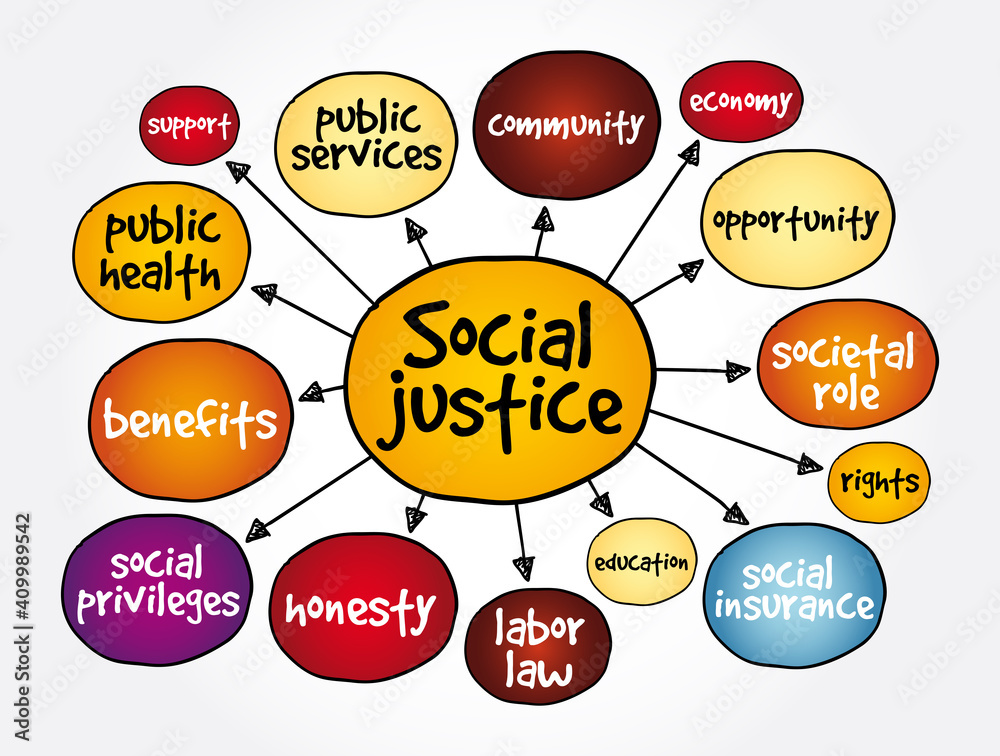
The mind map below illustrates the many areas often associated with the term "social justice." Hayek's argument challenges the very legitimacy of this central concept that ties them all together.
The Dangerous Consequences of Chasing the Mirage
For Hayek, this was not just an abstract philosophical point. He believed that when governments try to impose a specific "just" pattern of wealth distribution onto a spontaneous order, they cause immense harm.
1. Distorting Incentives and Reducing Prosperity
If the government decides that the market's distribution is "unjust" and must be "corrected" through redistribution, it must take resources from some to give to others. This fundamentally alters the signals of the market. Prices no longer reflect the real scarcity of goods or the value consumers place on them. Furthermore, it blunts incentives. People are less motivated to pursue activities that are highly valued by others (and thus highly rewarded by the market) if they know a large portion of their earnings will be confiscated.
Hayek makes this practical point in the following clip.
Here, Hayek explains the practical economic consequences of trying to impose social justice.
Watch the short segment from his discussion on disincentives. He argues that redistribution discourages people from doing what is "most beneficial to society."
2. Violating the Rule of Law
More fundamentally, the pursuit of social justice forces the government to abandon the Rule of Law, which we discussed as the principle of governing through general, abstract rules that apply equally to everyone. To achieve a specific distributive pattern (e.g., "the top 1% should only own 10% of the wealth"), the state cannot treat people equally. It must treat them unequally—by taxing them at different rates and providing them with different benefits—in order to make them more equal in their outcomes. This replaces impartial law with arbitrary power.
Hayek powerfully contrasts the classical idea of justice (equal treatment under the law) with the demands of social justice (unequal treatment for equal outcomes).
In this concluding segment of the interview, Hayek draws a sharp distinction between two competing ideas of justice.
Please watch from Hayek's final point. Note his powerful conclusion that making people equal would force the government to "treat people very unequally indeed."
3. The Conflict with Our Instincts
Hayek was keenly aware that market outcomes can often feel intuitively unfair. He uses the stark example of a nurse earning less than a strip-tease dancer. Our "tribal" instincts, developed in small, face-to-face groups where we knew each other's merits and needs, cry out that this is unjust. However, he argues that in order to sustain a large, complex, and prosperous global society, we must learn to discipline these instincts. The "unjust" price signals of the market are what allow for an efficient allocation of resources that, paradoxically, makes everyone, including the nurse, better off than they would be in a less efficient, "juster" system.
This is one of Hayek's most challenging and famous arguments. He discusses the conflict between our moral feelings and the requirements of a large-scale, efficient society.
Please watch from the nurse and strip dancer example to the end of the clip. This is a difficult but essential part of his argument: that a society which is efficient enough to support the world's population "cannot be just" in the way our instincts demand.
A Final Nuance: Hayek's Support for a Social Safety Net
Given this powerful critique, it might seem surprising that Hayek was not against all forms of social welfare. He supported the state providing a "safety net" in the form of a guaranteed minimum income for those unable to support themselves in the market (due to sickness, age, or disability).
How can this be reconciled? The key is his reasoning. Hayek did not support this as a tool of "social justice" to correct the market's distribution. Rather, he saw it as a pragmatic measure of collective insurance, taken outside the market, to ensure the social stability and basic security on which a free and functioning market order depends. It was a political decision about the minimum standard a wealthy society is willing to provide for its members, not an attempt to make the market's outcomes conform to a moral pattern.
5.2.4 Hayek's critique of social justice - Virtual Plater
This final section of the Virtual Plater article explains the practical implications of Hayek's argument and clarifies his position on a social safety net.
Please read the two paragraphs starting from the section on his influence. Pay close attention to the distinction between providing a safety net for security and attempting to redistribute wealth for "social justice."
Conclusion
In this lesson, we have dissected F.A. Hayek's famous and influential critique of social justice. His argument is not a simple rejection of fairness, but a deep philosophical and economic challenge to the very coherence of the concept when applied to the results of a free market.
Here are the key takeaways from his critique:
- Justice is an attribute of intentional human action. It cannot be applied to states of affairs that no one designed or intended.
- A market economy is a spontaneous order. The overall distribution of wealth is an unintended consequence of countless individual actions.
- Therefore, calling the market's outcome "just" or "unjust" is a category mistake, a "mirage."
- The government's attempt to impose a pattern of "social justice" is harmful because it distorts market signals, reduces incentives, and violates the Rule of Law by requiring the state to treat people unequally.
- Hayek's support for a social safety net was a pragmatic measure for social stability, not a concession to the principles of distributive justice.
Hayek's argument is largely consequentialist and epistemic—it focuses on the bad outcomes and the impossibility of the knowledge required to achieve "social justice." In our next module, we will turn to the American philosopher Robert Nozick, who arrives at a similar anti-redistributionist conclusion from a completely different starting point: the inviolable rights of the individual. This will provide a fascinating contrast and deepen your understanding of the libertarian perspective on justice.