Recommended resources
The freely available resources this lesson will direct you to.
- Spontaneous Order - Hayek's most important Idea?! [What Would Hayek Say?]www.youtube.com
- Spontaneous Order and the Market Processwww.youtube.com
- On Hayek's “Kinds of Order in Society,” Part II | The Daily Economythedailyeconomy.org
- The Power and Pervasiveness of Spontaneous Order - Econlibwww.econlib.org
Introduction
In our last lesson, we built the positive libertarian case for the free market, arguing that its mechanisms of price signals and profit-and-loss incentives lead to widespread prosperity. We saw how millions of disconnected individuals, each pursuing their own ends, can coordinate their activities to produce complex goods and services, a feat that cripples even the most powerful central planners.
This lesson gives a name to that remarkable phenomenon, introducing one of the most important concepts in the thought of Friedrich Hayek: spontaneous order. We will explore what this idea means and see how it applies not only to the market but to many other areas of life. Understanding spontaneous order provides a powerful lens for seeing the world, revealing how intricate, functional systems can emerge and thrive without a guiding hand or central blueprint. This directly addresses our learning goal of explaining Hayek's core concept and its most famous examples.
What is Spontaneous Order?
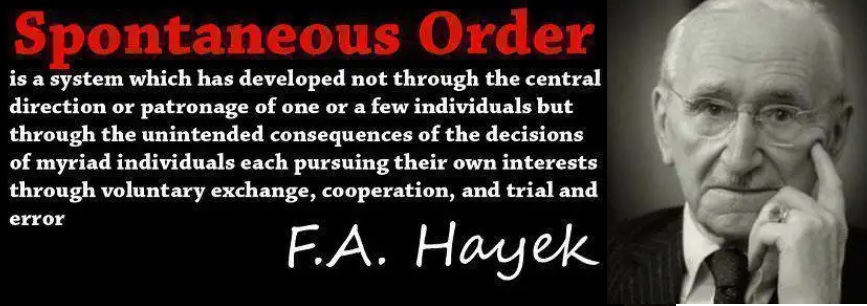
At its heart, spontaneous order is order that is not designed. It is a system or pattern that emerges as an unintended consequence of the actions of many individuals who are not trying to create the order itself. They are simply following their own plans and pursuing their own goals. The Scottish Enlightenment thinker Adam Ferguson first articulated this idea, which Hayek later popularized with the phrase that such orders are "the result of human action, but not of human design."
This concept is not limited to human society. Nature is filled with examples of spontaneous order. Think of the intricate and unique patterns of snowflakes, or the way iron filings arrange themselves in a pattern when a magnet is brought near. No one directs the water molecules or the iron filings; the order emerges from them following simple, local rules.

To get a more formal grasp of this idea as it applies to human institutions, let's turn to a clear explanation.
The Power and Pervasiveness of Spontaneous Order - Econlib
This article by Elaine Sternberg provides a crisp definition of spontaneous order and contrasts it with other types of order we might observe.
Please read the section titled "Meaning." Focus on how the author distinguishes spontaneous orders from both natural orders (like cats or crystals) and artificial or constructed orders (like skyscrapers). Pay special attention to the alternative characterization she offers: "an unintended order of intentional action."
As the reading highlights, the key is the absence of a planner or coordinator. In a spontaneous order, the individual components (people, in the case of social orders) are acting intentionally to achieve their own aims. The resulting overall pattern, however, was not part of anyone's intention.
Examples Beyond the Market
Before we connect this idea back to the economy, it's helpful to see how pervasive spontaneous order is in our daily lives. Recognizing it in more familiar contexts builds the intuition for understanding it in more complex ones.
Language
Language is perhaps the quintessential example of a social spontaneous order. No committee invented the English language. There was no single moment when a group of people decided that "tree" would refer to a tall, woody plant or that sentences should generally follow a subject-verb-object structure.
Instead, language evolved over thousands of years. Countless individuals, trying to communicate with one another to trade, to warn of danger, or to tell stories, made small innovations. Sounds became associated with objects, successful new words and grammatical forms were adopted by others, and less useful ones were forgotten. The vast, complex, and rule-governed system we call "English" is the cumulative result of these billions of uncoordinated individual interactions.
This video from the Austrian Economics Center explains how language serves as a prime example of a bottom-up, emergent institution.
Spontaneous Order - Hayek's most important Idea?! [What Would Hayek Say?]
In this segment of "Spontaneous Order - Hayek's most important Idea?!", the speaker illustrates how language develops organically, without a central committee or top-down design.
Please watch the portion from where he introduces certain patterns emerging naturally. Notice the contrast he draws between the bottom-up evolution of language and the idea of a "commission of language" trying to design it.
Everyday Social Norms
Think about how people navigate a crowded sidewalk or hallway. There's no traffic director telling people where to walk, yet we mostly avoid collisions. Individuals adjust their speed and path in response to the people immediately around them, and a collective, orderly flow emerges. Other simple examples include:
- The formation of desire lines, those unofficial paths worn into grassy areas on a college campus that show the most efficient routes between buildings.
- The unspoken etiquette of how people space themselves out in an elevator.
These might seem trivial, but they are small-scale examples of the same process that produces much larger and more complex social orders.
The Market as a Spontaneous Order
This brings us back to the economy. For libertarians following Hayek, the market economy is the paramount example of a beneficial spontaneous order. No single person or agency designed the global economy. No one is in charge of it. Yet, it coordinates the economic activities of billions of people with breathtaking complexity.
The Pencil and the Price System
In our last lesson, we touched on the impossibility of a central planner having enough knowledge to run an economy. The spontaneous order of the market solves this problem. Let's revisit the humble pencil, a classic example first used by Leonard Read and often cited by economists like Milton Friedman and Hayek.
Spontaneous Order and the Market Process
This video, "Spontaneous Order and the Market Process," opens by posing a puzzle: how many people does it take to make a simple pencil?
Watch the introduction from the start of the talk. The speaker walks through the staggering complexity involved in producing something as simple as a pencil, highlighting that no single person designs or controls the process.
The video makes the crucial point: this incredibly complex cooperative process is an order that is "not the product of design." But how do all these people—the lumberjack in Oregon, the graphite miner in Sri Lanka, the factory worker in Tennessee, the person who made the coffee for the truck driver—coordinate their efforts?
They are coordinated by the price system. The price system is the communication network of the market's spontaneous order. As we discussed in a previous module, prices act as signals, conveying condensed information about scarcity and demand. A high price for wood signals to everyone in the supply chain to use it more carefully and to producers to find ways to supply more. No one needs to know why the price is high; they only need to react to the signal.
Hayek argued that this is the genius of the market. It allows us to benefit from knowledge we don't personally possess.
Spontaneous Order and the Market Process
Here, the speaker connects the market's spontaneous order directly to Hayek's ideas about knowledge, explaining how prices work as "knowledge surrogates."
First, watch the segment on how order emerges in the marketplace. Focus on the idea that prices are "knowledge surrogates" that coordinate behavior. Then, watch the following segment from where he discusses tacit knowledge. The example of driving a stick shift is a brilliant illustration of knowledge that we possess but cannot easily articulate, which central planners can never access but which the market process can utilize.
A Quick Distinction: Spontaneous vs. Made Orders
To truly understand what a spontaneous order is, it helps to contrast it with its opposite: a made order, or what Hayek often called an organization.
- A made order is a top-down, designed arrangement created to achieve a specific, unified purpose. A business firm, a sports team, or an army are all made orders. Within the firm, a manager directs employees to pursue the company's goal (e.g., maximizing profit).
- A spontaneous order is a bottom-up, emergent system that has no single purpose. Instead, it provides a framework within which individuals can pursue their many different and diverse purposes. The market has no goal of its own; it is the process through which we all pursue our individual goals.
This video clarifies Hayek's distinction.
Spontaneous Order and the Market Process
This section explains Hayek's crucial distinction between "made orders" (which he called "economies" in the literal sense) and "spontaneous orders" (which he called a "catallaxy").
Watch the clip from where the speaker introduces the distinction. Note the key difference: made orders like a firm or military have a unified purpose, while spontaneous orders like language or markets have no purpose of their own, but rather serve the diverse purposes of their participants.
Conclusion
In this lesson, we have put a name and a framework to the processes we explored previously. Hayek's concept of spontaneous order gives us a way to understand how complex and beneficial systems can arise without a master plan.
Here are the key takeaways:
- A spontaneous order is an emergent pattern that is "the result of human action, but not of human design."
- Examples are found everywhere, from language and social norms to the intricate web of the global market.
- The market economy is a spontaneous order that solves the knowledge problem by using the price system to coordinate the actions of millions.
- Prices act as "knowledge surrogates," allowing us to benefit from vast amounts of dispersed and even tacit (inarticulate) knowledge that no central planner could ever possess.
- Spontaneous orders (like a market) differ from made orders (like a firm) in that they have no single overarching goal, but rather enable individuals to pursue their own diverse ends.
In our next lesson, we will delve deeper into this critical distinction between spontaneous and made orders. We will explore why Hayek believed this distinction was so important and why he saw the attempt to manage an entire society as if it were a single, purpose-driven organization as the fundamental error of central planning and socialism.