Recommended resources
The freely available resources this lesson will direct you to.
Hello! Welcome back to our module on the taxation of Spanish real estate.
In our last two lessons, we identified the full range of deductible expenses (gastos deducibles) and took a deep dive into calculating the most significant non-cash expense: depreciation (amortización). You now have all the individual components needed to determine your taxable rental income.
Today, we will put everything together. Our goal is to calculate the net rental income after deductions for Spanish tax purposes. This final figure, known as the Rendimiento Neto Reducido del Capital Inmobiliario, is the base amount upon which your income tax (IRPF) will be calculated.
1. The Full Calculation Formula
The process of moving from gross rent to the final taxable base involves several steps. The Spanish Tax Agency (Agencia Tributaria) defines a clear sequence for this calculation.
To start, let's look at a clear definition of the overall formula.
The article '¿Cómo puedo calcular el rendimiento neto obtenido por ...' from Solfinc provides the master formula that structures this entire calculation. It clearly lays out the components we need to subtract from our gross income.
Read the section titled '¿Cómo puedo calcular el rendimiento neto obtenido por el alquiler?'. Focus on the main formula presented in bold: RENDIMIENTO NETO = RENDIMIENTO ÍNTEGRO – GASTOS DEDUCIBLES – AMORTIZACIONES – REDUCCIONES. We will break this down step-by-step.
As you can see, the process can be summarized in four steps:
- Start with Gross Income (Rendimiento Íntegro).
- Subtract all Deductible Expenses (Gastos Deducibles), which includes amortization.
- The result is the Preliminary Net Income (Rendimiento Neto).
- Apply any applicable Reductions (Reducciones) to get the final Reduced Net Income (Rendimiento Neto Reducido).
Let's work through each step.
Step 1: Gross Income (Rendimiento Íntegro)
This is the most straightforward part. It is the total amount of rent you have received from your tenant(s) during the tax year.
If you charge the tenant for utilities or other costs that you pay initially (a practice called repercutir), both the payment you make (the expense) and the reimbursement you receive from the tenant (the income) must be declared. They will net out to zero, but both sides of the transaction must appear on your tax return.
Step 2: Deductible Expenses (Gastos Deducibles)
This is where your diligent record-keeping pays off. We have covered these expenses across previous lessons, but let's consolidate the list. Remember that all expenses must be prorated for the number of days the property was rented during the year.
For a concise and comprehensive list of deductible expenses allowed under Spanish law, let's consult the following resource.
Review the section titled '¿Qué gastos son deducibles en los rendimientos del alquiler?'. This provides a clear checklist of the costs you can subtract from your gross income.
To summarize, your key deductible expenses are:
- Financing Costs: Mortgage interest and associated costs.
- Repair & Conservation: Maintenance to keep the property in good condition (e.g., painting, fixing a leaky faucet). This does not include improvements.
- Taxes and Fees: IBI, garbage collection tax (tasa de basuras).
- Community Fees (Gastos de Comunidad).
- Insurance: Home insurance, rental default insurance, and life insurance linked to the mortgage.
- Utilities: Water, electricity, gas, internet (only if paid by the landlord and not reimbursed by the tenant).
- Amortization: This is the crucial non-cash expense we calculated in detail in our last lesson. It includes depreciation of:
- The property (construction part) at 3%.
- Improvements at 3%.
- Furniture and appliances at 10%.
Step 3: Preliminary Net Income (Rendimiento Neto)
Once you have summed up all your deductible expenses, you subtract this total from your gross income.
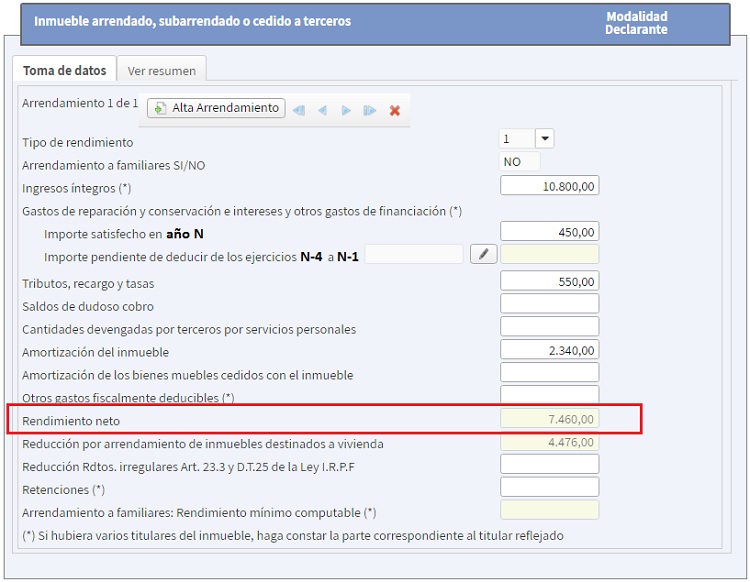
This gives you your preliminary net income. If this figure is negative (i.e., you have a loss), you can offset this loss against other positive rental income, and any remaining loss can be carried forward to offset rental income in the next four years.
The image below shows how this calculation appears on a Spanish tax form.
Step 4: The 60% Reduction for Housing (Reducción por Arrendamiento de Vivienda)
This is one of the most significant tax benefits for residential landlords in Spain. If your property is rented out as a primary residence for the tenant (i.e., not a vacation rental or office), you can apply a major reduction to your net income before it gets taxed.
Let's watch a short video that explains this crucial step.
IMPUESTOS en la inversión inmobiliaria💰FISCALIDAD💰Parte 1
The video 'IMPUESTOS en la inversión inmobiliaria' from 'El Excel de Alex' clearly explains this reduction, which is applied after calculating the net income.
Watch from 14:20 to 15:40. The presenter explains how the reduction is applied to the net rental income ('rendimiento neto') and mentions the recent changes in the law.
As the video explains, for rental contracts signed before January 1, 2024, the rule is a straightforward 60% reduction of the positive Rendimiento Neto.
Important Note on Law Changes: A new housing law has introduced changes for contracts signed from January 1, 2024, onwards. The general reduction is now 50%, but it can be increased to 70% or 90% if the property is in a designated "stressed" rental market (zona de mercado residencial tensionado) and meets certain conditions. For our examples, we will use the common 60% figure, but it is vital to be aware of these new rules for future investments.
The final calculation is:
This Rendimiento Neto Reducido is the final amount that will be added to your general income tax base (base imponible general) to be taxed.
A Comprehensive Example
Let's put all the pieces together. Assume you own a rental property and the data for the year is as follows:
- Gross Annual Rent: €12,000 (€1,000 / month)
- Mortgage Interest Paid: €2,500
- Community Fees: €600
- IBI & Basura Tax: €500
- Home Insurance: €300
- Repairs (painting): €400
- Calculated Annual Depreciation (from previous lesson): €2,200
Calculation:
-
Gross Income (Rendimiento Íntegro): €12,000
-
Total Deductible Expenses:
- €2,500 (Interest) + €600 (Community) + €500 (Taxes) + €300 (Insurance) + €400 (Repairs) + €2,200 (Depreciation) = €6,500
-
Preliminary Net Income (Rendimiento Neto):
- €12,000 - €6,500 = €5,500
-
Reduction (60%):
- Since the
Rendimiento Netois positive, we apply the reduction: - €5,500 * 60% = €3,300
- Since the
-
Final Reduced Net Income (Rendimiento Neto Reducido):
- €5,500 - €3,300 = €2,200
In this scenario, out of €12,000 in gross rent, only €2,200 is added to your taxable income base. This demonstrates the powerful effect of correctly accounting for all expenses and the 60% reduction.
From Calculation to Declaration
Seeing the numbers is one thing, but understanding how they fit into the actual tax declaration process makes it concrete. The following video gives a detailed walkthrough of entering these figures into Spain's online tax portal, Renta Web.
Cómo Declarar los INGRESOS por ALQUILER en la RENTA y Pagar Menos IRPF
The video 'Cómo Declarar los INGRESOS por ALQUILER' by El Banquero del Pueblo is an excellent practical guide. It shows exactly where to input your income and prorated expenses.
Watch the segment from 12:47 to 17:25. Observe how the user inputs the gross income ('Ingresos íntegros') and then fills in each category of deductible expense ('gastos deducibles') we've discussed. Notice how the system automatically calculates the 'Rendimiento neto' and then applies the 'Reducción por arrendamiento' to arrive at the final taxable figure. This connects our theoretical calculation to the real-world process.
Test your understanding!
An investor receives €15,000 in gross annual rent. Their total deductible expenses for the year, including amortization, are €9,000. The property is rented as a primary residence. What is the Rendimiento Neto Reducido?
Show answer
- Rendimiento Neto = Gross Income - Expenses = €15,000 - €9,000 = €6,000.
- Reducción = €6,000 * 60% = €3,600.
- Rendimiento Neto Reducido = €6,000 - €3,600 = €2,400.
Python Implementation
Let's codify this logic. Building on the function from our last lesson, we can create a master function to calculate the final taxable income from a rental property.
def calculate_spanish_rental_taxable_income(
    gross_rental_income: float,
    deductible_expenses: dict,
    is_primary_residence: bool = True,
    reduction_pct: float = 0.60
) -> dict:
    """
    Calculates the net rental income for Spanish IRPF purposes.

    Args:
        gross_rental_income: Total rent received in the year.
        deductible_expenses: A dictionary containing all prorated deductible expenses.
                             Example: {'interest': 2500, 'community': 600, 'depreciation': 2200, ...}
        is_primary_residence: True if rented as a tenant's main home.
        reduction_pct: The applicable reduction percentage (e.g., 0.60).

    Returns:
        A dictionary with the full breakdown of the calculation.
    """
    total_expenses = sum(deductible_expenses.values())

    rendimiento_neto = gross_rental_income - total_expenses

    reduction_amount = 0
    if rendimiento_neto > 0 and is_primary_residence:
        reduction_amount = rendimiento_neto * reduction_pct

    rendimiento_neto_reducido = rendimiento_neto - reduction_amount

    return {
        "gross_income": round(gross_rental_income, 2),
        "total_deductible_expenses": round(total_expenses, 2),
        "net_income (rendimiento_neto)": round(rendimiento_neto, 2),
        "reduction_applied": round(reduction_amount, 2),
        "final_taxable_income (rendimiento_neto_reducido)": round(rendimiento_neto_reducido, 2)
    }

# Using our example from above:
expenses = {
    'interest': 2500,
    'community': 600,
    'taxes': 500,
    'insurance': 300,
    'repairs': 400,
    'depreciation': 2200
}

result = calculate_spanish_rental_taxable_income(
    gross_rental_income=12000,
    deductible_expenses=expenses
)
print(result)

# Expected output:
# {
#  'gross_income': 12000,
#  'total_deductible_expenses': 6500,
#  'net_income (rendimiento_neto)': 5500,
#  'reduction_applied': 3300,
#  'final_taxable_income (rendimiento_neto_reducido)': 2200
# }
Conclusion
Congratulations! You have now mastered the complete process of calculating the taxable income from a rental property in Spain. This is a cornerstone skill for any serious real estate investor in the country.
Key Takeaways:
- The final taxable income is calculated as:
(Gross Income - All Deductible Expenses) - Reduction. - A comprehensive and accurate list of all deductible expenses, including amortization, is essential to minimize your tax base.
- For residential rentals, the 60% reduction on positive net income dramatically lowers your tax liability.
- This entire process is formalized in the
Renta Websystem, where you input the components and the software performs the final calculation.
Preview of the Next Lesson:
We have successfully calculated the Rendimiento Neto Reducido. The question now is: how much tax will you actually pay on this amount? In our next lesson, we will calculate IRPF tax on rental income for Spanish residents, considering applicable reductions, by learning how to apply Spain's progressive income tax brackets to this figure.