Recommended resources
The freely available resources this lesson will direct you to.
Hello! Welcome back to our ninth module on the taxation of Spanish real estate.
In our last lesson, we navigated the critical first step of any property purchase: calculating the acquisition tax, distinguishing between IVA and ITP. This set the foundation for determining your true initial investment cost. Now that we've "acquired" the property in our model, we need to manage its ongoing operations from a tax perspective.
Today's lesson focuses on a crucial element for calculating your investment's profitability. Our learning outcome is to identify the deductible expenses for rental properties under Spanish IRPF regulations. Mastering this allows you to reduce your taxable rental income legally, which directly increases your after-tax cash flow and overall returns. This is a fundamental building block for the comprehensive tax model we are constructing.
1. The Principle of "Gastos Deducibles"
When you receive rental income (rendimientos íntegros del capital inmobiliario), the Spanish Tax Agency (Agencia Tributaria) doesn't tax you on the gross amount. Instead, it allows you to subtract all the "necessary expenses" incurred to generate that income. The result is your net rental income (rendimiento neto), which is the figure upon which your income tax (IRPF) is calculated.
The core principle is that an expense is deductible if it has a clear and direct correlation with earning rental income from your property. Let's look at the most common categories.
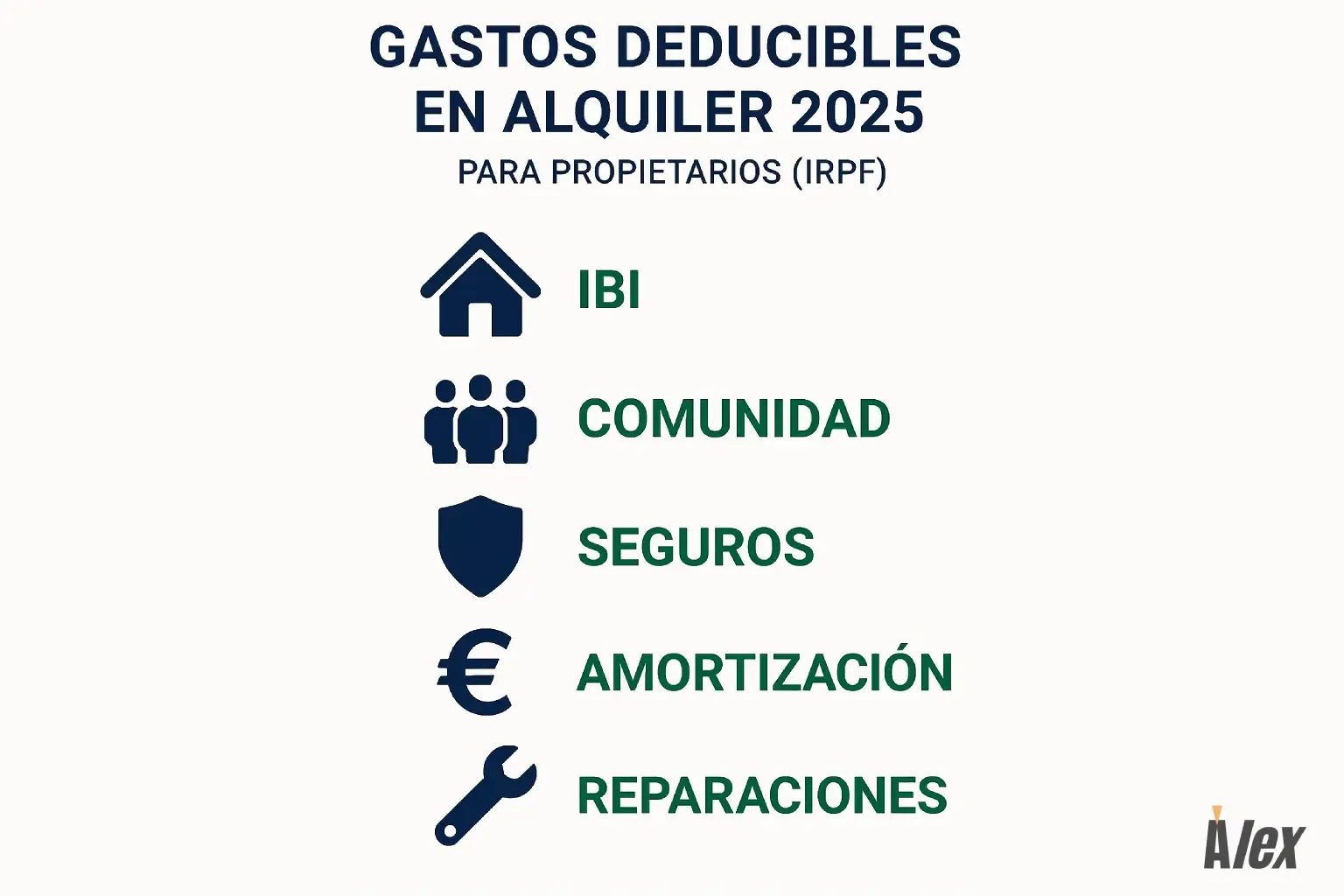
To get a comprehensive overview, we'll start with a practical walkthrough of the main categories of deductible expenses.
GASTOS que me PUEDO DEDUCIR del ALQUILER
The video 'GASTOS que me PUEDO DEDUCIR del ALQUILER' from the channel 'El Banquero del Pueblo' offers an excellent and straightforward summary of the 11 main categories of deductible expenses recognized by the Spanish tax authorities. This will serve as our checklist.
Watch the video from 03:40 to 10:56. The presenter systematically goes through each category of deductible expense. As you watch, make a mental list of these categories, from mortgage interest to property amortization.
Now, let's organize this information and delve into the crucial details and conditions for each category, using a more formal structure provided by tax professionals.
For a definitive and structured list, we will refer to the 'GUÍA PRÁCTICA DE LOS IMPUESTOS 2024' published by AEDAF (Spanish Association of Tax Advisors). This guide provides the legal basis and important nuances for each expense.
Please read the section titled '3 Gastos deducibles', starting from the beginning and ending just before '3.2.7 . Amortización'. This covers all expenses except depreciation, which we will handle separately. Pay close attention to the distinction between expenses with a limit and those without.
Based on these resources, let's break down the expenses into two main groups as defined by the regulations.
2. Group 1: Expenses Subject to a Joint Limit
Spanish tax law groups two specific expense types and subjects their combined total to an annual limit: they cannot exceed the gross rental income generated by the property in that year.
Annual Limit: Interests & Financing Costs + Conservation & Repair Costs ≤ Gross Rental Income
If your expenses in this group exceed your income, the excess is not lost. You can carry it forward and deduct it over the next four years, subject to the same limit each year.
A. Interests and Financing Costs
This includes the interest portion of your mortgage payments and any other costs associated with the loan used to acquire or improve the property.
- What's deductible: Mortgage interest, loan opening fees, broker commissions, notary and registration costs for the mortgage.
- What's NOT deductible: The principal portion of your mortgage payments. This is a return of capital, not an expense.
B. Conservation and Repair Costs
This is one of the most scrutinized categories. These are costs aimed at maintaining the normal use and function of the property. However, they must be distinguished from improvements.
The distinction is critical:
- Conservation/Repair: An expense deducted in the current year (subject to the limit). Examples include painting, fixing plumbing or electrical systems, or replacing a broken window.
- Improvement/Ampliation: An investment that increases the property's value, size, or efficiency. It is NOT deducted as an expense. Instead, its cost is added to the property's acquisition value and recovered via depreciation. Examples include adding a new bathroom, installing an elevator where there was none, or a major structural renovation.
This distinction can be tricky. Let's watch a video that provides clear, real-world examples based on rulings from the tax authorities.
Gastos de conservación y mejora en inmuebles arrendados ¿Cómo se deducen en el IRPF?
The video 'Gastos de conservación y mejora...' from Graciani Asesores & Abogados focuses exclusively on this critical difference. It gives concrete lists of what is considered a repair versus an improvement.
Watch from the beginning (00:04) to 06:44. Focus on the lists provided: What counts as a conservation expense (e.g., changing windows, pipes, painting). What counts as an improvement (e.g., structural consolidation, adding an accessibility ramp).
3. Group 2: Expenses Not Subject to the Limit
These expenses can be fully deducted from your gross rental income without being subject to the annual limit mentioned above.
-
Taxes and Levies: Any non-state tax related to the property is deductible. This primarily includes the annual Property Tax (Impuesto sobre Bienes Inmuebles, IBI) and municipal fees like waste collection (tasa de basuras). Fines and penalties are not deductible.
-
Third-Party Services: Fees paid for services related to the property. This includes community fees (gastos de comunidad), property management agency fees, and costs for a concierge or security.
-
Utilities (Suministros): Costs for water, electricity, and gas are deductible only if the landlord pays for them according to the lease agreement. If the tenant pays the utility companies directly, you cannot deduct these expenses.
-
Insurance Premiums: Premiums for insurance policies covering the property are deductible. This includes home insurance (fire, civil liability) and, importantly, rent default insurance (seguro de impago de alquiler).
-
Legal and Administrative Costs: Expenses related to the rental activity, such as the cost of a lawyer to draft the lease agreement or legal fees to handle a tenant eviction (desahucio).
-
Unpaid Rent (Saldos de dudoso cobro): You can deduct unpaid rent as an expense under specific conditions: the tenant is officially in bankruptcy, or more than six months have passed since you first initiated a formal collection process (e.g., a burofax) and the end of the tax year. If you later recover this rent, you must declare it as income in the year you receive it.
4. The Major Non-Cash Deduction: Amortización (Depreciation)
Depreciation is one of the most powerful deductions because it doesn't require a cash outlay each year. It's a tax allowance for the gradual wear and tear and obsolescence of the property and its contents.
There are two types of amortization:
-
Amortización of the Property (Inmueble): The tax law allows you to deduct 3% of a specific value of your property each year. This is a complex calculation involving the acquisition cost and cadastral value, and importantly, you can only depreciate the construction value, not the land value.
-
Amortización of Movable Goods (Bienes Muebles): If you rent the property furnished, you can also depreciate the furniture, appliances, and other items ceded with the property. The standard rate for this is 10% of their purchase cost per year.
We've introduced the concept here because it is a key deductible expense. However, due to its importance and calculation complexity, we will dedicate our entire next lesson to a deep dive into how to calculate amortization correctly.
5. Essential Conditions for All Deductions
Before you deduct any expense, you must be prepared to prove it to the Agencia Tributaria.
- Documentation is Key: You must have a complete, formal invoice (factura) for every expense. The invoice must be in your name and, ideally, list the address of the rental property. Simple receipts may not be sufficient.
- Prorating for Vacancy: If the property was not rented for the entire year (e.g., it was vacant for two months between tenants), you must prorate annual expenses like IBI and amortization. You can only deduct the portion of the expense corresponding to the number of days the property was actually rented. For example, if it was rented for 300 days out of 365, you can only deduct (300/365) of the IBI for that year. This is a critical point for accurate financial modeling.
Test your understanding!
An investor in Spain incurred the following costs for their rental apartment this year. Which of them are fully or partially deductible for IRPF purposes?
- €3,000 for the annual IBI and waste collection fees.
- €6,000 in mortgage payments, of which €2,500 was interest and €3,500 was principal.
- €1,200 for a new, more efficient air conditioning system to replace a 15-year-old broken one.
- €15,000 to build a new guest bathroom in what was previously a storage closet.
- A €200 fine for paying the IBI late.
- €800 in community fees (gastos de comunidad).
Show answer
- IBI and waste fees (€3,000): Deductible. These are non-state taxes directly related to the property.
- Mortgage payment (€6,000): Partially deductible. The €2,500 in interest is deductible (subject to the joint limit with repairs). The €3,500 in principal is not deductible.
- New A/C system (€1,200): Deductible as a repair/conservation cost. Replacing an existing essential element is considered conservation. This amount will be added to the interest expense and tested against the gross income limit.
- New guest bathroom (€15,000): Not deductible as an expense. This is a clear case of an improvement (mejora) as it adds a new feature and increases the property's value. This cost should be capitalized (added to the acquisition value) and recovered via depreciation over many years.
- Late payment fine (€200): Not deductible. Penalties and sanctions are never deductible.
- Community fees (€800): Deductible. This is a classic third-party service expense.
Conclusion
Today, you have built a comprehensive map of the deductible expenses allowed under Spanish IRPF law for rental properties. Understanding and correctly applying these deductions is not just about compliance; it's a core strategy for optimizing your investment's financial performance.
Key Takeaways:
- Deductible expenses are costs necessary for generating rental income and must be properly documented with invoices.
- Expenses are divided into two groups: interest/financing + conservation/repairs are subject to a joint annual limit equal to gross rent, while most other expenses (IBI, community fees, insurance) are not limited.
- A crucial distinction exists between conservation (deductible now) and improvements (capitalized and depreciated).
- Amortization (depreciation) is a major non-cash deduction for the property (3%) and its furnishings (10%).
- Annual expenses must be prorated for any period the property is vacant and not generating income.
Preview of the Next Lesson:
We've identified amortization as a key deductible expense. Now, we need to master its calculation. In our next lesson, we will do a deep dive into explaining depreciation (amortización) under Spanish tax law and calculating the annual deduction. We will cover how to separate land and construction value and apply the 3% rule correctly, a skill that will significantly impact your after-tax return calculations.