Recommended resources
The freely available resources this lesson will direct you to.
Hello! Welcome back to your course on circuit analysis.
In the last few lessons, you've mastered the mechanics of our two primary systematic analysis techniques: nodal analysis and mesh analysis. You know how to set up and solve the equations for each, including handling the special cases of voltage and current sources. You've moved from applying basic laws to wielding powerful, general-purpose tools.
Today, we shift from mechanics to strategy. For any given circuit, one method is almost always more efficient than the other. This lesson is dedicated to helping you develop the intuition to quickly inspect a circuit and decide which tool—nodal or mesh—will lead to a solution with the least amount of work. This skill separates a novice from an expert and is crucial for solving problems quickly and accurately, especially under exam conditions.
Your learning outcome for this lesson is to compare nodal and mesh analysis for a given circuit and choose the more efficient method based on its structure.
The Core Trade-Off: Counting Your Equations
The most fundamental measure of a method's complexity is the number of simultaneous equations you need to solve. All else being equal, fewer equations mean a simpler problem.
- Nodal Analysis: Requires one KCL equation for each node, except for the chosen reference node.
- Number of Equations = (Number of Nodes) - 1
- Mesh Analysis: Requires one KVL equation for each mesh in a planar circuit.
- Number of Equations = (Number of Meshes)
Let's look at a simple circuit and apply this first-pass check.

In the circuit above:
- There are 3 nodes (one at the top, one in the middle, and the reference node at the bottom). Nodal analysis will require equations.
- There are 2 meshes. Mesh analysis will also require 2 equations.
In this case, the number of equations is the same. So, is it a tie? Not necessarily. We need to look deeper at the components within the circuit.
Beyond the Count: Finding Analytical "Shortcuts"
The efficiency of a method is dramatically affected by the types of sources in the circuit and how they are connected. Certain configurations can reduce the number of unknowns you need to solve for, even if the total number of equations remains the same. This is the key to true efficiency.
A source provides a "shortcut" when it directly sets the value of a variable.
- Nodal analysis is simplified by voltage sources. A voltage source connected between a node and the reference ground directly sets that node's voltage, eliminating one unknown.
- Mesh analysis is simplified by current sources. A current source located on the perimeter of a single mesh directly sets that mesh's current, eliminating one unknown.
Conversely, some sources introduce complications that require extra steps:
- A "floating" voltage source (not connected to reference) requires a supernode.
- A current source shared between two meshes requires a supermesh.
While supernodes and supermeshes are perfectly valid techniques, they do add a step to the process. A method that avoids them is often simpler.
The following resource provides an excellent, concise summary of these criteria.
Lecture 4 - Methods of Circuit Analysis
Please read this section from a set of lecture notes from ShanghaiTech University. It provides a clear, bullet-pointed list of guidelines for when to choose nodal or mesh analysis.
Read the two slides under the heading 'Nodal vs. Mesh'. Pay close attention to the lists under 'Nodal Analysis if...' and 'Mesh Analysis when...'. These bullet points are your strategic checklist.
Heuristics vs. Reality: A Practical View
A common rule of thumb is "use nodal for circuits with current sources, and mesh for circuits with voltage sources." The video below demonstrates why this simple rule can be misleading and reinforces the importance of looking for those analytical shortcuts.
The Complete Guide to Mesh Analysis | Engineering Circuit Analysis | (Solved Examples)
This short clip from Question Solutions directly addresses the strategic choice between nodal and mesh analysis, using two excellent counterexamples to challenge the simplistic 'voltage source vs. current source' rule.
Watch the section from 24:47 to 26:32. The narrator shows a circuit with many voltage sources that is easier with nodal analysis, and a circuit with many current sources that is easier with mesh analysis. Focus on the reasoning: the choice is dictated by which method gives you more direct equations, thereby reducing the number of simultaneous equations to solve.
Practice Your Judgment
Let's apply this thinking to two simple circuits. For each one, decide which method you would use and why.
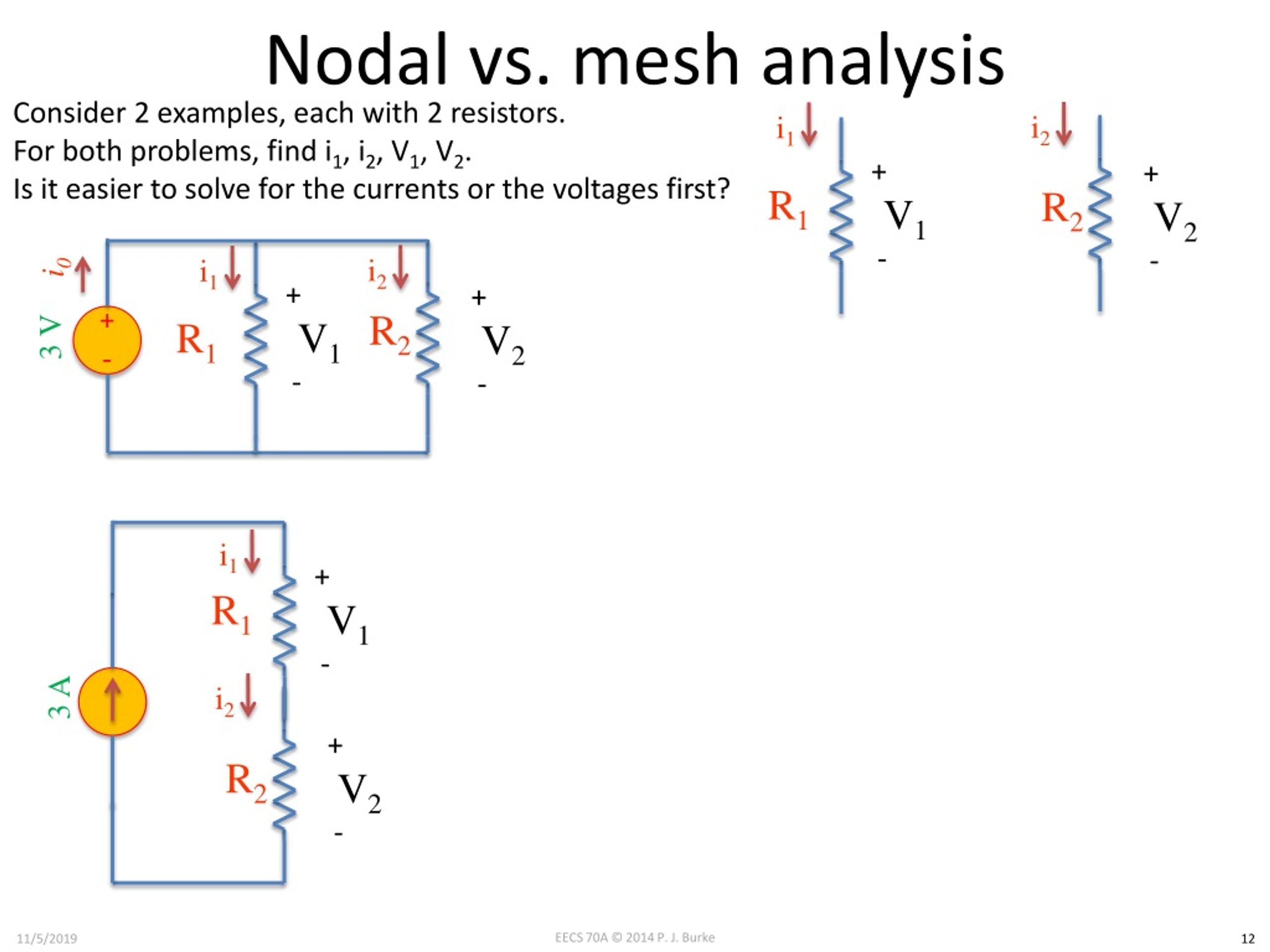
Circuit on the Left (Voltage Source):
- Count: It has 3 nodes (top, middle, bottom). If we pick the bottom as reference, that's 2 nodal equations. It has 2 meshes, so that's 2 mesh equations. It's a tie.
- Shortcuts/Complications:
- Nodal: The voltage source is not connected to the reference node, so it creates a supernode between the top and middle nodes. We would have one KCL equation for the supernode and one constraint equation from the voltage source: .
- Mesh: There are no current sources. We would simply write two standard KVL equations.
- Decision: Mesh analysis is more direct. It involves two standard KVL equations, while nodal analysis requires setting up a supernode.
Circuit on the Right (Current Source):
- Count: It has 2 nodes (top and bottom). If we pick the bottom as reference, that's 1 nodal equation. It has 2 meshes, so 2 mesh equations.
- Shortcuts/Complications:
- Nodal: We just need to write one KCL equation at the top node. The current source value will appear directly in this equation. Very simple.
- Mesh: The current source is shared between the two meshes, requiring a supermesh. We would have one KVL equation around the supermesh and one constraint equation from the current source: .
- Decision: Nodal analysis is dramatically more efficient. It requires solving only one equation, whereas mesh requires solving a system of two and involves a supermesh.
The Deeper Connection: The Principle of Duality
Your preference for abstract, logical systems will find the concept of duality in circuits interesting. Nodal and mesh analysis are not just two random methods; they are mathematical duals. They are mirror images of each other, reflecting a fundamental symmetry in the laws of electromagnetism.
This duality means that for every concept in one method, there is a corresponding concept in the other.
| Nodal Concept | Dual Mesh Concept |
|---|---|
| Node | Mesh |
| KCL | KVL |
| Voltage | Current |
| Voltage Source | Current Source |
| Series | Parallel |
| Resistance () | Conductance () |
| Open circuit | Short circuit |
| Reference Node | Outer Mesh |
Understanding this symmetry helps explain why our strategic rules work. A voltage source connected to the reference node simplifies nodal analysis. Its dual action is a current source on the perimeter (part of the outer mesh), which simplifies mesh analysis. A "floating" voltage source (between two non-reference nodes) creates a supernode. Its dual is a current source between two inner meshes, which creates a supermesh.
For a deeper dive into this fascinating symmetry, the following paper argues for a revised mesh analysis procedure to make the duality even more explicit. You don't need to absorb the whole method, but reading the introduction will solidify your understanding of this elegant relationship.
Turning Mesh Analysis Inside Out
This academic paper, 'Turning Mesh Analysis Inside Out,' explores the deep symmetry between nodal and mesh analysis. Reading the introduction will give you a strong conceptual appreciation for the principle of duality.
Read the 'Introduction' section of the paper. Focus on the discussion of duality and the side-by-side comparison of the procedural steps for nodal and mesh analysis. Notice how the authors point out the asymmetry in the standard textbook approach and why that obscures the underlying dual relationship.
Conclusion
You are now equipped not just to use nodal and mesh analysis, but to use them wisely. Choosing the right method is the first step in solving a complex circuit problem efficiently. It's a diagnostic skill that transforms you from someone who just follows procedures into an analytical problem-solver.
Key Takeaways:
- Your primary goal is to minimize the number of simultaneous equations you need to solve.
- Start by comparing the number of equations: for nodal vs. for mesh.
- The most important step is to look for "shortcuts":
- Nodal: Voltage sources connected to ground give you a node voltage for free.
- Mesh: Current sources on a perimeter branch give you a mesh current for free.
- Avoid supernodes and supermeshes if a simpler alternative exists.
- The choice between methods is a direct consequence of the principle of duality that connects voltage/current, nodes/meshes, and KCL/KVL.
Preview of the Next Lesson:
With your mastery of systematic analysis consolidated, we will now apply these skills to several classic and important circuit configurations. In the next lesson, we will begin by analyzing the Wheatstone bridge, a circuit fundamental to measurement and sensor applications. You will see how the principles you've just learned allow you to understand and solve these more advanced network topologies.