Recommended resources
The freely available resources this lesson will direct you to.
- Resources I used during my Early JEE Prep📚 | What Books I Used and How did I Use Them🤔www.youtube.com
- The Ultimate Study Material Review for JEE (Main & Adv.) | Allen vs FIITJEE vs Reso...(PART 1)www.youtube.com
- iesc1ps.pdfncert.nic.in
- Best Book for JEE Main Chemistry | Physical, Organic & Inorganic | Must-Have Books for Class 11, 12 & Dropperscompetishun.com
Hello! This course will help you turn a large collection of hand-me-down material into a usable study system while you strengthen chemistry and keep pace with your current mathematics, physics, and biology topics. We begin with the chemistry shelf. Before deciding which book to study, you need a reliable way to tell what each book is for.
Today you will classify resources on four separate axes: syllabus level, topic coverage, difficulty, and intended use. That distinction matters when you are in Grade 9 but already have material written for later JEE preparation. A book can be valuable without being the right book for this week. Allow about 35–40 minutes, including the short resource visits and a first pass through your own materials.
A cover tells you where to look, not what you can learn from it
Consider the six covers below. Three are subject textbooks marked Class XI; two advertise chapter-wise previous-year questions; one advertises daily practice problems. Those labels give you useful first clues, but they do not show how clearly a chapter explains atomic structure, which prerequisites it assumes, or how difficult its first exercise is.
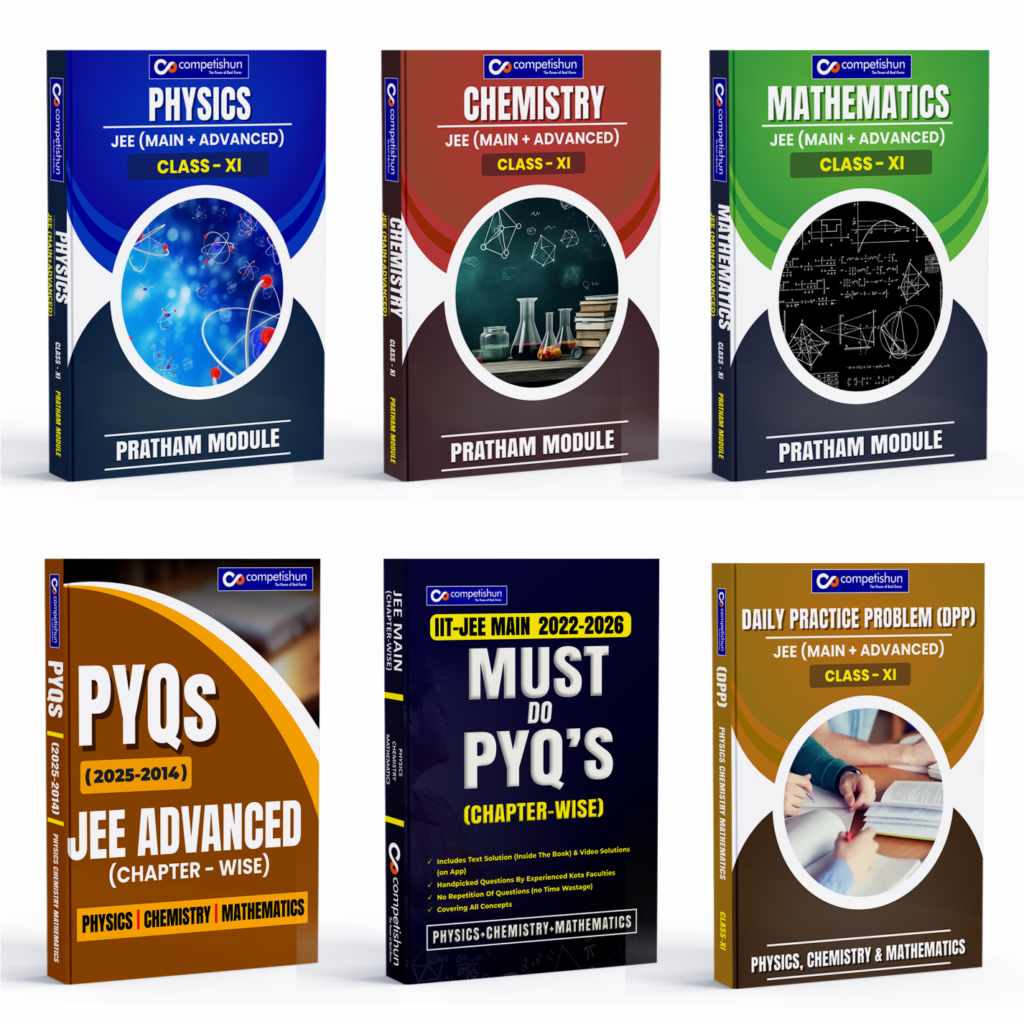
This is the first rule of resource classification: record what you can verify, and mark what you can only infer. “Class XI” is evidence of the stated syllabus level. “Advanced” on a cover is a claim about the intended exam, not proof that every question inside is advanced. Even within one chemistry book, the introductory examples and final exercises may belong in different difficulty bands.
For each resource, inspect a specific chapter, not just the book as a whole. Atomic Structure is an efficient starting point because it is part of your current chemistry work. Later, you can repeat the same inspection for Chemical Bonding.
The four labels to record
Think of each label as answering a different question. Keeping them separate prevents a common mistake: calling a resource “too advanced” when only its final exercise is too advanced, or calling it “complete” because it has many pages.
| Axis | Question to ask | Evidence to inspect |
|---|---|---|
| Syllabus level | Which stage is this material written for? | Stated grade or exam, chapter headings, and assumed prerequisites |
| Topic coverage | Which parts of the topic does it actually include? | Contents page and the chapter’s subsection headings |
| Difficulty | What can you do independently at the start, middle, and end? | A solved example and a few questions from each exercise tier |
| Intended use | What kind of studying is it designed to support? | Amount of explanation, examples, drills, past-paper questions, or brief summaries |
Syllabus level is not the same as difficulty. A Grade 11 atomic-structure chapter may begin with accessible definitions and finish with demanding numerical problems. Label its level “Grade 11/JEE foundation” if that is what the book states; label the parts you sampled separately as introductory, intermediate, or challenging. Use “not yet checked” rather than guessing.
Coverage needs finer detail than a chapter title. “Covers Atomic Structure” is a start, but “covers atomic number, isotopes, and electron arrangement; quantum numbers not found in the inspected chapter” is more useful. Do not conclude that something is absent from an entire series until you have checked its contents or index.
Intended use describes the material’s design, not your final study plan. A textbook with explanations and worked examples is suited to learning concepts. A problem booklet supplies independent practice. Chapter-wise previous-year questions show how examined questions are phrased; a concise summary helps you revisit material you have already learned. One resource can support several uses, but its layout usually makes some uses easier than others. In the next lesson, you will decide which overlapping resource gets which role in your own plan.
Compare a school-level foundation with later chemistry material
Start with the contents and front matter of a secondary-school science textbook. It provides an example of how to verify coverage and intended use without attempting the whole book.
Read the textbook’s contents and explanation of its chapter features to see how a foundation resource signals both topic coverage and depth.
Near the front, inspect “Contents”: note Chapter 5, “Exploring Mixtures and their Separation” (p. 72); Chapter 8, “Journey Inside the Atom” (p. 140); and Chapter 9, “Atomic Foundations of Matter” (p. 162). Then, in “About this Book” (pp. vii–viii), read the chapter approach, paying attention to activities, self-assessment, and solved examples. Continue to “Threads of Curiosity” (pp. viii–ix) and read the extension note. Notice that an occasional advanced box does not change the level of the whole book.
From the contents alone, you can identify likely coverage relevant to your chemistry foundations: mixtures and two chapters about atoms and matter. The front matter tells you more about intended use: explanations, activities, questions for self-assessment, and some solved numerical examples support initial learning. The “Threads of Curiosity” boxes offer extensions, but it would be misleading to classify the entire textbook as advanced because those boxes exist. You would inspect Chapter 8 itself before claiming that it covers every atomic-structure idea in your current course.
Now contrast that with a guide aimed at later JEE Main chemistry. It sorts material by physical, organic, and inorganic chemistry and distinguishes theory, problem books, and optional references.
Read this Competishun guide as an example of resource categories, not as a shopping list or a rule that you must finish every named book.
Under “Best Books for Physical Chemistry (JEE Main),” find “For Theory: NCERT + Class Notes” and read the theory comparison. Then go to “Best Books for Inorganic Chemistry (JEE Main).” Read the practice distinction. Finally, glance at the table under “Complete Book List: JEE Main Chemistry (Section-Wise)” to see how it separates theory, problems, and optional reference. Focus on those categories rather than its strong recommendations or score claims.
There is a useful idea here, independent of any particular author’s book choices: a source of theory and a source of harder problems solve different needs. The guide discusses Class 11–12 JEE study; it is not telling you to replace your present school-level foundations with every book it names. You already have substantial material, so classification comes before adding anything.
A student’s account of early JEE preparation offers another perspective. Treat it as an example of selective use, not a schedule you need to copy.
Resources I used during my Early JEE Prep📚 | What Books I Used and How did I Use Them🤔
Watch “Resources I used during my Early JEE Prep” by Shubham Kumar for how one student used different chemistry materials at different stages, then relied increasingly on course modules.
Watch chemistry materials: notice the distinction between rereading explanations, using modules for a topic, and attempting selected problem-book chapters. Then watch the later shift: focus on why an existing module can reduce the need to pursue every separate book. These are personal choices, not universal rankings of the resources you own.
The three resources illustrate different things: a school textbook’s structure, a JEE-oriented guide’s categories, and one learner’s choices under time constraints. None can tell you the difficulty of your particular edition of a hand-me-down module. That requires a small inspection of the copy in front of you.
Make a first-pass catalogue of your chemistry shelf
Use 8–10 minutes, not an entire afternoon, for a first pass. Select only four to six items: your current chemistry notes or module, a school science textbook, one older chemistry text, and a few other chemistry booklets you are most likely to open. Leave physics and mathematics books out of this chemistry catalogue; they belong to their own subjects even if they sit in the same pile.
For each item, note the edition or year if visible and fill in four short fields. Here is what evidence-based entries look like; the second row is deliberately marked provisional until its pages are checked.
| Resource inspected | Syllabus level | Topic coverage | Difficulty observed | Intended use suggested by layout |
|---|---|---|---|---|
| School science textbook, from its contents and front matter | Secondary-school foundation | Mixtures; chapters on atoms and matter | Not sampled inside the chapters | Initial explanations and self-assessment |
| Class XI chemistry module, from its cover only | Stated Class XI/JEE | To verify: find Atomic Structure in contents | Not yet checked | To verify: inspect theory, examples, and exercises |
| Chapter-wise previous-year-question book, from its cover only | Stated JEE exam practice | To verify: inspect chapter list | Not yet checked | Past-question practice, rather than a first explanation of a topic |
To replace those “to verify” notes, open the Atomic Structure chapter and inspect three places:
- Contents or headings: Which of your current subtopics appear? For example, can you locate isotopes, electron arrangement, or quantum numbers? Record only what you find.
- An explanation and worked example: Could you follow the example with your present knowledge, or does it assume ideas you have not studied? This helps distinguish an approachable starting section from one to revisit later.
- Questions from different positions: Compare an early exercise question with a later one. If the book names exercise levels, record its labels, but also note your own observation. “Early examples accessible; last section not yet accessible” is more informative than “hard book.”
Keep the catalogue brief enough that it fits alongside your existing work. A 45-minute additional study slot should normally be for learning and practice, not repeated rearrangement of resources. This first inventory is worthwhile because it prevents the larger waste of beginning several overlapping books without knowing what each contains. You also do not need to complete all the material you possess by the end of Grade 10 to benefit from it; some of it is meant for a later stage.
What you should now be able to see
A useful resource label has four parts: who the material is written for, what it covers, how difficult its sampled sections are, and what its format is designed to help you do. Covers and recommendations offer clues; chapter headings, explanations, and questions provide stronger evidence. When evidence is missing, write “not yet checked” rather than turning a guess into a plan.
Next, you will use this catalogue to handle overlap: deciding which resource should be your main explanation, which should supply practice, and which can wait as a revision or reference source.