Recommended resources
The freely available resources this lesson will direct you to.
Hello — this revision module has two aims: first, becoming precise with how sets are written and compared; then, using those sets in Venn diagrams. This lesson focuses on the language underneath everything else: listing a finite set correctly, and choosing between “is an element of” and “is a subset of.”
By the end, you should be able to turn a description such as “odd numbers from 1 to 10 inclusive” into a set, and confidently decide whether statements using , , , and are true.
1. Sets are collections with clear membership rules
A set is a collection of objects that satisfy a clear rule. The objects in a set are its elements.
For a maths test, a useful question is always:
Can I decide clearly whether a particular object belongs in this collection?
For example, “factors of 12” is a clear set: a number either divides 12 exactly or it does not. But “nice numbers” is not clear enough, because different people could disagree.
Sets & Symbols in Math | Roster Method + Set-Builder Notation [Animated] - Pre-Algebra
Watch “Sets & Symbols in Math | Roster Method + Set-Builder Notation [Animated]” by Teach Me Animated Math for a quick visual introduction to sets, elements, and subsets.
Watch roster notation to see how elements are listed inside curly brackets. Then watch membership and subsets, focusing on the difference between an object belonging to a set and a smaller set being contained in a larger one.
Roster notation: listing the elements
For a finite set — one with a limited number of elements — list every element inside curly brackets:
This is read: “ is the set whose elements are 1, 3, 5, 7, and 9.”
When translating a written description into roster notation:
- Identify the rule.
- Work through the possible values carefully.
- Include endpoints only if the wording tells you to, especially with the word inclusive.
- Put each element in curly brackets, separated by commas.
- Do not repeat elements.
| Description | Reasoning | Roster notation |
|---|---|---|
| Odd numbers from 1 to 10 inclusive | Start at 1, finish at 10; keep odd values | |
| Prime numbers less than 10 | A prime has exactly two factors | |
| Factors of 12 | Numbers that divide 12 with no remainder | |
| Letters in the word SETS | Repeated letters only appear once |
The order does not matter in a set:
Also, repetition does not create extra elements:
Still, in a test, list numbers in increasing order where possible. It is easier for both you and the examiner to check.
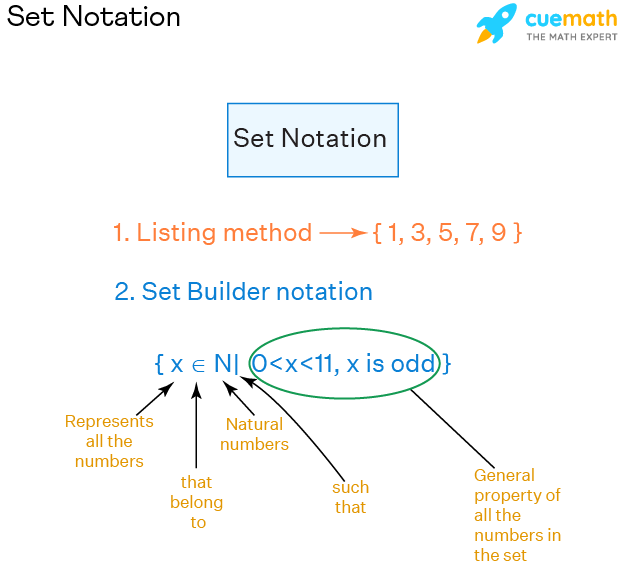
The image also shows set-builder notation, a compact way of stating a rule. For example, its lower expression describes the odd natural numbers greater than 0 and less than 11. The equivalent roster form is:
For the current test skill, work from the description to this explicit listed form.
Read the opening part of “Sets and Venn Diagrams” from the Australian Mathematical Sciences Institute. It reinforces the rules of roster notation and explains why order and repeated elements do not affect a set.
In the section “Describing and naming sets,” read from the opening explanation. Continue through the examples of listed sets, then read the paragraphs explaining that order does not matter and repeated entries are ignored. Finish at Exercise 1; do not worry yet about the later material on finite and infinite sets.
2. Membership: and
The symbol means “is an element of” or “belongs to.”
The symbol means “is not an element of” or “does not belong to.”
Suppose:
Then:
is true because 3 is written in the set.
is true because 9 is not written in the set.
The item on the left of or is usually a single object: one number, one letter, or one name.
For instance, if
then:
but
Read the set before answering
Do not decide from the name of the set alone. First write the elements, then check.
For example:
Write the set:
Now it is easy to see:
Although 17 is between 10 and 20, it is prime, not composite.
3. Subsets: and
A subset is a set whose elements all belong to another set.
The symbol
means “is a subset of.”
The symbol
means “is not a subset of.”
Return to “Sets and Venn Diagrams” for the formal definition of a subset. The key idea is that every element of the smaller set must occur in the larger set.
Find the section “Subsets and Venn diagrams,” then the subsection “Subsets of a set.” Read from the definition and numerical example. Continue through the next paragraph on “not a subset,” paying attention to the fact that one missing element is enough to show that a subset statement is false.
Let:
Then:
is true. Every element of appears in .
But:
is true, because 7 is not in . You only need one counterexample to prove that something is not a subset:
The key distinction: an element is not the same as a subset
This is one of the most common set-test mistakes.
Using the same set,
compare these statements:
This is true because 4 is an individual number listed in .
This is true because the expression on the left is itself a set, and all of its elements occur in .
Now look at:
This is true. The elements of are individual numbers, not little sets such as .
A helpful test rule is:
- If the left-hand side is a single number, letter, or person, think or .
- If the left-hand side is written with curly brackets, it is a set, so think or .
For ordinary first-year questions involving sets of numbers, this rule prevents most symbol errors.
A subtle but useful example
Suppose:
All three statements below say different things:
They are all true.
- is an element of .
- The set containing only 3 is a subset of .
- But the set is not itself an element listed inside .
4. Two special subset facts
There are two statements that are always true:
Every set is a subset of itself, because every element of is certainly in .
Also:
The symbol means the empty set, a set with no elements. It is a subset of every set.
However, do not confuse that with membership:
is usually false unless the empty set has actually been listed as an element of .
5. A test-ready method
When you see a statement about sets, use this short method.
-
Translate any written description into roster notation.
This avoids guessing whether an object belongs. -
Look at the left-hand side of the symbol.
A single object suggests membership. Curly brackets suggest a subset relationship. -
For or , check one object.
Is it on the list? -
For or , check every element of the smaller set.
One element missing from the larger set proves . -
Write the complete mathematical statement.
Do not just write “true” if the question asks for a symbol.
Here is a worked example.
Let be the set of digits in the number 2024:
Then:
The last statement is the one to pause over: is an element of , but the one-element set is not listed as an element of .
For revision before Tuesday, make a compact symbol box on paper:
| Symbol | Read it as | What to check |
|---|---|---|
| is an element of | Is this one object in the set? | |
| is not an element of | Is this one object absent? | |
| is a subset of | Are all elements of the left-hand set in the right-hand set? | |
| is not a subset of | Can I find at least one missing element? |
Wrap-up
A finite set is written by listing each distinct element once inside curly brackets. Order does not change the set, but neat ordering makes your work clearer.
The essential symbol distinction is:
When checking a subset, every element must fit; one missing element is enough to prove it is not a subset.
Next, you will use these same listed sets in Venn diagrams to find unions, intersections, and complements.