Recommended resources
The freely available resources this lesson will direct you to.
- How to Calculate Nominal GDP, Real GDP, and GDP Deflatorwww.youtube.com
- Real GDP and nominal GDP | GDP: Measuring national income | Macroeconomics | Khan Academywww.youtube.com
- Macroeconomics: GDP, GDP Deflator, CPI, & Inflationlearningcentre.vcc.ca
- Chapter 4.2: Nominal vs. Real GDP - CUNY Pressbooks Networkpressbooks.cuny.edu
Introduction
Welcome back. In our last two lessons, we established two different ways to calculate an economy's Gross Domestic Product (GDP): the expenditure approach (summing all spending) and the income approach (summing all income). Both methods give us the total monetary value of all final goods and services produced in a specific period.
However, consider this: if GDP in one year is $1,000 and the next year it's $1,200, did the economy actually produce 20% more stuff? Not necessarily. The increase could simply be due to a rise in prices—a phenomenon known as inflation. To be a useful measure of actual economic growth, we need a way to separate the change in production from the change in prices.
This lesson directly addresses that challenge. Our goal is to distinguish between nominal GDP and real GDP and compute the GDP deflator. By the end of this lesson, you will be able to:
- Define nominal GDP and real GDP.
- Calculate real GDP to measure an economy's output adjusted for inflation.
- Calculate and interpret the GDP deflator as a measure of the overall price level.
1. The Problem with Prices: Nominal vs. Real GDP
Let's start by building an intuitive understanding of why simply comparing the dollar value of GDP across different years can be misleading.
Real GDP and nominal GDP | GDP: Measuring national income | Macroeconomics | Khan Academy
This Khan Academy video uses a simple, one-good economy (apples) to clearly illustrate how price changes can distort our perception of economic growth. It introduces the core idea of measuring one year's output using another year's prices to get a 'real' measure of production.
Watch the video from the beginning until 07:30. Focus on the distinction Sal Khan makes between growth in dollar terms and growth in the actual quantity of apples produced.
As the video demonstrates, we need to differentiate between two types of GDP:
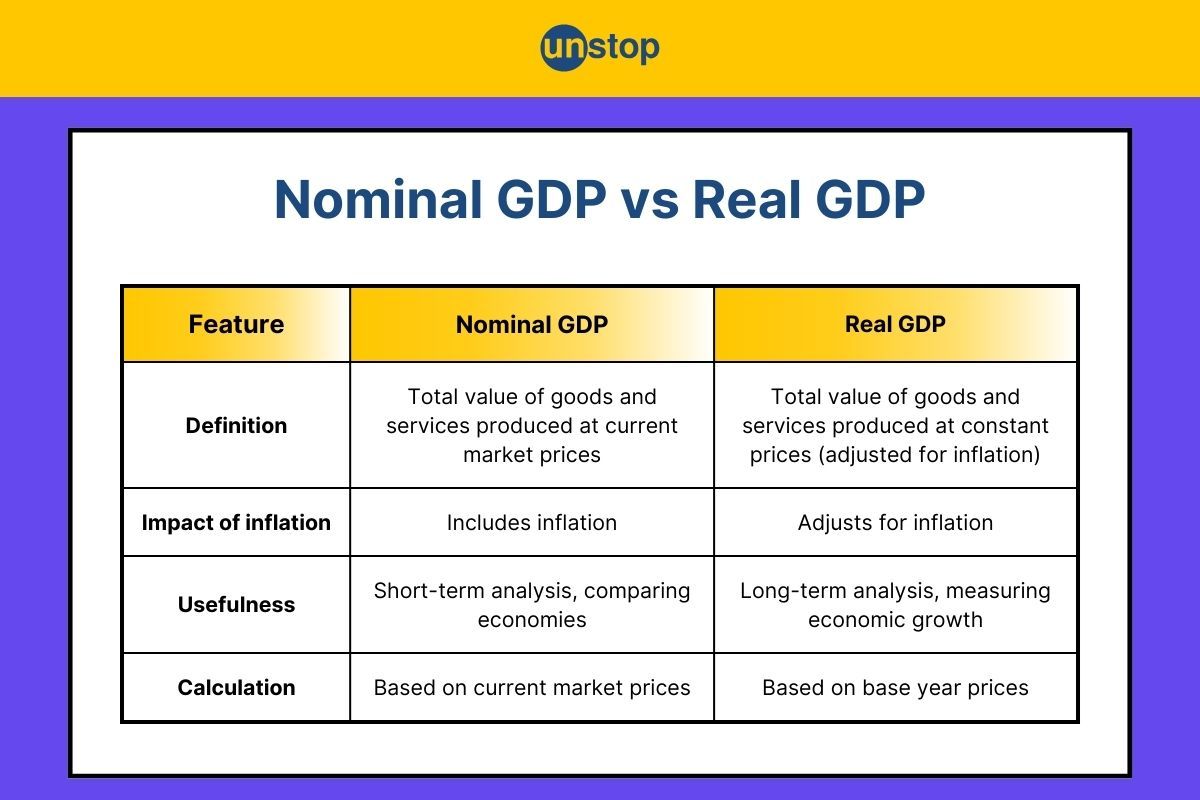
- Nominal GDP: The value of goods and services produced in a given year, measured using that year's current prices. It is calculated as the sum of
(Current Quantity of Good i) × (Current Price of Good i)for all goods. This is what we have been calculating in previous lessons. - Real GDP: The value of goods and services produced in a given year, measured using the prices of a specific base year. This adjustment removes the effect of price changes, allowing us to see how the actual quantity of output has changed. It is calculated as the sum of
(Current Quantity of Good i) × (Base Year Price of Good i).
By holding prices constant, Real GDP provides a more accurate measure of an economy's actual change in production.
This table provides a concise summary of the key differences.
2. Calculating Nominal and Real GDP
Now let's apply these definitions to a slightly more complex economy with multiple goods. Your technical background should make these calculations straightforward. The key is to be careful about which year's prices you are using.
How to Calculate Nominal GDP, Real GDP, and GDP Deflator
This video from 'Economics in Many Lessons' provides a direct, step-by-step guide to calculating both nominal and real GDP from a table of price and quantity data.
Watch the video from 00:13 to 02:53. Pay close attention to which prices and quantities are used for each calculation. Notice that for the base year (2019 in this example), nominal GDP and real GDP are identical.
Let's recap the process from the video:
To calculate Nominal GDP for a given year:
For each good, multiply the quantity produced in that year by the price in that same year. Then, sum the values for all goods.
To calculate Real GDP for a given year (using a base year):
For each good, multiply the quantity produced in that year by the price from the base year. Then, sum the values for all goods.
An important rule to remember is that in the base year, nominal GDP always equals real GDP. This is because the "current" prices are, by definition, the "base year" prices.
3. Measuring the Price Level: The GDP Deflator
We've seen that nominal GDP reflects changes in both output and prices, while real GDP reflects changes in output only. This relationship allows us to isolate the change in prices. The tool we use for this is the GDP deflator.
The GDP deflator is a price index that measures the average level of prices of all final goods and services produced in an economy. It is calculated by comparing nominal GDP to real GDP.
The formula is:
Let's continue with the video you just watched to see how this calculation is done.
How to Calculate Nominal GDP, Real GDP, and GDP Deflator
The final part of the same video demonstrates how to calculate the GDP deflator for each year using the nominal and real GDP values you just learned to compute.
Watch from 02:32 to 03:57. Notice that the GDP deflator is always 100 for the base year, which follows logically from nominal GDP being equal to real GDP in that year.
Interpreting the GDP Deflator:
- In the base year: The GDP deflator is always 100.
- If the deflator is greater than 100: This means the average price level has risen since the base year (inflation). For example, a deflator of 110 means prices have increased by 10% on average since the base year.
- If the deflator is less than 100: This means the average price level has fallen since the base year (deflation).
4. Applying the Concepts with Real Data
The GDP deflator isn't just a theoretical tool; it's used by economists and statistical agencies like the Bureau of Economic Analysis (BEA) to analyze economic data. The formula can also be rearranged to find real GDP if you know the nominal GDP and the price index.
This next resource will walk you through how to apply this formula using actual U.S. economic data.
Chapter 4.2: Nominal vs. Real GDP
This textbook chapter, 'Nominal vs. Real GDP', explains the formula for converting nominal GDP to real GDP using the deflator and provides a detailed worked example with real U.S. data.
Read the sections titled 'Converting Nominal to Real GDP', 'Work It Out', and the subsequent section that discusses the relationship between nominal and real GDP over time. Pay special attention to the table in the 'Work It Out' section, which shows the step-by-step calculation of real GDP from nominal GDP and the deflator for various years.
The graph in that reading, which plots U.S. nominal and real GDP on the same chart, is particularly insightful. It visually demonstrates how inflation, especially during periods like the 1970s, caused nominal GDP to grow much faster than real GDP.
5. Practice Your Skills
Let's test your understanding with a short exercise. Use the formulas we've covered to fill in the missing values.
Problem:
The table below provides nominal and real GDP data for a hypothetical country for three years. The base year is 2008.
| Year | Nominal GDP (billions) | Real GDP (billions) | GDP Deflator |
|---|---|---|---|
| 2008 | $864.5 | $864.5 | ? |
| 2009 | $882.6 | $851.9 | ? |
| 2010 | $923.4 | $875.1 | ? |
Instructions:
- Calculate the GDP deflator for 2008, 2009, and 2010. Round your answers to the nearest whole number.
- Based on your calculations, did this country experience inflation or deflation between 2008 and 2010?
(This problem is adapted from the practice sheet provided by the VCC Learning Centre, resource ID LINK.)
Click here for the solution.
Solution:
-
Calculating the GDP Deflator:
- 2008: ($864.5 / $864.5) × 100 = 100. (As expected for the base year).
- 2009: ($882.6 / $851.9) × 100 ≈ 103.6 = 104.
- 2010: ($923.4 / $875.1) × 100 ≈ 105.5 = 106.
Completed Table:
| Year | Nominal GDP (billions) | Real GDP (billions) | GDP Deflator |
|------|------------------------|---------------------|---------------|
| 2008 | $864.5 | $864.5 | 100 |
| 2009 | $882.6 | $851.9 | 104 |
| 2010 | $923.4 | $875.1 | 106 | -
Interpretation:
Since the GDP deflator increased from 100 in 2008 to 106 in 2010, the country experienced inflation. The average price level rose by approximately 6% over this two-year period. Notice that in 2009, nominal GDP rose, but real GDP actually fell, indicating a recession masked by inflation.
Conclusion
In this lesson, we've made a crucial refinement to our understanding of GDP. While nominal GDP gives us the market value of an economy's output, it's real GDP that tells us if the economy is actually producing more goods and services over time.
Key Takeaways:
- Nominal GDP measures economic output using current prices, making it susceptible to distortion from inflation.
- Real GDP measures output using constant prices from a base year, providing a more accurate gauge of economic growth.
- The GDP Deflator is a price index derived from nominal and real GDP. It measures the overall change in the price level of all goods and services produced in an economy.
- The formula connecting them is:
GDP Deflator = (Nominal GDP / Real GDP) × 100.
Preview of the Next Lesson:
We now have a robust tool for measuring an economy's real output. But does a higher real GDP automatically mean a country's citizens are better off? In our next lesson, we will critically evaluate the limitations of GDP as a measure of economic well-being, exploring what this important statistic leaves out.