Recommended resources
The freely available resources this lesson will direct you to.
- How to Create a Realistic Digital Transformation and Software Implementation Project Planwww.youtube.com
- Initiating A Project – Part 1/5 (Intro to Implementation/Project Management)www.youtube.com
- The Complete Guide to Customer Lifecycle Management: Key CS ...www.planhat.com
- Introduction to the Success by Design framework - Dynamics 365 | Microsoft Learnlearn.microsoft.com
Hello again. In the previous lesson, we separated delivery ownership from the decisions and approvals that belong to other teams. Now we can place those responsibilities on a timeline. What happens between a signed contract and a deployment that has live data, working access, and an ongoing owner?
This lesson gives you a reusable map of that journey. The aim is not to memorize a fixed sequence of meetings. It is to recognize what each stage must establish before the deployment can safely move forward—and why “the integration works” is not, by itself, the end of onboarding.
Start with a journey, not a build list
An enterprise onboarding usually has several paths moving at once: technical setup, customer approvals, data preparation, user readiness, and delivery decisions. A phase map helps you see how those paths come together. It also stops a common mistake: treating the date when configuration finishes as the date when the customer is ready to operate.
Start with this short video segment on project initiation.
Initiating A Project – Part 1/5 (Intro to Implementation/Project Management)
Watch “Initiating A Project – Part 1/5” from Max Mao for the connection between a signed agreement and the internal transfer of delivery context.
Watch initiation and handoff. Notice the distinction between having an agreement to reference and knowing enough about stakeholders, scope, and expectations to begin customer work.
For the rest of the journey, use Planhat’s enterprise onboarding guide. Its eight steps provide a useful spine, while its checklist makes the customer’s contributions and each phase’s exit condition visible.
The Complete Guide to Customer Lifecycle Management: Key CS ...
Read Planhat’s eight-step process to see how delivery extends from commercial handoff through live use and transfer to the ongoing team.
Under “The customer onboarding and implementation process: 8 steps,” read Steps 1–8. Begin in “Step 1: The sales-to-services handoff” at the phase descriptions, ending with the final paragraph of “Step 8: The services-to-customer-success handover.” Then read the “Customer onboarding checklist,” from the checklist introduction and table; stop before “What to define before the checklist is useful.” Focus on what the customer supplies and what would demonstrate that a phase is complete. Treat the proposed checklist as a model to adapt, not as a required procedure for every organization.
For your prospective role, the eight steps can be grouped into seven landmarks. This is a map of changing questions, not a rule that every activity must finish before the next begins.
| Landmark | The question you need to answer |
|---|---|
| Signed contract and internal handoff | What was agreed, what remains an assumption, and what context must delivery inherit? |
| Kickoff, discovery, and planning | What does the customer need to achieve, what must be built, and who will supply or approve each prerequisite? |
| Implementation | Can the agreed data, integration, identity, and workflow design be made to work? |
| Validation and launch readiness | Does it work correctly and acceptably, and are the customer and support arrangements ready? |
| Go-live | Has production use begun under a controlled, verified launch decision? |
| Hypercare | Is the live deployment stable while real use exposes problems that setup could not reveal? |
| Handoff | Can ongoing owners support the customer without relying on the onboarding engineer’s memory? |
Planhat lists customer collaboration, approvals, and enablement as separate steps. In practice, you should expect them to run through several landmarks. An approval might be needed to obtain a sample during discovery, authorize a data treatment during implementation, and accept the result before launch. User enablement may begin before validation is fully complete, while final readiness depends on users being able to carry out their intended work.
From contract to a plan both sides can act on
A signed contract gives the project a commercial starting point. It does not guarantee that the technical approach, customer owners, or operational meaning of every field is already known. The first transition is therefore an internal handoff: collect the agreed scope, intended outcome, relevant promises, known constraints, stakeholders, and unresolved questions before asking the customer to repeat the sales process.
Kickoff then establishes how the two teams will work together. You are trying to align on the intended first use, responsibilities, major dependencies, decision routes, and an initial rhythm for resolving open questions. Discovery goes deeper. For a sensitive operational-data deployment, it may need to establish which systems hold the records, how data can be accessed, who can explain its meaning, what handling restrictions apply, who will use the results, and what the customer must approve. Detailed methods for eliciting those answers come later in the course; here, notice their place in the journey.
The output is an executable shared understanding, not simply a completed meeting. At this point you should be able to describe the intended deployment, distinguish confirmed facts from questions, name the owners of immediate prerequisites, and show how the next stage will be judged. If a source system or data owner is still unknown, that may be acceptable—but it must be visible as an unresolved dependency, not hidden inside a confident implementation date.
The order can vary. Some discovery happens before a formal kickoff; new findings may alter the plan afterward. A good phase map accommodates that iteration. What matters is that the team does not quietly turn an untested sales assumption into an implementation commitment.
From implementation to an evidence-based launch decision
Implementation is where agreed choices become working configuration and connections. In this kind of role, that may include receiving files or connecting to an API, mapping and migrating historical records, configuring identity access, and applying approved treatment to sensitive fields. These tasks are familiar engineering work, but their completion depends on customer actions: access, representative data, field interpretations, identity-provider configuration, and decisions about permitted use.
Validation begins before all building ends. An early sample can reveal that a field has a different meaning than expected; an identity test can expose a missing customer-side setting. Finding those problems early allows the plan to change while there is still room to do so. A later, broader validation asks whether the whole agreed deployment is suitable for launch: whether records arrive and are transformed as intended, authorized users can perform relevant workflows, exceptions are understood, and required approvals are in place.
This creates an important distinction:
- A technical test establishes that a particular behavior works under stated conditions.
- Customer acceptance establishes that the agreed behavior meets the customer’s intended use.
- Launch authorization establishes that the remaining risks, operational arrangements, and timing are acceptable to the people empowered to make that decision.
No one of these substitutes automatically for the others. For example, a successful historical load does not settle whether missing records are acceptable; a user logging in does not prove that their permissions are appropriate; and a target launch date does not replace a readiness decision.
Training and operational preparation belong here too. Intended users need a way to learn their workflows, and the teams responsible for live operation need monitoring, support routes, and a response if the launch does not behave as expected. We will examine validation and cutover in detail later. For now, retain the boundary: implementation produces a candidate deployment; validation and readiness establish whether it should become a live one.
Go-live is a transition; hypercare tests whether it holds
At go-live, the agreed production workflow becomes active. The immediate concern is not merely whether a switch was flipped, but whether the deployment behaves as expected under real conditions: data arrives, authorized users can get in, important outputs are usable, and someone is watching for failures. The team should know who makes the launch decision, who verifies the result, and what would trigger a pause or reversal.
A deployment can be live before it has demonstrated first value. Users might have access and a healthy data feed but not yet have enough relevant information or familiarity to use the results for the intended purpose. Conversely, a convincing demonstration on test data is not evidence of a functioning production service. Keeping these distinctions visible prevents a premature declaration of success.
Hypercare is a time-bounded period of closer attention after launch. Real data volumes, schedules, and user behavior can expose issues that controlled tests did not. The onboarding team may monitor more actively and provide a faster route for investigating problems while the service stabilizes. Hypercare should have an understood support route and an exit condition; otherwise “we’ll keep an eye on it” can become indefinite, informal ownership.
Finally, handoff transfers the deployment into normal operation and the ongoing customer relationship. That transfer includes more than a completion notice. The receiving owners need to know how the integration operates, where failures become visible, whom to contact on each side, which decisions and approvals were made, what remains open, and what expectations were set with the customer. Some of this transfer should begin before go-live so that support is not learning the system for the first time after an incident.
Handoff is complete when the ongoing owners can act on the context, not merely when they have been sent it. If material problems remain, they need named owners and an explicit route to resolution; they should not disappear into the phrase “handed over.”
Compare phase names without losing the underlying path
Organizations package this journey differently. Microsoft’s Success by Design framework, for example, uses five broad phases rather than Planhat’s eight steps. Read its phase descriptions as a second way to group the work, not as a procedure you must adopt.
Introduction to the Success by Design framework - Dynamics 365 | Microsoft Learn
Read Microsoft Learn’s five phase descriptions to see how a broader implementation framework groups discovery, building, launch preparation, and live operation.
In “Success by Design phases,” begin with the phase overview. Read the “Discover,” “Initiate,” “Implement,” “Prepare,” and “Operate” subsections through the opening paragraph of “Operate.” Focus on each phase’s purpose; you can pass over the product-specific and AI-first considerations between those descriptions.
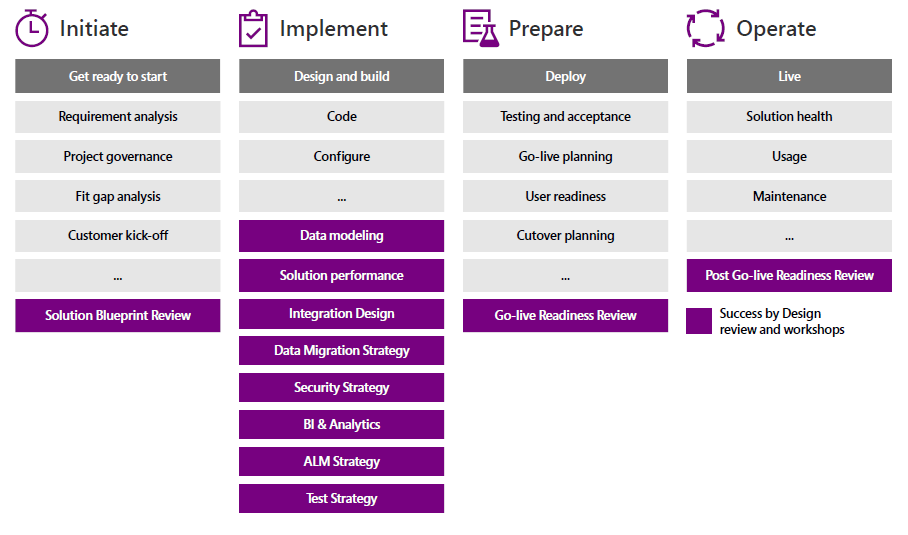
In that broader vocabulary, your kickoff and discovery work spans much of Discover and Initiate; technical delivery occupies Implement; testing, approvals, and launch planning come together in Prepare; and stabilization after launch belongs to Operate. The mappings are approximate because the frameworks draw their boundaries differently. Neither removes the need to identify the signed commitment at the start or to transfer usable context to ongoing owners at the end.
This is the portable lesson behind the labels: at each transition, ask what has changed, what evidence supports moving forward, who has authority to accept it, and who owns what happens next. Those questions give you a structured path even when a customer’s project is compressed, delayed, or partly overlapping.
Key takeaways
The typical onboarding path runs from commercial handoff, through kickoff and discovery, implementation, validation and readiness, go-live, hypercare, and handoff to ongoing ownership. Each landmark resolves a different uncertainty. Working software is necessary, but it does not replace customer acceptance, launch readiness, stable live operation, or a usable handoff.
You now have the overall journey and the major ownership boundaries. In the next lesson, we will look across that journey at its parallel workstreams—commercial, technical, data, security, organizational, and adoption—so that important work does not vanish behind a single “implementation” status.