Recommended resources
The freely available resources this lesson will direct you to.
- How to form and use the futur simple in French: easy animated video explanation w practice workwww.youtube.com
- The FUTUR SIMPLE = will in English // French conjugation course // Lesson 31www.youtube.com
- Le futur simple: the future tense in Frenchfrancais.lingolia.com
- Learn French Conjugation: Detailed Guide With Chartswww.busuu.com
Bonjour! Welcome to our new module. We've just finished our deep dive into expressing negation, learning how to form and interpret a wide range of negative sentences. This is a crucial skill for understanding nuance in French.
Today, we pivot from the past and present to the future. Our goal is to form the futur simple for regular and common irregular verbs from example patterns. This tense is the French equivalent of "will do" in English and is essential for discussing future plans, making predictions, and telling stories. You may have already encountered the futur proche (e.g., je vais manger - "I am going to eat") through your comprehensible input. The futur simple offers another, very common way to express future actions.
Let's begin by discovering the core pattern.
The Basic Pattern: Infinitive + Endings
The good news is that for most verbs, forming the futur simple follows a very straightforward pattern. Instead of dropping an ending to find a stem, you start with the entire infinitive of the verb.
Have a look at this image which breaks down the conjugation for parler (to speak).
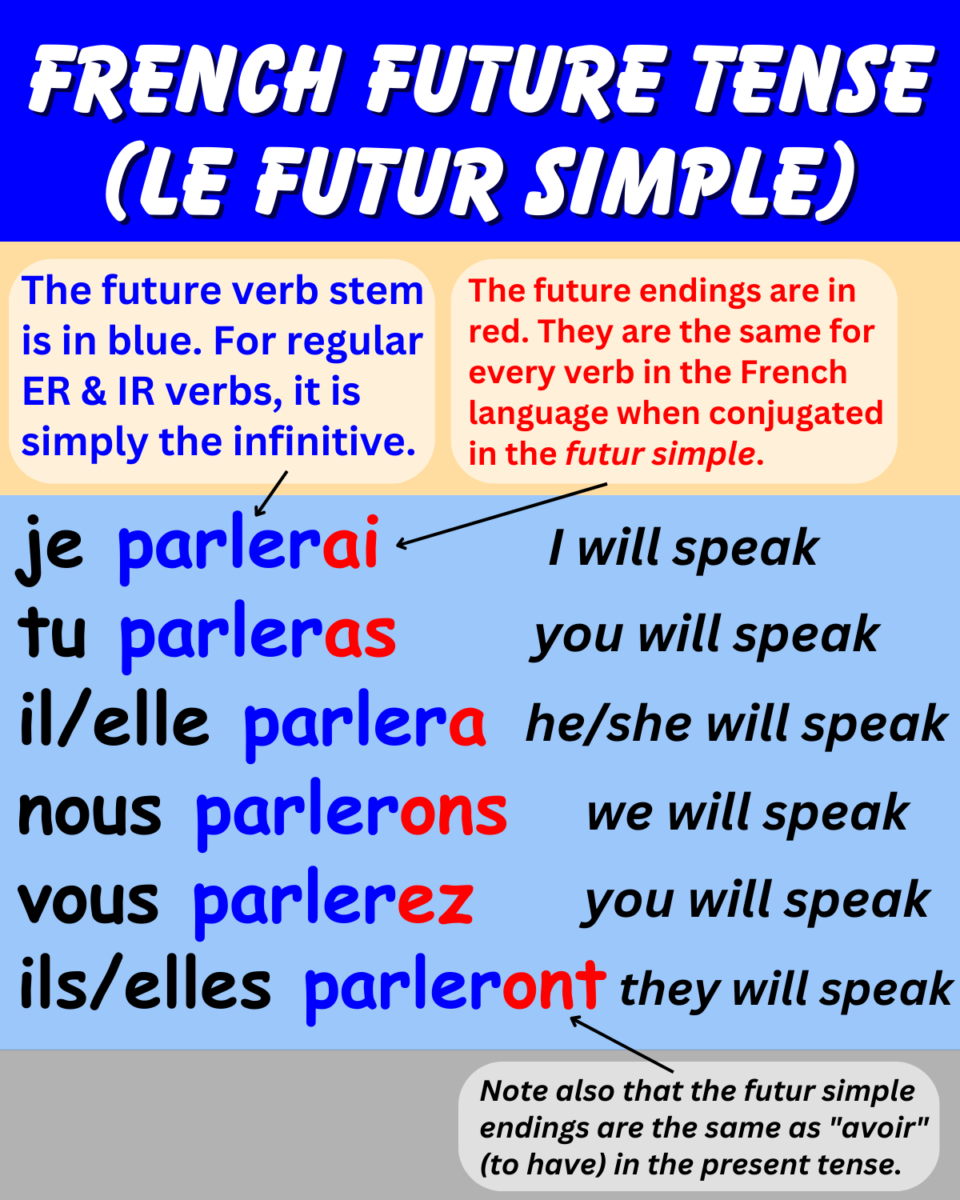
As you can see, the process is: Infinitive + Future Ending.
The endings are the same for all verbs in the futur simple:
- je:
-ai - tu:
-as - il/elle/on:
-a - nous:
-ons - vous:
-ez - ils/elles:
-ont
You might notice these endings look very similar to the present tense conjugation of the verb avoir (j'ai, tu as, il a, nous avons, vous avez, ils ont). This can be a helpful mnemonic.
This pattern holds true for all regular -er and -ir verbs. Let's solidify this with a few more examples.
Le futur simple: the Future Tense in French - Lingolia Français
The article 'Le futur simple' from Lingolia provides very clear conjugation tables that illustrate this pattern. We will focus on the formation of regular verbs first.
Please read the section 'How to conjugate the futur simple in French'. Focus on the first table that shows the conjugation for '-er verbs' (aimer) and '-ir verbs' (finir). Notice how the infinitive remains intact before the ending is added.
A Small Twist: Verbs Ending in -re
Verbs ending in -re follow a nearly identical pattern, with one small adjustment. Look at the chart below and see if you can spot the difference in the stem for attendre (to wait).
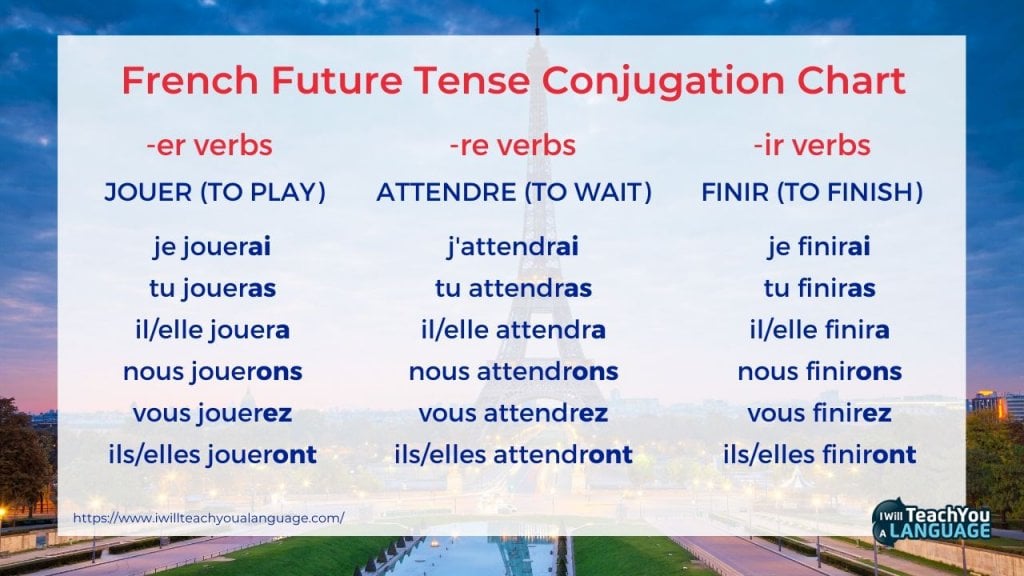
Did you notice it? For -re verbs, you remove the final -e from the infinitive before adding the same set of future endings.
attendre->attendr-+ai->j'attendraivendre->vendr-+a->il vendrarépondre->répondr-+ons->nous répondrons
This is the only variation for regular verbs.
Common Irregular Verbs
As with most tenses, some of the most frequently used verbs are irregular. However, they still follow a pattern: they use a special, irregular stem, but attach the same future endings (-ai, -as, -a, -ons, -ez, -ont).
Your preference for breaking down complex topics is wise here. Instead of learning a long list, we will focus on the four most essential irregular verbs: être (to be), avoir (to have), aller (to go), and faire (to do/make).
Learn French Conjugation: Detailed Guide With Charts
The article 'Learn French Conjugation' from Busuu has excellent, separate tables for these key irregular verbs, which makes them easier to digest.
Please scroll to the section titled 'Irregular verbs'. Study the four conjugation charts provided for 'Être', 'Avoir', 'Aller', and 'Faire'. For each verb, identify the irregular stem used for the 'Futur simple' and notice how the endings remain consistent.
Let's summarize the irregular stems you just saw:
| Infinitive | Irregular Stem | Example (with je) |
|---|---|---|
| être | ser- |
je serai (I will be) |
| avoir | aur- |
j'aurai (I will have) |
| aller | ir- |
j'irai (I will go) |
| faire | fer- |
je ferai (I will do/make) |
By focusing on learning these new stems, you can form the future tense for these critical verbs just as you would for regular ones.
Practice Activity
Let's apply these patterns. Complete the following sentences by conjugating the verb in parentheses into the futur simple.
- Demain, nous ___________ (manger) au restaurant. (Tomorrow, we will eat at the restaurant.)
- Tu ___________ (finir) tes devoirs plus tard. (You will finish your homework later.)
- Pour mon anniversaire, j'___________ (avoir) beaucoup de cadeaux. (For my birthday, I will have many gifts.)
- La semaine prochaine, elle ___________ (aller) à la plage. (Next week, she will go to the beach.)
- Ils ___________ (vendre) leur maison. (They will sell their house.)
- Vous ___________ (être) surpris par la nouvelle. (You will be surprised by the news.)
- Je ___________ (faire) une promenade ce soir. (I will take a walk this evening.)
Solutions
- mangerons
- finiras
- aurai
- ira
- vendront
- serez
- ferai
Conclusion
Excellent work today. You have learned the fundamental patterns for forming one of the most important tenses in French.
Key Takeaways:
- The futur simple is generally formed by adding the endings
-ai, -as, -a, -ons, -ez, -ontto the verb's infinitive. - For verbs ending in
-re, you must drop the final-ebefore adding the future endings. - Common irregular verbs like
être(stem:ser-),avoir(stem:aur-),aller(stem:ir-), andfaire(stem:fer-) use unique stems but the same set of endings.
Preview of the Next Lesson:
Now that you can form the futur simple, our next lesson will focus on when to use it. We will distinguish between the futur simple (for more distant or certain future events) and the futur proche (for near-future events or intentions), helping you choose the correct tense in any situation.