Recommended resources
The freely available resources this lesson will direct you to.
Introduction
Welcome to the third lesson in our course. In our last session, we developed a diagnostic toolkit based on the principles of cognitive load and attention conflict. You learned to analyze your feelings of overwhelm, your tendency towards busywork, and the high cost of context switching through the lens of cognitive science, pinpointing the impact of extraneous load and attention residue.
Today, we shift from diagnosis to strategy. The goal of this lesson is to learn how to categorize your tasks using a prioritization framework to identify high-leverage activities. This is the critical first step in designing a work system that respects your cognitive limits. Instead of reacting to the demands on your attention, you will learn to proactively identify the work that truly matters, setting the stage for protecting it. We'll explore two powerful, complementary frameworks: Cal Newport's Deep vs. Shallow Work and the Pareto Principle (80/20 Rule).
Defining the Spectrum: Deep vs. Shallow Work
Let's start by establishing a clear vocabulary for the different kinds of work you do. The concepts of "Deep Work" and "Shallow Work," popularized by computer science professor Cal Newport, provide a powerful lens for this.
To get a more formal definition and understand the fundamental value proposition, please watch this short video.
Deep Work by Cal Newport (animated book summary) - How to work deeply
This animated summary of Cal Newport's book offers a clear and concise introduction to the core concepts of Deep and Shallow work. It lays the groundwork for everything we'll discuss today.
Watch the beginning of the video, from 00:08 to 01:29. Focus on the precise definitions provided for both Deep and Shallow Work.
As the video explains:
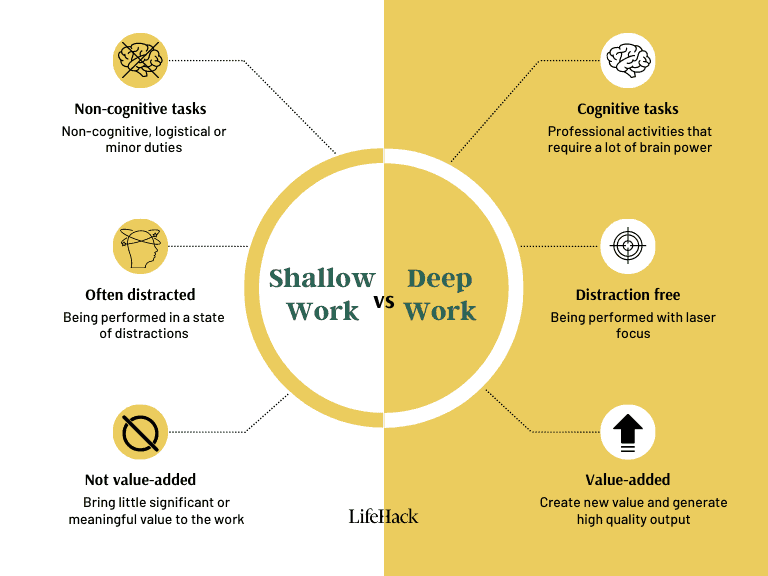
- Deep Work: Professional activities performed in a state of distraction-free concentration that push your cognitive capabilities to their limit. These efforts create new value, improve your skill, and are hard to replicate.
- Shallow Work: Non-cognitively demanding, logistical-style tasks, often performed while distracted. These efforts tend not to create much new value and are easy to replicate.
Your experience with "busywork" is a direct encounter with the lure of shallow work. Now, let's connect this back to our last lesson. A key reason shallow work is so detrimental to productivity is its relationship with attention residue.
Watch this next segment from the same video, which explains the connection.
Deep Work by Cal Newport (animated book summary) - How to work deeply
This clip explains the concept of 'attention residue,' which you'll recognize from our last lesson. It demonstrates why even a quick glance at a shallow task (like email) can impair your ability to perform deep work.
Watch from 01:29 to 02:33. Pay attention to how the video illustrates the cognitive cost of switching away from a deep task, even for a moment.
This leads to a simple but powerful equation for productivity:
Shallow work, by its nature, is performed at a low intensity of focus. It often involves multitasking and distraction, which, as we've seen, creates attention residue and contaminates the periods you set aside for high-intensity deep work. By categorizing and separating these work types, you can better protect the "Intensity of Focus" variable in this equation.
The "Why": The Value of Deep Work and the Lure of the Shallow
Given your interest in the underlying reasons for these strategies, it's worth exploring why this distinction is so critical in today's economy and why our work environments naturally pull us toward the shallow end.
The Ultimate Guide To Deep Work
This guide to 'Deep Work' provides an excellent summary of Newport's arguments. It explains both the economic value of deep work and the psychological and organizational forces that make shallow work so prevalent.
Please read two main sections from this guide: Start with the heading 'Deep Work is Valuable' and read until you reach 'Deep Work is Rare'. This section discusses who succeeds in the modern economy and introduces the concept of attention residue. Next, read the section 'Deep Work is Rare'. Focus on the four reasons provided for the prevalence of shallow work: the Metric Black Hole, the Principle of Least Resistance, Busyness as a Proxy for Productivity, and the Cult of the Internet.
The article highlights a crucial paradox: while deep work is becoming more valuable, environmental and psychological pressures constantly push us toward shallow, low-value tasks. "Busyness as a proxy for productivity" is a particularly strong trap—it feels good to be visibly active, even if that activity isn't generating meaningful results. Recognizing this is the first step toward consciously choosing depth over shallowness.
Frameworks for Identifying Your High-Leverage Activities
Knowing the definitions is one thing; applying them to your complex workload is another. How do you objectively determine what is deep and what is shallow in your own work? And how do you identify the tasks that give you the greatest return on your focused effort? Here are two practical frameworks.
1. The Deep Work Heuristic
A task's depth isn't always obvious. Is preparing a client presentation deep or shallow? What about debugging a tricky piece of code? Cal Newport provides a useful heuristic to cut through this ambiguity.
The Ultimate Guide To Deep Work
Let's return to 'The Ultimate Guide To Deep Work' for a practical tool. This section offers a single, powerful question to help you quantify the depth of any activity.
Please read the subsection titled 'Quantify the Depth of Every Activity'. It's located within 'Rule #4: Drain the Shallow'. Focus on the evaluative question it proposes.
The question is: "How long would it take (in months) to train a smart recent college graduate with no specialized training in my field to complete this task?"
Activities that would require a long training period are, by definition, deep. They rely on your unique, hard-won expertise. Activities that a recent graduate could learn quickly are shallow.
2. The 80/20 Rule and the Leverage Test
The Deep/Shallow framework is primarily about cognitive demand and skill. The Pareto Principle, or 80/20 Rule, offers a complementary perspective focused on results. It posits that for many outcomes, roughly 80% of the results come from 20% of the effort. Your goal is to identify and focus on that vital 20%.
The 80/20 Rule of Productivity: Focus on What Matters
This article explains how to apply the 80/20 rule to personal productivity. It provides a structured way to move beyond just feeling busy and identify the specific actions that create disproportionate value.
First, read the introduction and the section 'What Is the 80/20 Rule of Productivity?' to grasp the core concept. Then, jump to the section 'A Framework for Identifying High-Leverage Activities' and focus on the '4-question leverage test'.
The article introduces a 4-Question Leverage Test to identify your 20% tasks. For any given task, ask:
- Impact: If I did more of this, would results increase disproportionately?
- Uniqueness: Is this something that only I (with my specific skills and role) can do?
- Repeatability: Can this produce compounding benefits (e.g., create a system, build a valuable relationship, generate a reusable asset)?
- Alignment: Does this task directly advance my most important goals?
High-leverage activities are those that get a "yes" on most or all of these questions.
Application: Conduct a Task Audit
Now, let's put these frameworks into practice. This exercise is the core of today's lesson. Take about 15-20 minutes to audit your own work.
-
List Your Tasks: Open a notebook or a document and list 10-15 distinct tasks you've worked on in the past week. Be specific. Instead of "client work," write "Drafting the project proposal for Client X" or "Answering client emails." Include a mix of everything: core project work, administrative tasks, meetings, etc.
-
Apply the Frameworks: Create a table with your tasks. For each task, answer the following questions in the columns:
| Task | Deep or Shallow? (Newport's Heuristic) | Impact? | Uniqueness? | Repeatability? | Alignment? | High-Leverage? (Your judgment) |
|---|---|---|---|---|---|---|
| e.g., Drafting Q3 strategy | Deep (12+ months) | Yes | Yes | Yes | Yes | Yes |
| e.g., Formatting presentation | Shallow (1 month) | No | No | No | No | No |
| e.g., Weekly team sync | Shallow (2 months) | Maybe | No | Yes | Yes | Maybe |
| e.g., Investigating a new tech stack | Deep (8 months) | Yes | Yes | Yes | Yes | Yes |
- Identify Your 20%: Review your completed table. Circle or highlight the tasks you marked as "High-Leverage." Do these tasks align with what you consider to be your most important work? Are there any surprises? This list represents the 20% of efforts that likely drive 80% of your results. These are the tasks that deserve your most protected, focused time.
From Identification to Action: The 4D Method
Once you've identified your high- and low-leverage tasks, the final step is to decide what to do with them. A simple but effective model for this is the 4D method.
- Do: Your high-leverage, deep work activities. These are your top priority.
- Defer: Important work that can be scheduled for a later time.
- Delegate: Necessary but low-leverage tasks that someone else could do.
- Delete: Low-impact, low-value tasks that can be eliminated entirely.
Look at the tasks you classified as "Shallow" and "No" on the leverage test. For each one, consider if it can be deferred, delegated, or deleted. This act of sorting is the bridge between identifying what's important and actually making time for it.
Conclusion
In this lesson, we moved from analyzing your challenges to building a strategic framework for action. You now have a robust system for evaluating any task on your plate.
Key Takeaways:
- Work can be categorized on a spectrum from Deep (cognitively demanding, high-value, hard to replicate) to Shallow (non-demanding, low-value, easy to replicate).
- The 80/20 Rule provides a results-oriented lens, helping you identify the 20% of activities that generate 80% of your desired outcomes.
- You can use practical heuristics like the "college grad" test and the 4-question leverage test to objectively classify your work.
- Categorizing your tasks allows you to strategically Do, Defer, Delegate, or Delete, which is the first step toward taking control of your schedule.
Preview of the Next Lesson:
Identifying your deep, high-leverage work is a crucial step, but it's meaningless if you don't have the time and focus to actually execute it. In our next lesson, we will address exactly that. You will learn to apply timeboxing and calendar blocking to schedule your prioritized tasks and protect time for deep work. We will take the "Do" list you've started building today and learn how to build a fortress of focus around it on your calendar.