Recommended resources
The freely available resources this lesson will direct you to.
- HOW TO APPLY FOR MEDICINE IN AUSTRALIA (2022) | UCAT, pathways, UAC applications, medical interviewswww.youtube.com
- What Happens After Medical School (Australia)www.youtube.com
- How to become a surgeon - The University of Sydneywww.sydney.edu.au
- Fellowship Training in Australia and New Zealand - Anzastanzast.org
Last lesson, you separated the roles of paramedics, emergency physicians, nurses, general surgeons, and trauma surgeons during a major injury. Now we will zoom out from the trauma bay and map the long Australian pathway that can eventually lead to trauma-focused surgical practice.
This is a long journey, but it is made of understandable stages. Your job in Year 8 is not to plan every detail perfectly. It is to understand the map, recognise the important milestones, and keep future options open.
The overall pathway: a map, not a stopwatch
In Australia, a trauma surgeon is first a doctor, then a trained surgeon, and then usually develops additional expertise in trauma care. Trauma surgery is not normally the first surgical specialty chosen straight after medical school.
Here is the broad sequence:
- Finish secondary school and meet entry requirements for a medical degree.
- Complete medical school and graduate as a doctor.
- Work as an intern in hospital under supervision.
- Gain general medical registration and work as a resident doctor.
- Build surgical experience and successfully enter accredited surgical training.
- Complete General Surgery training and gain Fellowship of the Royal Australasian College of Surgeons, known as FRACS.
- Develop advanced trauma expertise through trauma-focused posts and, for some surgeons, a formal trauma fellowship program.
- Practise independently as a specialist surgeon with trauma responsibilities.
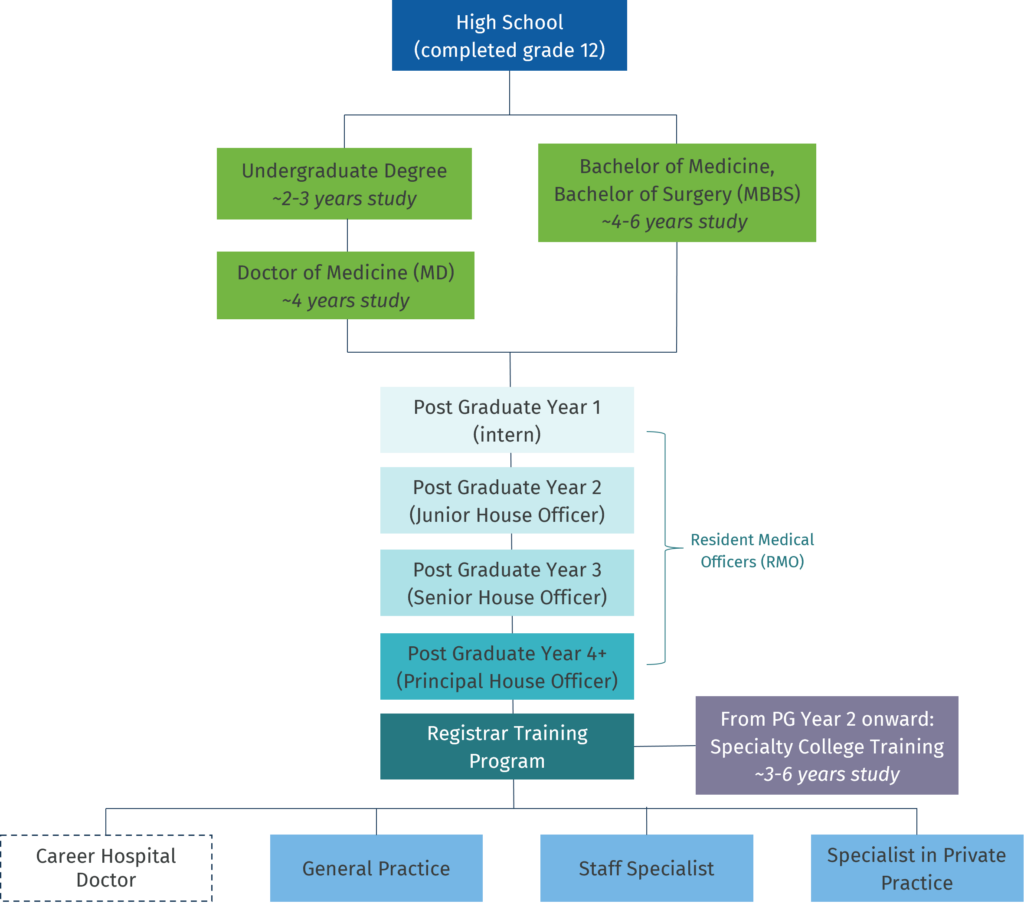
The diagram is useful as a big-picture guide, but it simplifies some important details. For example, getting into surgical training is competitive, and trauma surgery usually builds on General Surgery rather than being a separate first specialty from medical school.
A good way to remember the pathway is:
| Stage | The main question being answered |
|---|---|
| School | “Can I enter a medical course?” |
| Medical school | “Can I graduate as a doctor?” |
| Internship and residency | “Can I practise safely as a hospital doctor and explore surgery?” |
| Surgical training | “Can I become an independently qualified surgeon?” |
| Trauma-focused training and work | “Can I lead and provide specialist care for severely injured patients?” |
Stage 1: secondary school and entry to medicine
Your first formal milestone is completing Year 12. For now, the most important goal is to build strong learning habits and keep science and mathematics options available. In South Australia, this will later mean making thoughtful SACE subject choices, which you will investigate in the next module.
There are two broad ways students enter medicine in Australia.
Route A: direct-entry medicine
Some universities accept students from Year 12 directly into an undergraduate medical program. The degree may have a name such as Bachelor of Medical Studies/Doctor of Medicine or Bachelor of Medicine/Bachelor of Surgery. It commonly takes around five to six years, although course structures vary.
Route B: graduate-entry medicine
Other students first complete a different undergraduate degree, often over three years, and then apply for a four-year Doctor of Medicine program. The first degree can be in science, health, arts, engineering, or another area, depending on the university’s rules. A science-related degree can be helpful preparation, but it is not the only possible starting point.
Neither route makes someone “more of a doctor” than the other. Both lead to graduating from medical school. They simply organise the years before graduation differently.
At the time you apply, universities may consider a combination of:
- school results or later university grades;
- an admissions test;
- an interview;
- eligibility pathways, such as rural, equity, or Aboriginal and Torres Strait Islander entry pathways.
The exact requirements can change, so a Year 8 student should avoid treating today’s test or score rules as permanent. What lasts is the need for solid academic skills, communication, persistence, and the ability to learn responsibly.
Stage 2: medical school — learning to become a doctor
Medical school teaches students the science, practical skills, communication, ethics, and clinical judgement needed to begin working as doctors. Early study includes subjects such as anatomy, physiology, infection, medicines, and how body systems work. Later, students spend increasing time learning in hospitals, general practices, and other health services.
Medical school does not turn someone straight into a trauma surgeon. It provides the foundation required for every medical specialty.
How to become a surgeon - The University of Sydney
Read the University of Sydney’s overview to see how medical qualification, residency, and surgical fellowship fit together. It uses one university’s pathway as an example, while the overall stages apply broadly across Australia.
In the section “How do I qualify as a surgeon?”, begin with the first two stages. Notice the distinction between graduating from medical school, completing internship, and then working in residency. Then continue to the Fellowship section, focusing on why hospital rotations, skills courses, research, and assessments are part of surgical training.
One important clarification: the University of Sydney example describes a three-year undergraduate degree followed by a four-year Doctor of Medicine. That is one route, not the only Australian route. A direct-entry medical degree can have a different length.
Stage 3: internship — the first paid year as a doctor
After medical school, a graduate begins work as an intern, usually called a Postgraduate Year 1 doctor, or PGY1. An intern is a real doctor employed by a hospital, but works with close supervision and clear limits on responsibility.
Interns rotate through hospital areas such as:
- medical wards;
- surgical wards;
- emergency departments;
- other required clinical placements.
During this year, they learn what hospital work is really like: reviewing patients, writing notes, communicating with families and staff, ordering tests under supervision, and recognising when a senior doctor must be called. After meeting internship requirements, doctors can move from provisional registration toward general registration with the Medical Board of Australia.
This is a key safety milestone. A person is not expected to become an expert immediately after graduation; they grow gradually, with supervision and increasing responsibility.
What Happens After Medical School (Australia)
Watch Dr Syl’s “What Happens After Medical School (Australia)” for a doctor’s overview of the hospital stages after graduation. The useful focus here is the difference between intern, resident, registrar, fellow, and consultant.
Watch the intern year to understand PGY1 and hospital rotations. Continue with residency choices, noting that doctors can explore possible career directions rather than having every decision fixed immediately. Then watch registrar training and the senior stages. Focus on the terms “unaccredited,” “accredited,” “fellow,” and “consultant”; ignore the salary discussion, which is not relevant to mapping the pathway.
Stage 4: residency — building experience before specialist training
After internship, doctors usually work as resident medical officers, often shortened to residents or RMOs. These are postgraduate years after the intern year.
A resident doctor interested in surgery may seek jobs that provide relevant experience, such as surgical ward rotations, emergency care, intensive care, anaesthetics, or surgical research. They may also learn practical skills, attend courses, find mentors, and gradually build a record that supports a future application to surgical training.
It is important to understand that being a resident is not the same as being a surgical trainee. Residency is a period of broad clinical development and career exploration. Some doctors enter specialist training relatively quickly; others spend several extra years gaining experience before applying successfully.
That is normal. The pathway is competitive, and the number of training places is limited.
Stage 5: registrar work and General Surgery training
A registrar is a more senior hospital doctor. In surgery, there are two terms that can sound similar but mean very different things:
| Term | What it means |
|---|---|
| Unaccredited surgical registrar | A doctor works in a surgical registrar job but is not yet in the official college training program. The work builds experience, but the time does not necessarily count toward specialist-training requirements. |
| Accredited surgical registrar | A doctor has been selected into an official specialist training program. Their work, learning, assessments, and rotations count toward becoming a specialist. |
To become a general surgeon, doctors apply to the Royal Australasian College of Surgeons, or RACS, for Surgical Education and Training in General Surgery. This is often called the SET program.
Training includes working in accredited hospitals, learning from senior surgeons, operating with supervision, studying, completing skills courses, undertaking assessments, and passing examinations. It is paid employment, but it is also demanding professional training. The minimum accredited period is several years; surgical training programs commonly require at least five years, and the full time from medical-school graduation can be longer because entry itself is competitive.
A future trauma surgeon needs General Surgery because serious injuries often involve the abdomen, chest, blood vessels, and internal bleeding. Trauma surgeons must also understand the whole injured patient and coordinate closely with other surgeons, such as orthopaedic surgeons and neurosurgeons.
At the end of successful General Surgery training, a doctor may gain FRACS:
This Fellowship is the major professional qualification that marks someone as a fully trained specialist surgeon. They can then apply for specialist registration and practise independently within their surgical specialty.
Stage 6: becoming trauma-focused
Here is the most important detail for your specific career goal: trauma surgery in Australia commonly builds on General Surgery.
A general surgeon may treat trauma as part of their work, especially in regional hospitals or emergency general-surgery services. Some surgeons then complete additional trauma-focused training to become highly specialised in caring for severely injured patients.
The Australian and New Zealand Association for the Surgery of Trauma describes a formal Post Fellowship Education and Training, or PFET, program in Trauma Surgery. It is designed to build on General Surgery training.
Fellowship Training in Australia and New Zealand - Anzast
Read this explanation from the Australian and New Zealand Association for the Surgery of Trauma to see where dedicated trauma training sits after General Surgery. It is especially useful because it explains that trauma care is still widely provided by general surgeons, while some pursue more defined specialist trauma training.
In “Introduction,” read the program context. Then, under “Fellowship Training Explained,” read the two-year program description. Finally, in “Who is training open to?”, use the eligibility explanation to identify the abilities expected of a trauma surgeon: resuscitation, urgent surgical procedures, definitive care, and coordination with other specialties.
The PFET Trauma Surgery program is described as a two-year, full-time program. It includes more than operating. Trauma surgeons must be able to lead a trauma resuscitation, make time-critical surgical decisions, provide care before and after surgery, coordinate other specialists, and contribute to trauma systems.
This connects directly to the previous lesson. A trauma surgeon works within a team. Being the surgeon does not mean doing every task alone; it means taking responsibility for difficult surgical decisions and helping the team provide organised care.
What “independent practice” really means
The final destination is often described as becoming a consultant surgeon or staff specialist. This means the surgeon has completed their formal specialty qualification and can take overall responsibility for patients within their scope of practice.
An independently practising trauma-focused surgeon may:
- lead or contribute to trauma-team care;
- decide whether a patient needs emergency surgery;
- perform operations within their surgical specialty;
- supervise junior doctors and trainees;
- coordinate care with emergency physicians, anaesthetists, nurses, ICU teams, radiologists, and other surgical specialties;
- improve hospital trauma systems through teaching, research, audits, and leadership.
The exact job title varies. One hospital may advertise a “trauma surgeon”; another may employ a “general surgeon with trauma responsibilities.” Larger major-trauma centres and smaller regional hospitals can organise services differently.
So the most accurate career map is not:
Medical school, then trauma surgeon.
It is:
Medical school, then junior doctor years, then General Surgery training, then trauma-focused fellowship training and experience.
How long might it take?
It is sensible to think in stages, not to count down to one exact age. Still, the journey is long enough that you should understand its scale.
From finishing Year 12, a trauma-focused surgeon may complete:
| Part of pathway | Typical broad duration |
|---|---|
| Medical degree | About 5–6 years direct entry, or often about 7 years through a bachelor degree plus Doctor of Medicine |
| Internship | 1 year |
| Residency and preparation for surgical selection | Variable; often several years |
| Accredited General Surgery training | At least several years, commonly five or more |
| Formal trauma fellowship program, where undertaken | 2 years |
That means becoming a trauma-focused specialist commonly takes fifteen years or more after Year 12, sometimes longer. This is not a reason to feel discouraged. It reflects the level of responsibility: a trauma surgeon may need to make high-stakes decisions for patients with life-threatening injuries.
The pathway also contains useful checkpoints. You do not need to wait until the end to discover whether medicine or surgery suits you. At school, university, medical school, internship, residency, and registrar level, you learn more about your strengths and interests.
Your realistic Year 8 focus
You cannot yet apply to medical school or surgical training, but you can start building the habits that will matter at every later stage:
- Learn science for understanding, not just for memorising facts.
- Keep practising mathematics, reading, writing, and clear explanation.
- Build reliable study routines and ask for help early when a topic is difficult.
- Take care of sleep, wellbeing, friendships, and interests outside school. Medicine is demanding, and sustainable habits matter.
- Explore health careers with curiosity. Your aim may stay trauma surgery, or your understanding of the field may grow and change over time.
You do not need to be perfect, have every answer, or behave like a medical student now. A strong foundation in school is the appropriate next step.
Key takeaways
The Australian pathway to trauma-focused surgical practice has several major stages:
- Finish Year 12 and enter medicine through a direct-entry or graduate-entry route.
- Complete medical school and graduate as a doctor.
- Complete internship, then gain general medical registration.
- Work as a resident doctor and develop hospital and surgical experience.
- Enter accredited General Surgery training as a surgical registrar.
- Complete General Surgery training and gain FRACS, allowing independent specialist surgical practice.
- Develop advanced trauma expertise, often through trauma-focused work and potentially the two-year Trauma Surgery PFET program.
The main insight is that trauma surgery usually grows out of General Surgery, with extra trauma training and experience. In the next module, you will look much more closely at the medicine-entry routes available through Flinders University and Adelaide University, so this long-term map becomes more relevant to your own South Australian choices.