Recommended resources
The freely available resources this lesson will direct you to.
Hello! Welcome back to our project to build a secure ThinkPad.
In our last lesson, we established that the proprietary, closed-source UEFI firmware on your x230 is a "black box" that represents a significant security risk. We learned that its high privilege, persistence, and lack of verifiability make it a prime target for sophisticated adversaries, undermining the entire system's chain of trust.
Today, we delve deeper. We will uncover a second, even more powerful and opaque computer that lives inside your laptop's chipset: the Intel Management Engine (ME). If the UEFI firmware is a black box, the ME is a locked safe inside that box. Understanding its function is a critical step in understanding the modern threat landscape and the rationale for our Coreboot project.
Our learning outcome for this lesson is to define the Intel Management Engine (ME) and explain its function as an autonomous subsystem within Intel chipsets.
This lesson should take approximately 60 minutes to complete.
1. Unveiling the "Computer-Within-a-Computer"
In the previous lesson, we focused on the firmware your main CPU executes to boot the system. However, since 2006, nearly every Intel-based computer contains another processor that runs a separate, secret operating system. This is the Intel Management Engine (ME).
It is not an exaggeration to call it a computer-within-a-computer. It is an autonomous subsystem designed to function completely independently of your main CPU and your operating system (Windows, Linux, etc.).
-
Action: To get a formal definition, please read the first two short sections of the following WikiChip article. Focus on what the ME is, where it's located, and its high-level purpose.
Management Engine (ME) - Intel (Management Engine Definition and Core Functions; ME Overview and Integration)
(Reading time: ~5 minutes)
As the article states, the ME is a microcontroller coprocessor integrated directly into your computer's chipset (in the case of the x230, this is the Platform Controller Hub or PCH). It has been present in virtually all Intel desktops and laptops for over a decade. Its primary, official purpose is to provide a set of advanced features for remote corporate asset management, platform security, and content protection.
Given your background in political philosophy, particularly Hayek's work, you can think of the ME as a form of "central planner" for the hardware. It operates with privileged information and control, separate from the "spontaneous order" of the main operating system and user activities.
2. The Architecture of the ME
To appreciate the ME's capabilities, we need to look at its internal architecture. It's not just a simple logic circuit; it's a full-fledged computing system.
The Components of Intel® Active Management Technology is a technical document from Intel that, while focused on a specific application of the ME (Intel Active Management Technology or AMT), gives us an unparalleled look inside.
-
Action: Please read the section "Intel® Manageability Engine (Intel ME)" in the document below, which includes a hardware architecture diagram. Don't worry about memorizing every component; focus on the fact that it has its own processor, caches, memory controller, and crypto engine.
The Components of Intel® Active Management Technology (Intel Manageability Engine (Intel ME) Internal Architecture)
(Reading time: ~10 minutes)
As you've just read, the ME subsystem on a machine like your x230 includes:
- A Processor: Originally a 32-bit ARC processor (as described in the document), and on more modern systems an x86-based Intel Quark core. This CPU is completely separate from your main Core i5/i7 CPU.
- An Operating System: The processor runs a real-time operating system (RTOS). Historically this was a proprietary OS called ThreadX; on more recent systems, it's a version of MINIX.
- Memory: The ME carves out a protected 16MB region of your main system RAM for its own use, which is made invisible to your OS by the hardware.
- Storage: The ME's firmware—its operating system and applications—is stored on the same SPI flash chip that holds the UEFI BIOS. It has its own protected partition on that chip.
- A Crypto Engine: A dedicated hardware block to accelerate cryptographic operations, used for security features and secure communication.
The following diagram provides a clear visual summary of the ME's internal software structure.
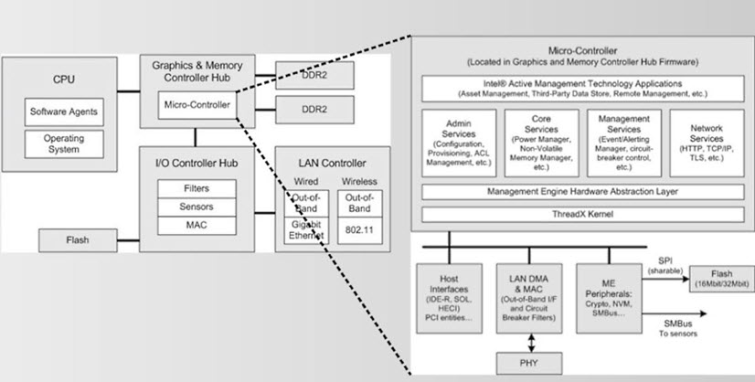
This diagram shows the ME's internal architecture. On the right, you can see the various software services (Networking, Management, Security) running on top of a kernel (ThreadX in this case), all within the ME subsystem, completely separate from the main OS.
3. The ME's Intended Functions
So, what does this powerful, hidden computer actually do? Its functions can be broadly grouped into three categories.
-
Action: Please read the "Mechanism" section of the WikiChip article, followed by a skim of the "Intel® ME Common Services" section (Tables 7.1-7.3) in the Intel document. This will provide an overview of the ME's vast capabilities.
Management Engine (ME) - Intel (ME Services and Network Access)
(Reading time: ~5 minutes)The Components of Intel® Active Management Technology (Intel ME Common Services)
(Skimming time: ~5 minutes)
The key functions are:
-
Remote Management: This is the ME's flagship feature, primarily sold as Intel® Active Management Technology (AMT). It allows an IT administrator to remotely access a computer to perform maintenance, install software, or even reinstall the OS, regardless of whether the computer is on or if the OS is functional. This requires the ME to have its own independent network stack.
-
Platform Security: The ME acts as a hardware root of trust for several security technologies.
- Intel Boot Guard: Verifies the cryptographic signature of the UEFI firmware before allowing the main CPU to execute it.
- Intel Platform Trust Technology (PTT): An implementation of a Trusted Platform Module (TPM) that runs inside the ME firmware, used for cryptographic key storage.
- Anti-Theft Technology (AT): A "kill switch" that allows a device to be remotely disabled if stolen.
-
Content Protection: The ME is used to enforce Digital Rights Management (DRM). For example, the Protected Audio Video Path (PAVP) ensures that high-definition content (like from a Blu-ray disc) travels through an encrypted path within the computer, preventing you from copying it.
4. The Heart of the Matter: Autonomy and Privilege
The most critical concept to grasp about the ME is its autonomy. It is designed to be completely independent and more privileged than any software on the main CPU, including the OS kernel and even System Management Mode (SMM), which we discussed in the last lesson.
-
Action: Read the "Mechanism" section from the WikiChip article and the "Network Access" and "Power Management" sections from the Intel document. Pay close attention to how the ME interacts with the network and how it operates in different power states.
Management Engine (ME) - Intel (ME Mechanism and Autonomy)
(Reading time: ~5 minutes)The Components of Intel® Active Management Technology (Network Access to Intel ME and Autonomous Operation; Intel AMT Power Management States and ME Operation)
(Reading time: ~10 minutes)
This reading highlights three pillars of the ME's power:
- Out-of-Band (OOB) Access: The ME has a direct, "out-of-band" connection to the network interface card (NIC). It can send and receive network packets without the knowledge or involvement of the main CPU or operating system. It can even have its own MAC and IP addresses.
- Power Independence: The ME is active as long as the motherboard has power (even standby power from the battery or wall adapter). It runs when your computer is in sleep (S3), hibernate (S4), or even "soft off" (S5). The Intel document refers to this as the "M1" state. This is how AMT can power on a machine remotely.
- Total Hardware Privilege: The ME has unfettered, direct memory access (DMA) to all of system RAM, and direct access to the SPI flash chip and other peripherals. It sits at a level of privilege that is, by design, superior to the main CPU.
This diagram helps visualize the ME's privileged position within the system architecture.

This diagram shows the ME (running its own OS on an x86 core) integrated into the Platform Controller Hub (PCH). Notice its separation from the main CPU and its direct connection to the system's core components and firmware flash chip. It is not a peripheral; it is part of the central nexus of the machine.
The combination of these three characteristics makes the Intel ME the most powerful and privileged component in a modern Intel system. It is a true autonomous subsystem.
5. Conclusion
In this lesson, we have defined the Intel Management Engine and explored its function. We've moved beyond the main UEFI firmware to an even deeper layer of the system.
Key Takeaways:
- The Intel Management Engine (ME) is an autonomous coprocessor—a "computer-within-a-computer"—integrated into the chipset of nearly all modern Intel machines.
- It runs its own dedicated processor, its own operating system (like MINIX), and uses its own protected region of RAM.
- Its intended functions include remote corporate management (AMT), platform security (Boot Guard), and DRM enforcement (PAVP).
- The ME's defining characteristic is its autonomy: it has out-of-band network access and remains operational even when the main computer is off, all while being invisible to the main OS.
- This autonomy is built on a foundation of extreme hardware privilege, with direct, unfettered access to system memory and peripherals.
Preview of the Next Lesson:
Now that we have a solid understanding of what the ME is and the immense power it wields, the next logical step is to ask: what are the implications of this? In our next lesson, we will analyze the security and privacy implications of the Intel ME, referencing known vulnerabilities and its potential as a backdoor. We will explore why this powerful, proprietary, and unauditable subsystem is considered by many in the security community to be a fundamental threat to user freedom and control.