Recommended resources
The freely available resources this lesson will direct you to.
Hello again. In the last lesson, you kept a clear core sentence and added one supported detail. Now the information comes in two separate note fragments. Your job is to decide how they relate, then say them as one coherent sentence.
This matters in Describe Image, Retell Lecture, and Summarize Group Discussion: your notes may be brief, but your spoken response needs to make the relationship clear. Today’s target is a connector you can choose quickly—not a memorized sentence pattern you have to force onto every prompt.
Decide what the notes mean together
Imagine your notes say:
enrolment up / tuition unchanged
Each fragment supplies a fact. Together, they show a contrast: one measure changed while the other stayed the same. You could say, “Enrolment rose, but tuition remained unchanged.”
The connector does more than fill a gap. But tells the listener how to interpret the second fact. Compare these common relationships:
| Relationship in the source | Useful connector | Spoken example |
|---|---|---|
| Two related facts | and | “The lecturer discussed solar power and wind power.” |
| A difference | but | “Enrolment rose, but tuition remained unchanged.” |
| A stated choice | or | “Participants could attend in person or online.” |
| A stated reason | because | “The harvest fell because there was a drought.” |
| A stated result | so | “The drought damaged the crops, so the harvest fell.” |
The final two examples make a stronger claim than “a drought occurred” and “the harvest fell.” Use because or so only if the source establishes that relationship. If it reports two events without linking them, and may be the more accurate choice.
Turn fragments into speech, not a string of keywords
A fragment does not always contain enough grammar to stand alone. With “enrolment up / tuition unchanged,” you supplied verbs—rose and remained—before joining the ideas. The finished sentence has two complete parts: “Enrolment rose” and “tuition remained unchanged.”
Sometimes the fragments are smaller parts of one clause. If your notes say “solar power / wind power” and the lecturer named both as topics, “The lecturer discussed solar power and wind power” is smoother than making two separate clauses. You do not need a new subject and verb for every keyword.
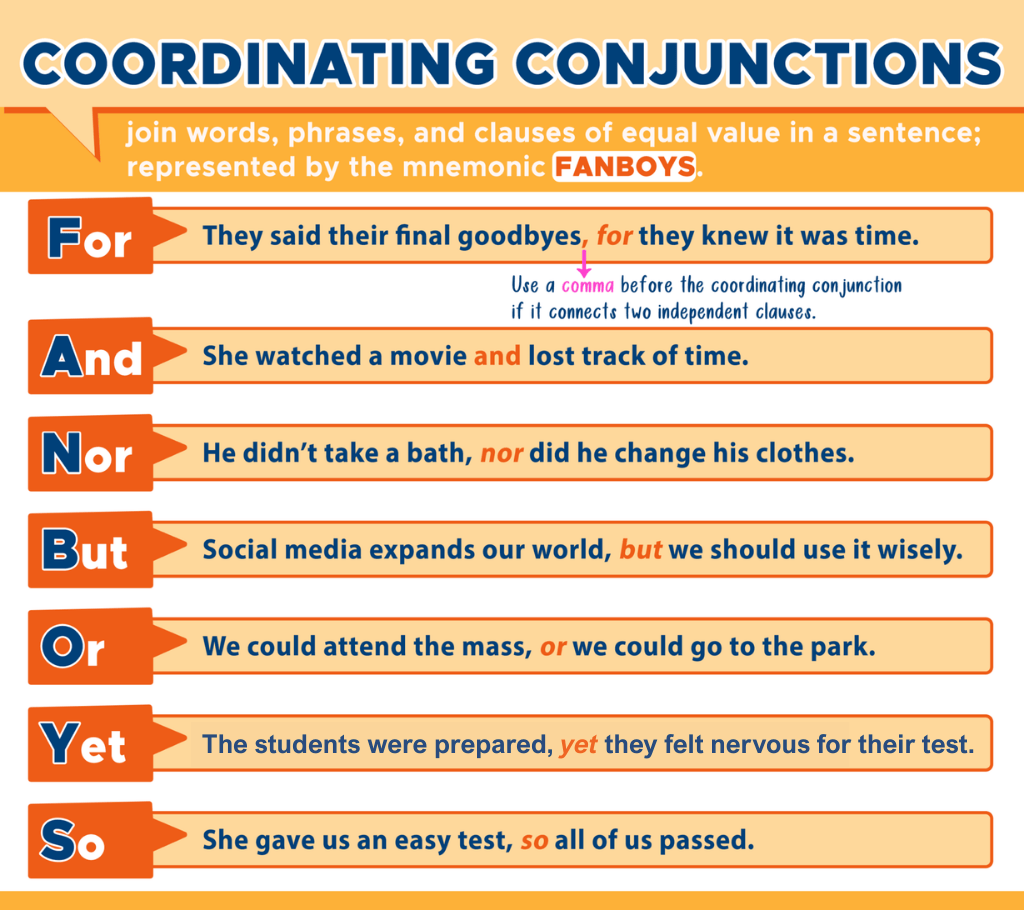
The following image groups seven coordinating conjunctions under the mnemonic FANBOYS. Use it to notice what these words can join; for fast PTE speaking, and, but, or, and so will usually be more useful than trying to use all seven.
Listen to how three of those short connectors signal different relationships in Connectors & Conjunctions: And, Or, So, Because & Although from Simple English Videos.
Connectors & Conjunctions: And, Or, So, Because & Although
Watch the short explanations of “and,” “or,” and “but” to hear what each connector signals in conversation.
Watch adding information, presenting options, and showing contrast. Focus on the meaning each word prepares you to hear next, rather than memorizing the video’s sentences.
For a closer look at the grammar, read the selected parts of Cambridge Dictionary’s Conjunctions. You need the distinction between joining words or phrases and joining clauses; you do not need to study every connector on the page.
Conjunctions - Grammar - Cambridge Dictionary
Read these sections to see how the size of your note fragments affects the sentence you build.
Under “And, but, either … or, etc. (coordinating conjunctions),” start at “One-word conjunctions.” Read the explanation and examples, then continue through the “Connecting clauses” example, which joins two clauses. Near the end of “Two-word conjunctions,” read the warning against combining “because” and “so” in the same construction. Finally, under “After, although, as soon as, etc. (subordinating conjunctions),” read from the clause explanation through the next sentence about comma placement. Focus on why a clause beginning with “because” needs a main clause to complete its meaning.
Punctuation can help you recognize the structure on the page, but you do not speak a comma aloud. In “Enrolment rose, but tuition remained unchanged,” both sides could be sentences; the comma belongs in writing. In speech, a natural rhythm and a clear but carry the contrast.
Keep reasons and results in the right order
The previous lesson introduced reasons and results as possible additions. Here, you are choosing a connector between two recorded ideas. The direction matters:
“The harvest fell because there was a drought.”
“There was a drought, so the harvest fell.”
Because introduces the reason; so introduces the result. Both sentences express the same stated relationship, but they start from different facts. Avoid “Because there was a drought, so the harvest fell”: choose one of the two constructions.
The same video explains this distinction through spoken examples. Watch it with your notes in mind: which fragment gives the reason, and which gives the result?
Connectors & Conjunctions: And, Or, So, Because & Although
Return to Connectors & Conjunctions: And, Or, So, Because & Although for its comparison of “because” and “so.”
Watch reason versus result. Notice that the speaker can change the order of the ideas, but must change the connector to preserve the intended meaning.
Do not make a causal link just to sound fluent. If an image shows “prices fell / sales rose,” you can accurately say, “Prices fell, and sales rose.” Saying “Prices fell, so sales rose” adds an explanation the image may not support. In PTE speaking, a short, faithful connection is more useful than an impressive-sounding guess.
Make the choice quickly enough to keep speaking
When you see two fragments, use this compact preparation routine:
- Name the relationship silently: addition, contrast, choice, reason, or result.
- Supply the missing grammar: decide whether you need one clause or two complete clauses.
- Speak the simplest accurate version. Commit to it and move on.
For example, “speaker one supports plan / speaker two worries about cost” becomes “The first speaker supports the plan, but the second speaker is concerned about its cost.” But preserves the disagreement; complete clauses make it easy to say. You do not need a more formal connector to make the sentence effective.
For a short, ungraded speaking rehearsal, give yourself about eight minutes. Record two versions of each of these practice scenarios, allowing only a few seconds to prepare: “survey completed / results published later” (sequence); “fares rose / ridership fell” (two observations, with no cause stated); and “online attendance / in-person attendance” (two stated options). On the second recording, aim to make the relationship clearer without adding a fact. Listen for whether your connector matches the notes and whether the whole sentence comes out without a restart.
Takeaway
Two fragments become a coherent spoken sentence when you restore the missing grammar and choose a connector that reflects the source. Use and for related facts, but for contrast, and or for genuine alternatives. Use because or so only when a reason or result is established—and keep their direction straight.
Next, you will paraphrase a short idea by changing its wording and sentence structure while preserving its meaning. The accuracy you practised here will help you do that without accidentally changing the relationship between ideas.