Recommended resources
The freely available resources this lesson will direct you to.
Hello again. Last lesson separated what instruments measure from what they control, monitor, or protect. This lesson asks a different question: what could harm you while you work near an instrument, even when the instrument appears to be doing its job?
We will use a separator level-transmitter task to identify five overlapping hazard categories: process, pressure, electrical, toxic-gas, and flammable-gas. The aim is recognition, not authorization to open equipment or carry out electrical work. Allow about 40 minutes, including the selected reading and video.
Start with the task, not the device
Imagine a work order reporting an unreliable level indication on an oil-and-gas separator. You have been asked to help inspect the field transmitter and its connections under supervision. The transmitter has process connections to the vessel and wiring to a nearby junction box. The separator remains part of an operating system; the work order does not say that anything has been isolated.
It would be easy to call this an “instrument problem” and look only at the transmitter. A better first pass is to ask three questions:
- What is present? Process fluid, pressure, electrical power, and possibly hazardous gases.
- How could it reach or affect someone? A leak, an opened connection, contact with an energized conductor, or ignition of a gas cloud.
- What would the consequence be? Injury from a jet or hot fluid, electric shock, toxic exposure, fire, or explosion.
A hazard is a source or condition capable of causing harm. The fact that harm has not occurred—and that an instrument currently displays a normal value—does not establish that the hazard is absent. Several hazards can arise from a single event. A leaking connection, for example, may release fluid under pressure, expose someone to a toxic component, and create a flammable atmosphere.
Process hazards: what the equipment contains and does
A process hazard comes from the material or operation itself. Around a separator, it may include hot or cold fluids, corrosive chemicals, hydrocarbon liquid, unexpected flow, or movement of a valve or other equipment. Released liquid can splash onto skin, spread across a walking surface, or enter a drain. A change in valve position can alter where material flows, even if no one is touching the valve locally.
The process line attached to an instrument is not necessarily harmless because it is small. An impulse line or sample connection can provide a path from a much larger inventory. Nor can you infer the contents of a connection solely from its appearance: the vessel may contain gas, oil, water, or a mixture, and operating conditions can change. For hazard identification, the important point is to treat the connection as part of the process until its actual condition has been established through site procedures.
Pressure is related to the process hazard, but deserves its own check. A blocked-in instrument line or valve cavity may retain pressure after flow has stopped. A connection that appears inactive can still release material when disturbed. Pressurized gas can expand rapidly; liquid under pressure can produce a forceful spray. Either can drive debris or fluid toward a person. A pressure indication elsewhere on the plant does not, by itself, prove that the particular volume you might disturb is depressurized.
For this scenario, record both the source and a plausible exposure route: “separator fluid at an instrument connection; opening or failure of the connection could release fluid under pressure.” That is more useful than writing only “pressure hazard,” because it identifies where the concern comes from without assuming an isolation has worked.
A release can create a hazardous atmosphere
Read the opening of this joint OSHA–NIOSH hazard alert. Its specific task is opening production-tank hatches, not servicing our separator transmitter. Use it to understand what hydrocarbon-containing equipment can release and why a release may present several hazards at once.
OSHA NIOSH Hazard Alert - Health and Safety Risks for ...
Read this OSHA–NIOSH alert for its account of hydrocarbon gas and vapor releases, oxygen displacement, and fire and explosion hazards. Keep the difference between its tank-hatch example and the transmitter scenario in mind.
On p. 1, in the Introduction, begin where the authors describe workers opening tank hatches. Read the release discussion, ending with the explanation of how the risk varies. On p. 2, under “Hydrocarbon Gas and Vapor Release from Production and Flowback Tanks,” read the vapor discussion. Focus on the difference between gas released from liquid and vapor formed as liquid evaporates, and on where either may travel.
The alert makes an important distinction: flammability is not the only danger from hydrocarbons. Released gas or vapor may displace oxygen, and some components can harm health through inhalation. A hazardous atmosphere can form where a person is breathing; it need not remain immediately beside the opening. The amount released depends on the material, pressure, temperature, operating condition, and opening or leak.
For the separator task, you cannot assume that a transmitter connection will behave like a tank hatch. You can identify the credible route: if a process connection leaks or is opened, its contents may escape and affect the surrounding air. Oxygen deficiency is an additional atmospheric hazard to recognize, particularly where gas can collect or ventilation is poor. It is not the same as toxic-gas exposure: someone can be harmed by too little oxygen even when the displaced gas is not itself toxic.
Toxic gas: ask what could be inhaled
Hydrogen sulfide, often abbreviated H₂S, is a potentially lethal toxic gas that may be present in some oil-and-gas streams. Its presence must come from knowledge of the particular service and site information, not from assuming every separator contains it. Some hydrocarbon vapors also have harmful health effects; the alert describes how a released mixture can affect a worker’s breathing zone.
Watch the selected portions of this H₂S training video. Concentrate on where a release might occur and why smell is not a dependable detector; do not treat the video’s example concentrations as your site’s limits or alarm settings.
H2S Don't Mess with H2S training video
Watch “H2S Don't Mess with H2S training video” from RIGVIDS for a visual introduction to where H₂S can be encountered, why odor cannot establish safety, and why an unprotected rescue can create another casualty.
Watch possible release points for the discussion of gas emerging from process materials and collecting in low areas. Then watch unreliable odor, focusing on why loss or absence of a smell is not proof of clean air. Finally, watch rescue danger for the warning against entering a suspected hazardous atmosphere to retrieve another person without the designated emergency response.
H₂S is a toxic-gas hazard because breathing it can cause severe harm; it can also be flammable. Do not try to classify the air by odor. If an atmosphere is suspected to be hazardous, a person collapsing nearby is not evidence that it is safe to approach. The immediate issue is to avoid becoming another casualty and to follow the site’s emergency arrangements.
Flammable gas and electrical equipment can interact
A flammable-gas hazard exists when a gas or vapor release could form a mixture with air that can ignite. The lower explosive limit (LEL) describes the lower end of the concentration range at which a particular gas–air mixture can burn if an ignition source is present. You do not need to calculate an LEL for this lesson. What matters in the scenario is the combination of a possible release, air, and a possible ignition source.
The nearby junction box makes this interaction worth noticing. An electrical circuit can present two distinct hazards:
- Electrical injury: contact with energized parts may cause shock; faults may cause an arc or burns.
- Ignition: switching, a fault, a spark, or a hot surface may ignite a suitable gas–air mixture.
A circuit that seems unlikely to give a severe shock must not therefore be treated as unable to ignite gas. Conversely, equipment approved for a hazardous area is not automatically safe to open, modify, or test while energized. Electrical and ignition hazards require separate questions.
Read this HSE explanation of electricity in potentially explosive atmospheres. Its regulatory references are jurisdiction-specific; focus here on the physical ignition mechanisms rather than on applying a particular country’s rules to an unspecified site.
Electricity in potentially explosive atmospheres - HSE
Read the UK Health and Safety Executive’s explanation to connect an electrical task with possible gas ignition. It also explains why equipment intended for a potentially explosive atmosphere needs appropriate design and marking.
In the opening paragraphs before “Equipment in explosive atmospheres,” read the ignition explanation, including the warning about static discharge. Then, under “Equipment in explosive atmospheres,” continue into the “Reduce risks by” list and read the equipment discussion. Under “Product marking,” read the first paragraph beginning “Recently installed equipment should be marked” and ending “potentially explosive atmospheres.” Notice that suitability has to be established for the particular application; an “Ex” symbol alone is not a work permit.
The illustration below is a conceptual reminder that potential flammable-atmosphere hazards can vary around process equipment. It is not a drawing from our hypothetical site. Its colored bands are not to scale, and its “Ex” symbols do not establish that any depicted device is suitable for a real installation. You will study formal area classification and equipment markings later in the course.
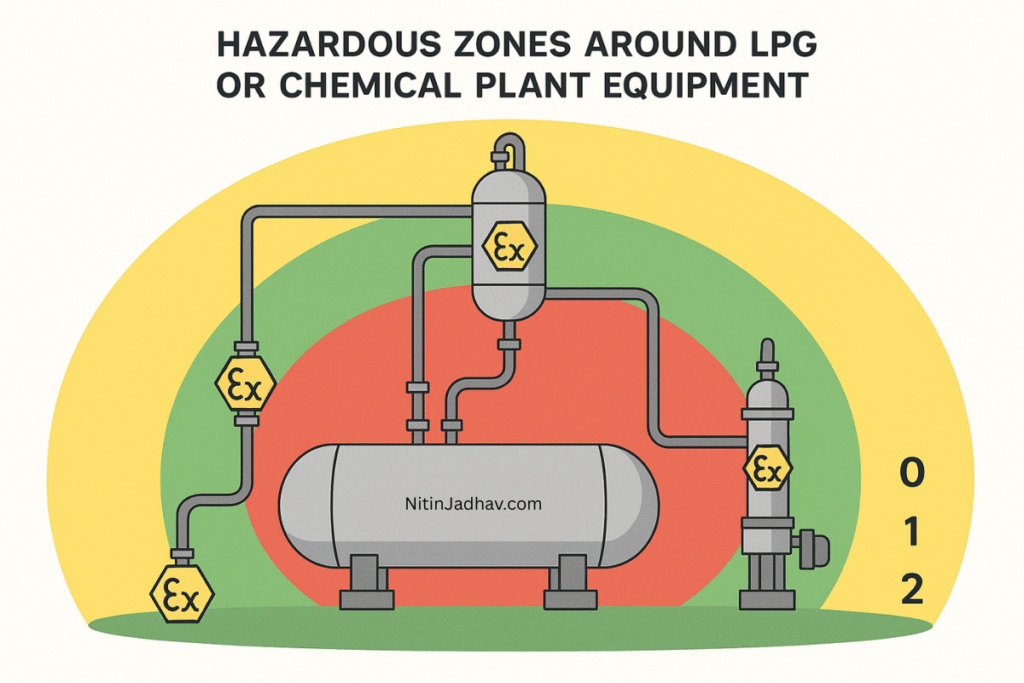
Return to the junction box in the scenario. Before anyone opens it, there are at least two unknowns: the electrical state and the condition of the surrounding atmosphere. Neither the presence of an “Ex” label nor a lack of visible gas resolves those unknowns. A gas cloud may be invisible, and an energized conductor may look no different from a de-energized one.
Put all five hazards on one field note
A trainee’s first contribution is often a clear description of what needs checking, not an attempt to resolve every hazard personally. Here is a concise hazard note for the hypothetical separator task:
| Category | Potential source in the scenario | How harm could occur |
|---|---|---|
| Process | Separator contents or changing process flow | Hot, cold, or harmful fluid escapes; an unexpected process change affects the work area |
| Pressure | Vessel connection, impulse line, or trapped volume | Fluid or debris is released forcefully when a connection fails or is disturbed |
| Electrical | Transmitter wiring or nearby junction box | Contact with energized parts or an electrical fault causes shock, arc, or burns |
| Toxic gas | H₂S if present in the service, or harmful hydrocarbon vapors | A leak contaminates the breathing zone and is inhaled |
| Flammable gas | Released hydrocarbon gas or vapor | A suitable mixture with air encounters a spark, static discharge, or hot surface |
These are potential hazards, not findings that a leak, H₂S, or an energized exposed conductor is definitely present. Identification means recognizing credible sources and routes so that the actual conditions can be verified. Equally, “no leak visible,” “no odor,” and “the display looks normal” are not adequate grounds to mark the hazards absent.
The table also shows why categories should not be checked in isolation. One disturbed connection could account for the process, pressure, toxic-gas, and flammable-gas entries. Opening electrical equipment nearby could introduce a separate ignition source. Thinking about the combined scenario is more informative than counting five labels.
At this stage, do not improvise a test by loosening a fitting, operating a valve, opening a junction box, or relying on a personal impression of the air. The next lessons will address how work is assessed, authorized, isolated, and verified under site procedures and supervision. For now, the job-ready habit is to describe the uncertain condition accurately and raise it before work proceeds.
Key takeaways
When you approach an instrument, look beyond the device to its process connection, stored pressure, electrical supply, and surrounding atmosphere. Identify each hazard by its source, a credible path to exposure, and its possible consequence. A single release can create several hazards at once, while normal indications or the absence of smell do not prove safe conditions.
Next, you will use the hierarchy of controls to consider how hazards identified in a task can be addressed before work begins.