Recommended resources
The freely available resources this lesson will direct you to.
In our previous lesson, we established a systematic framework for reading and critiquing research papers. We concluded that the third and most intensive pass—the researcher's critique—is not just about understanding a paper, but about challenging its assumptions and probing for weaknesses. Today, we will put that principle into practice.
This lesson directly addresses the final step in becoming a critical reader: identifying a paper's limitations. This skill is the crucial bridge between consuming knowledge and producing it. Every new research paper begins, implicitly or explicitly, with the limitations of prior work. By learning to spot these gaps, you are learning to find the opportunities for your own contributions. We will use NeRF and 3D Gaussian Splatting as our primary case studies.
A Framework for Finding Weaknesses
Identifying limitations is not an unstructured brainstorming session. It is a systematic search for specific categories of problems. When you critique a paper, you can use the following mental checklist:
- Theoretical & Foundational Limitations: Are there simplifying assumptions in the core mathematical model? Does the theory break down under certain conditions?
- Quality & Artifacts: In what scenarios does the method produce visually poor results (e.g., blurriness, noise, unrealistic effects)? Does it struggle with certain materials (transparency, reflections), lighting conditions, or geometries?
- Performance & Scalability: Does the method suffer from slow training or rendering speeds? Does it have a large memory or storage footprint? How does it perform as scenes become larger or more complex?
- Generality & Robustness: How well does the method work outside its ideal conditions? For example, how does it handle sparse camera views, dynamic scenes, non-standard camera lenses, or a lack of good initialization data?
- Usability & Workflow: How difficult is it to use the method in practice? Does it require a complex data capture process or extensive parameter tuning? Can the resulting scene representation be easily edited or integrated into existing graphics pipelines?
Let's begin by contrasting the representational strategies of NeRF and 3D Gaussian Splatting, as their limitations stem directly from these foundational choices.

Given these different approaches, let's briefly revisit the well-known limitations of NeRF before diving deep into 3DGS.
- Performance: NeRF is notoriously slow to render because it requires hundreds of forward passes through a large MLP for every pixel in the image. Training is also very time-consuming.
- Usability: Because the scene is encoded in the weights of a neural network, it's a "black box." Editing the scene—like moving an object—is impossible without retraining the entire model.
- Quality: Without positional encoding, MLPs exhibit "spectral bias," making them poor at learning high-frequency details, which results in overly smooth or blurry renderings.
3D Gaussian Splatting was designed specifically to overcome NeRF's performance limitations. However, in doing so, it introduced a new set of trade-offs and weaknesses.
Uncovering the Limitations of 3D Gaussian Splatting
Let's apply our framework to systematically identify the limitations of 3DGS.
1. Quality & Artifacts
While 3DGS produces photorealistic results, artifacts can appear when the underlying assumptions are pushed. A great way to build intuition for this is to see it in action.
3D Gaussian Splatting! - Computerphile
This segment from the Computerphile channel provides a fantastic visual exploration of a trained 3DGS scene, revealing some of its most intuitive limitations.
Watch the section from "What's Different Here?". As you watch, focus on two specific phenomena: What happens to the appearance of the bush when the camera zooms in very close? What do you see in the areas outside the captured room or on the floor where the camera never looked?
As the video demonstrates, 3DGS has two clear quality limitations:
- "Shardy" or "Point-like" Appearance: Up close, the illusion breaks. You are no longer looking at a solid surface but at the individual, semi-transparent Gaussians that constitute it. The scene dissolves into a collection of "shards" or blobs. This is a direct consequence of its explicit, primitive-based representation.
- Voids from Unseen Areas: Unlike NeRF, which might try to hallucinate content (often poorly) in unobserved regions, 3DGS is more direct. If there were no cameras capturing a particular area, no Gaussians will be generated there. The result is a literal void—a black hole in your scene.
2. Theoretical & Foundational Limitations
This is where your interest in first principles becomes critical. The core mathematical challenge in 3DGS is projecting a 3D Gaussian primitive onto a 2D image plane. This projection is a non-linear transformation. To make the process differentiable and fast, the authors of 3DGS used a local affine approximation.
Let's pause here for a Socratic question. From a systems engineering perspective, what is the inherent risk of using an approximation in a core component of a rendering pipeline? What might be the consequence if the conditions of the approximation are violated?
The risk is that the approximation introduces error, and this error is not uniform. It will be larger under certain conditions, leading to predictable failures. If the real-world scenario (e.g., the camera parameters) deviates too much from the conditions where the approximation holds true, the error will manifest as visual artifacts.
This is precisely what happens in 3DGS. A research paper specifically investigated this limitation.
On the Error Analysis of 3D Gaussian Splatting and an Optimal ...
This paper from Wang et al. (2024) provides a rigorous mathematical analysis of the projection error introduced by the local affine approximation in 3DGS. It's a perfect example of research that identifies and solves a foundational limitation.
First, read the introduction, focusing on the sections that frame the problem. Pay attention to the discussion starting from this paragraph. This explains how the approximation introduces errors that can lead to artifacts. Next, jump to the "Discussions" section and read the subsection titled "Impacts of Decreasing Focal Length". This connects the theoretical error to a concrete failure case: using wide-angle lenses.
This paper brilliantly demonstrates a key limitation:
- Projection Error from Local Affine Approximation: The math shows that the error introduced by the projection approximation is minimal when a Gaussian is near the center of the view. However, the error increases significantly for Gaussians that project to the edges of the image. This problem is exacerbated by wide-angle lenses (which have short focal lengths), as more of the scene's Gaussians are far from the projection center. The result is "cloud-like" or "needle-like" artifacts, degrading image quality.
3. Generality & Robustness
A method's generality is tested by applying it to scenarios beyond the ones presented in the original paper. The original 3DGS paper focused on standard, pinhole-camera datasets. What happens when we try to use other camera types or introduce more complex physical phenomena?
The following video, an interview with a lead researcher at NVIDIA, directly discusses the effort to overcome these exact limitations.
This Fixed 3D Gaussian Splatting's Biggest Problems!
This video from the Pixel Reconstruct channel features an interview with NVIDIA's Sonia Fidler about their work extending 3D Gaussian Splatting.
Watch two key segments: From the first segment, listen for the types of cameras and sensors that standard 3DGS cannot handle. In the second segment, note the types of realistic rendering effects that are not possible with the original 3DGS formulation.
This interview highlights several major limitations in the generality of the original method:
- Limited Camera Model Support: Standard 3DGS assumes an idealized pinhole camera model. It struggles with more complex and common camera types like fisheye lenses, 360-degree cameras, and even rolling shutter cameras (common in smartphones), which are crucial for robotics and autonomous driving applications.
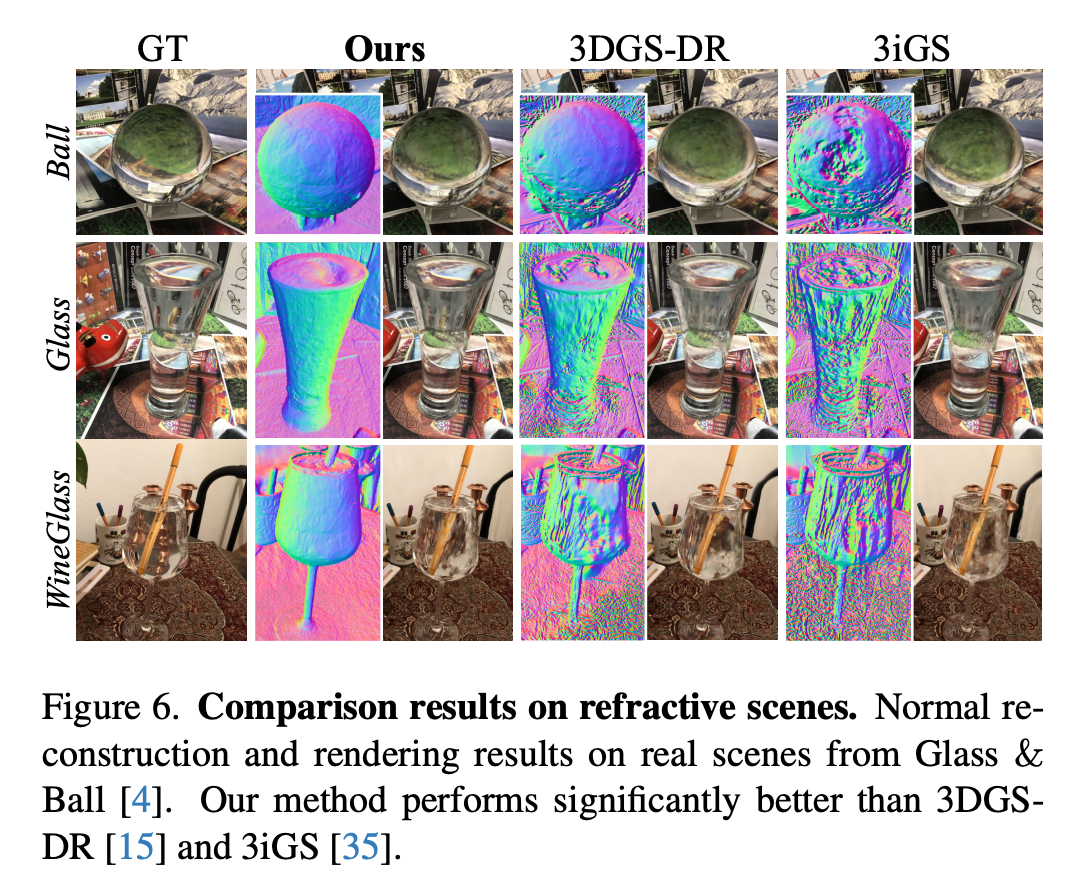
- Lack of Realistic Lighting Effects: The 3DGS rasterization pipeline is fundamentally a forward-projection process (splatting). It does not inherently support ray tracing, which is necessary for simulating physically accurate lighting effects like casting shadows, reflections, and refractions. This makes it difficult to realistically insert new virtual objects into a captured 3DGS scene.
4. The Structural Limitation: Independent Primitives
Finally, let's consider a more subtle structural limitation, which is well-summarized in the introduction of another follow-up paper.
[PDF] NeRF Is a Valuable Assistant for 3D Gaussian Splatting
This paper proposes a hybrid NeRF-3DGS model. Its introduction serves as a concise summary of the limitations it aims to solve.
Read the second paragraph of the introduction. Focus on the three key deficiencies it attributes to 3DGS.
This paper points out several intertwined issues that stem from the discrete nature of the Gaussians:
- Sensitivity to Initialization: 3DGS heavily relies on a good point cloud from Structure-from-Motion (SfM) to initialize the Gaussians. If the SfM process fails or produces a sparse point cloud, 3DGS training can become unstable or produce poor results.
- Weak Inter-Gaussian Correlation: The Gaussians are largely optimized as a "bag of points." There is no explicit mechanism enforcing that adjacent Gaussians on a surface should have similar properties. This "limited spatial perception" can lead to a lack of smoothness and contributes to the "shardy" artifacts we saw earlier.
Conclusion
You have now moved beyond simply understanding a paper and have started to think like a researcher. By applying a structured framework, you can systematically uncover a method's weak points.
Key Takeaways:
- Limitations are Research Opportunities: Every limitation identified in a paper is a potential starting point for a new project.
- 3DGS Limitations Summary:
- Quality/Artifacts: "Shardy" appearance up close and voids in unobserved areas.
- Theoretical: Projection errors from the local affine approximation cause artifacts, especially with wide-angle lenses.
- Generality: Limited to pinhole cameras and lacks support for physically-based effects like shadows and reflections.
- Structural: Highly dependent on good SfM initialization and lacks strong spatial correlation between its discrete primitives.
- The Critical Mindset: The goal of reading research is not just to learn what was done, but to ask: What was not done? What was simplified? Where does it fail?
Preview of the Next Lesson:
In this lesson, we identified the problems. In our final lesson of this module, you will take the next logical step: proposing solutions. You will practice formulating a concrete follow-up research question based on the limitations we have discussed today, completing the full cycle from analysis to ideation.