Recommended resources
The freely available resources this lesson will direct you to.
Introduction
Welcome to your first lesson in our survey of Western philosophy! This course is designed to give you a historical overview of major philosophical ideas, with a special focus on the threads that lead to your areas of interest: analytic philosophy and the philosophy of mathematics.
Today, we begin with one of the most influential thinkers in the entire Western tradition: Plato. Our goal is to explain his famous Theory of Forms and its crucial epistemological implications—that is, its consequences for his theory of knowledge.
Understanding Plato's Forms is foundational for almost all subsequent philosophy. For your interests in particular, Plato's theory offers one of the first and most powerful accounts of abstract objects, such as numbers, geometric shapes, and logical principles. The question of whether these entities exist independently of the human mind is a central debate in the philosophy of mathematics, often referred to as Platonism. This lesson will provide the original context for that very idea.
We will explore Plato's division of reality into two realms, define what he meant by a 'Form', and see how this metaphysical picture dictates what can be known and how we can know it.
Plato's Two Worlds: Being and Becoming
At the heart of Plato's philosophy is a metaphysical dualism—a belief that reality consists of two distinct realms. He developed this idea to resolve a conflict inherited from earlier philosophers: Heraclitus, who claimed that everything is in a constant state of change or "flux," and Parmenides, who argued that true reality must be singular, eternal, and unchanging.
Plato's solution was to agree with both:
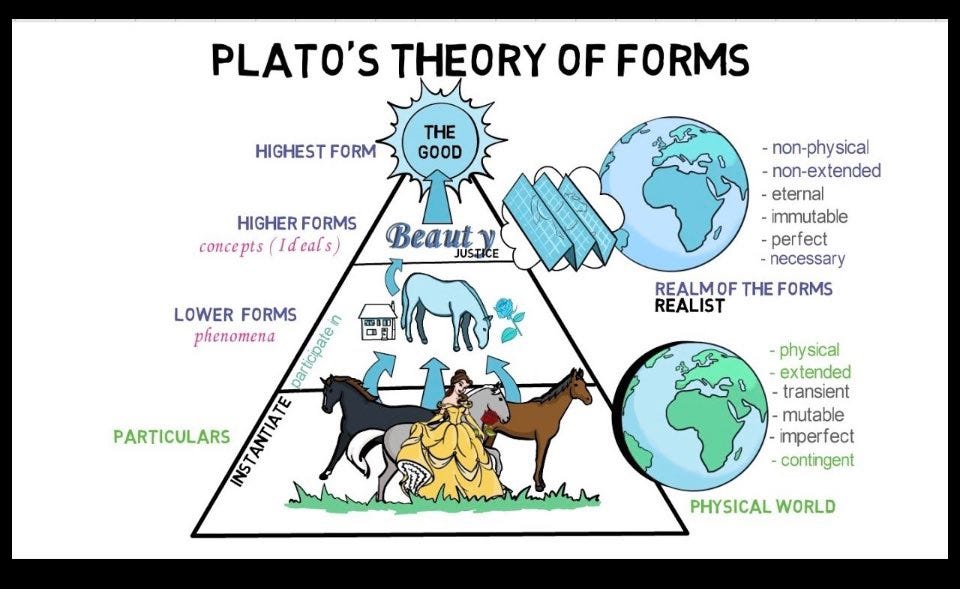
- The Realm of Becoming: This is the physical world we perceive with our senses. It is the world of Heraclitus, a world of constant change, decay, and impermanence. It contains particular, concrete objects—this tree, that act of kindness, this drawing of a circle. Because this realm is unstable and imperfect, Plato argued that we can only have opinion (doxa) about it.
- The Realm of Being: This is an entirely separate, non-physical, and intelligible realm. It is the world of Parmenides, a realm of perfection, eternity, and unchanging reality. This realm is populated by the Forms (or Ideas). The Forms are the true objects of knowledge (episteme), which we grasp not with our senses, but with our intellect.
To get a clear overview of this fundamental distinction, please read the introductory sections of the following resource.
Plato's Metaphysics and Epistemology
These notes, from a course at Florida International University, provide a concise introduction to Plato's dualistic metaphysics. They clearly lay out the distinction between the Realm of Being and the Realm of Becoming.
Please read the section titled 'Realm of Being / Realm of Becoming'. Focus on how Plato attempts to reconcile the views of Heraclitus and Parmenides and the characteristics he assigns to each realm.
This two-worlds structure is the foundation for everything else. The following diagram provides a helpful visual representation.
What Exactly is a Form?
It's crucial not to misunderstand the term 'Form' or 'Idea' as a thought in someone's mind. For Plato, Forms are objective, independently existing entities—the most real things that exist. They are the perfect archetypes, blueprints, or essences of which the particular things in our world are mere imperfect copies.
Let's use an example that aligns with your mathematical background. Think of the concept of a triangle.
- In the Realm of Becoming, we have countless individual triangles. You can draw one on paper, see one in a yield sign, or build one with sticks. All of these are imperfect. Their lines are never perfectly straight, their angles never add up to exactly 180 degrees, and they have accidental properties (like being blue, or small, or made of chalk).
- In the Realm of Being, there exists the Form of Triangularity. This Form is the single, eternal, and perfect essence of what it is to be a triangle—a closed three-sided plane figure. It isn't a particular size or color; it is the pure definition itself.
According to Plato, we can recognize all the imperfect triangles in the world as triangles only because our intellect has access to the perfect Form of Triangularity. The same logic applies to other kinds of Forms:
- Moral Forms: Justice, Beauty, Courage. A particular action is just only insofar as it "participates" in the Form of Justice.
- Natural Kind Forms: The Form of Cat, which all individual cats imperfectly instantiate.
- Mathematical Forms: The Form of Equality, the Form of The Circle, and, we might speculate, the Forms of numbers themselves (e.g., the Form of Two).
To deepen this understanding, let's watch a segment of a lecture by Professor David Sedley, a leading scholar on ancient philosophy.
David Sedley: Plato’s Theory of Forms (Royal Institute of Philosophy)
In this video from The Royal Institute of Philosophy, Professor Sedley explains the origin of the Theory of Forms, connecting it to Socrates' search for definitions and the unchanging nature of the objects of knowledge, like mathematical truths.
Please watch the segment from 04:09 to 11:43. Pay close attention to the three 'presuppositions' he outlines, particularly the argument that the objects of knowledge (like Equality) must be unchanging and intelligible, not sensible.
As Sedley explains, the objects of knowledge must be stable and unchanging. My knowledge that "2+2=4" does not become obsolete. For Plato, this permanence implies that the object of that knowledge—the mathematical relation itself—must also be permanent and exist in a realm beyond the changing physical world.
Epistemological Implications: Knowledge as Recollection
Now we arrive at the core of this lesson's learning outcome: how does this metaphysical picture affect Plato's theory of knowledge?
The "two-worlds" view creates a sharp distinction between knowledge and opinion:
- Knowledge (episteme) is of the Forms. It is certain, infallible, and rationally justified. Since Forms are grasped by the intellect, true knowledge is purely intellectual, not sensory.
- Opinion (doxa) is of the physical particulars in the Realm of Becoming. It is fallible, changeable, and based on sensory experience. You can have a correct opinion (e.g., "This painting is beautiful"), but it is not knowledge because its object is an imperfect, changing particular.
This raises a profound question: If the Forms are not in the physical world, how do we ever come to know them?
Plato's answer is the Theory of Recollection (Anamnesis). He argues that we are born with this knowledge already latent within our immortal souls. Before our soul was united with a body, it dwelled in the Realm of Being and had direct acquaintance with the Forms. The process we call "learning" is not about acquiring new information from experience, but about recollecting what our soul already knows. Our sensory experience of imperfect copies (e.g., seeing two sticks that are almost equal) serves as a trigger that "reminds" our intellect of the perfect Form (Equality itself) it once knew.
This makes Plato a quintessential rationalist: he believes that true knowledge is a priori, meaning it is ultimately grounded in reason, not sensory experience.
Let's return to the lecture by Professor Sedley, who introduces this concept at the very beginning of his talk.
David Sedley: Plato’s Theory of Forms (Royal Institute of Philosophy)
This opening segment of the lecture introduces the Theory of Recollection as the starting point for the Theory of Forms.
Please watch from the beginning to 04:09. Focus on the argument that knowledge of concepts like 'equality' cannot be derived from sensory experience, leading Plato to conclude that it must be innate.
The FIU notes you read earlier also offer a clear summary of this doctrine and its justification. Feel free to re-read the sections titled "Epistemological Ramifications of this Metaphysical View" and "Plato’s Doctrine of Reminiscence" in resource LINK to solidify your understanding.
Critical Analysis: Participation and the Third Man
Philosophy is not just about understanding theories, but also about critically evaluating them. Plato himself was his own sharpest critic. A major challenge for the Theory of Forms is explaining the precise relationship between a Form and the particulars that instantiate it. Plato uses the term participation (methexis), but what does this mean?
- If a particular "takes a piece" of the Form, does that mean the Form is divisible? This would violate its unity and perfection.
- If the entire Form is present in every particular, how can it remain a single entity?
In his later dialogue, the Parmenides, Plato raises a famous objection known as the Third Man Argument. In simplified terms, it runs as follows:
- To explain the commonality among a group of large things (e.g., several men), we posit the existence of a Form, Largeness. We say they are all large because they participate in this Form.
- But now consider a new group: the original large things plus the Form of Largeness itself. This new group also shares a common property (largeness).
- Therefore, we must posit another Form—a "third man"—to explain this new group's commonality.
- This leads to an infinite regress, with an endless proliferation of Forms, which undermines the theory's goal of providing a simple, ultimate explanation.
This type of rigorous, logical analysis is a hallmark of the philosophical method and will be a recurring theme in this course. It shows that even the most foundational theories are subject to intense scrutiny.
Test your understanding!
Given your background, consider the number three. According to Plato's theory, there is a Form of Threeness. How would you describe the relationship between this Form and various instances of three in the physical world (e.g., three apples on a table, a triangle with three sides, the third hour of the day)? What makes these instances "three," and what makes them deficient compared to the Form of Threeness?
Show answer
According to Plato's theory, the Form of Threeness is the perfect, eternal, and unchanging essence of the number three. It exists in the Realm of Being.
Various instances in the physical world—three apples, three sides of a triangle—all "participate" in this Form. It is by virtue of this participation that we recognize them as groups of three.
These instances are deficient for several reasons:
- Materiality and Impurity: The three apples are physical objects that will rot and decay. Their "threeness" is tied to a specific, perishable material context. The Form of Threeness is immaterial and eternal.
- Complexity: The group of three apples has many other properties besides threeness (being red, sweet, on a table). They are not purely three. The Form of Threeness, in its purest sense, is just threeness and nothing else.
- Contingency: The group of apples is contingently three; someone could eat one, making it two. The Form of Threeness is necessarily three.
Essentially, the physical instances are temporary, mixed, and imperfect manifestations of the pure, eternal, and perfect idea of "three" that exists in the Realm of Forms.
Conclusion
This first lesson has laid some crucial groundwork. Let's summarize the key takeaways:
- Metaphysical Dualism: Plato divides reality into the changing, physical Realm of Becoming (the object of opinion) and the eternal, non-physical Realm of Being, which contains the Forms.
- The Forms: These are perfect, objective, and unchanging archetypes (essences) of everything that exists, from mathematical concepts like Equality to moral values like Justice.
- Epistemological Implications: True knowledge is possible only of the Forms and is attained through the intellect. Since the Forms are not in our world, this knowledge is a priori and accessed via recollection (anamnesis) of what our immortal soul knew before birth.
- Rationalism: Plato's theory is a foundational example of rationalism, the view that reason, rather than sensory experience, is the ultimate source of knowledge.
You've now grasped the core of a theory that has echoed through millennia of philosophy, science, and even theology.
Preview of the next lesson: In our next session, we will analyze Plato's Allegory of the Cave. This powerful and famous story is Plato's own illustration of the Theory of Forms and the philosopher's intellectual journey from the shadowy world of opinion to the brilliant light of true knowledge.