Recommended resources
The freely available resources this lesson will direct you to.
- Aristotle, Metaphysics, bk. 1 | Criticisms of Plato's Forms | Philosophy Core Conceptswww.youtube.com
- Aristotle's Metaphysics (A History of Western Thought 14)www.youtube.com
- Platonism in Metaphysics (Stanford Encyclopedia of Philosophy)plato.stanford.edu
- The Third Man Argument in the Parmenidesmoodle.unifr.ch
Introduction
Welcome back. In our last two lessons, we explored Plato's powerful and influential Theory of Forms. We saw how Plato posits a 'two-worlds' view: a transcendent, eternal, and perfect Realm of Being where the Forms reside, and the physical, transient Realm of Becoming that we perceive with our senses. For Plato, particulars in our world are merely imperfect copies that 'participate' in the Forms, and true knowledge is achieved by grasping these Forms through reason.
Today, we turn to Plato's most famous student, Aristotle. While deeply influenced by his teacher, Aristotle was also one of his sharpest critics. He found the idea of a separate realm of Forms to be both unnecessary and logically problematic. In this lesson, we will examine Aristotle's critique of Platonic Forms and then explore his own alternative theory, which brings the Forms back down to earth.
This lesson marks a pivotal moment in the history of philosophy. The disagreement between Plato and Aristotle on the nature of universals—the general concepts we use, like 'Redness' or 'Humanity'—sets the stage for a debate that has continued for over two millennia and remains central to metaphysics and, as you'll see later in the course, the philosophy of mathematics.
1. Aristotle's Critique of the Theory of Forms
Aristotle's fundamental disagreement with Plato was over the concept of separation (chorismos). He questioned the need to posit a separate, invisible world to explain the one we actually experience. He raised several powerful objections, many of which are detailed in his Metaphysics.
To get a comprehensive overview of his main criticisms, please watch the following video.
Aristotle, Metaphysics, bk. 1 | Criticisms of Plato's Forms | Philosophy Core Concepts
This video by Gregory B. Sadler, a specialist in ancient philosophy, walks through Aristotle's key objections to Plato's Forms as presented in Book 1 of his Metaphysics.
Please watch the video from 04:37 to 13:14 and then from 16:23 to 20:20. As you watch, focus on understanding the core of each distinct argument: The theory unnecessarily multiplies the number of entities to be explained. The 'Third Man Argument'. The problem of how static Forms can cause change and motion. The idea that Forms are separate from the things they define. The claim that 'participation' is merely a poetic metaphor, not a real explanation.
A Deeper Dive: The Third Man Argument (TMA)
Of all the criticisms, the most famous and logically potent is the Third Man Argument. Given your background in mathematics, you will appreciate its rigorous structure. The argument aims to show that Plato's theory leads to a vicious infinite regress. Plato himself was aware of this problem, presenting a version of it in his dialogue Parmenides.
The argument runs as follows:
- We have a collection of particular men (e.g., Socrates, Plato, etc.). According to Plato, we account for their common property of being 'man' by positing a transcendent Form of Man in which they all participate.
- But now, consider a new collection that includes the particular men and the Form of Man itself. What do all members of this collection have in common? They are all 'men'.
- Therefore, to explain this new, larger collection, we must posit another Form—a 'Third Man' (let's call it Form of Man₂) —in which both the particular men and the first Form participate.
- But this 'Third Man' is also a man. So we must now explain the commonality between the particulars, the first Form, and the second Form, which requires a fourth Form... and so on, to infinity.
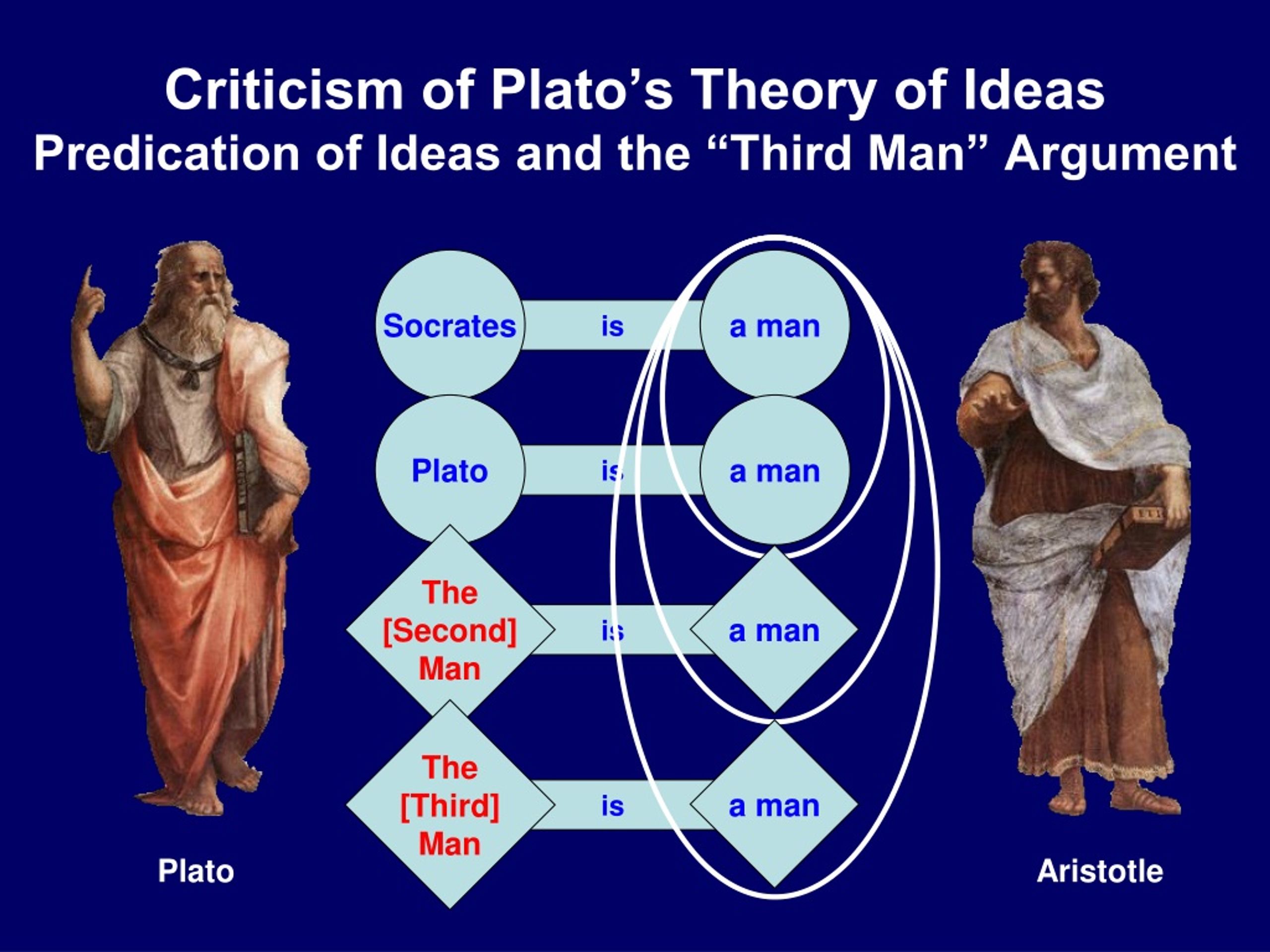
This is a vicious regress because the theory fails its explanatory purpose. To explain the 'man-ness' of one man, we end up needing an infinite number of Forms, and the explanation is never complete.
The argument's power comes from two unstated assumptions that Aristotle believed were implicit in Plato's theory:
- Self-Predication: Any Form of F is itself F. (e.g., The Form of Beauty is itself beautiful; the Form of Man is itself a man). Plato strongly suggests this when he describes Forms as the perfect exemplars of their properties.
- Non-Identity: If a thing x is F, it cannot be identical to the Form in virtue of which it is F. (A particular man cannot be the Form of Man).
When you combine Self-Predication with the basic principles of the Theory of Forms, the infinite regress becomes logically unavoidable.
Other Key Criticisms
As the video explained, Aristotle had other major objections:
- Forms don't explain change: The Forms are static and eternal. How can they be the cause of motion, generation, and destruction in the physical world? An eternal, unchanging blueprint doesn't explain how a particular acorn grows into an oak tree.
- "Participation" is an empty metaphor: What does it actually mean for a physical object to "participate" in or be a "copy" of a Form? Aristotle argued that this was just poetic language, not a rigorous philosophical explanation of the relationship.
- Substance and separation: For Aristotle, the essential nature—the 'what-it-is'—of a thing cannot exist separately from the thing itself. The 'humanity' of Socrates can't exist in a heavenly realm apart from Socrates. This leads us to his alternative account.
2. Aristotle's Alternative: Hylomorphism and Immanent Realism
Aristotle's solution was not to deny the existence of forms or universals, but to deny their separation. He brought the Forms down from Plato's transcendent heaven and placed them inside particular things.
This diagram offers a simple visual contrast between the two views.

Aristotle's alternative rests on a few key distinctions. The following video provides a clear introduction to his core metaphysical concepts.
Aristotle's Metaphysics (A History of Western Thought 14)
In this video, Dr. Jordan B Cooper explains Aristotle's foundational metaphysical concepts, including his 'moderate realism,' hylomorphism (matter/form), and the distinction between substance and accident.
Please watch from 02:46 to 13:25. Focus on how Aristotle re-conceives the 'form' as an inseparable part of a physical object, and how his distinction between substance and accident helps to explain the problem of change.
Let's formalize these ideas. Aristotle's view, in modern terminology, is a type of immanent realism.
Platonism in Metaphysics (Stanford Encyclopedia of Philosophy)
The Stanford Encyclopedia of Philosophy provides a precise, modern definition of the view Aristotle pioneered, known as 'Immanent Realism'. This will help situate his ideas within the broader landscape of metaphysics.
Please read the short section titled '2.2 Immanent Realism'. This section defines the view that universals (like redness) exist, but they exist in the physical objects themselves, not in a separate Platonic realm. Notice how it explicitly traces this view back to Aristotle.
To summarize Aristotle's alternative framework:
-
Hylomorphism: Every individual physical object is a composite of matter (hyle) and form (morphe).
- Matter is the potential 'stuff' a thing is made of (e.g., the bronze of a statue).
- Form is the actualizing principle, structure, or essence that makes the matter into a specific kind of thing (e.g., the shape that makes the bronze a statue).
- Crucially, form and matter are inseparable. You never find formless matter or matterless form in the physical world. The universal (form) exists only within the particular (the composite substance).
-
Substance and Accident:
- A substance (ousia) is a fundamental, individual entity—'this man' or 'this horse'. It is the composite of its own matter and form.
- The form defines the essence of the substance—what it is to be that thing. If the essence changes, the thing ceases to exist and becomes something else.
- An accident is a property that a substance has that is not essential to its nature. Socrates can be pale one day and tan the next; he can be sitting or standing. These accidental properties change, but the substance—Socrates, the human being—remains the same.
This framework allows Aristotle to explain how things can change (their accidents) while retaining their identity (their essential form), and how universals can be real without existing in a separate world.
Test your understanding!
Consider a marble statue of Athena.
-
According to Aristotle, identify its:
- Matter:
- Form:
- Substance:
- An example of one of its accidents:
-
How would Plato's account of the statue fundamentally differ?
Show answer
-
Aristotle's account:
- Matter: The marble.
- Form: The shape, structure, and essence of 'Athena-ness' that is imposed on the marble, making it a statue of Athena rather than a block of stone.
- Substance: The statue itself, the individual composite object of marble-in-the-form-of-Athena.
- Accident: Its location (in the Parthenon), its temperature, or the fact that it is covered in dust. These can change without it ceasing to be the statue of Athena.
-
Plato's account: Plato would say the statue is a doubly imperfect copy. The sculptor, in creating the statue, was imitating the physical appearance of a human being (or an artist's conception of a goddess). But that physical being is itself just an imperfect copy of the true, eternal, and perfect Form of Human (or Form of Beauty, or Form of Divinity) that exists in the Realm of Being. The statue is a shadow of a shadow, far removed from true reality. Its 'form' is not in the marble, but is a transcendent idea the statue feebly imitates.
Conclusion
In this lesson, we have seen Aristotle mount a formidable challenge to his teacher's two-worlds metaphysics. By focusing on logical consistency and the need to explain the world of our experience, he developed a powerful alternative.
Key Takeaways:
- Aristotle's primary critique of Plato's Forms targets their separation from the physical world.
- The Third Man Argument reveals a logical flaw in the Theory of Forms, showing that it leads to a vicious infinite regress.
- Aristotle also argued that transcendent Forms fail to explain causation and change, and that the notion of 'participation' is an unexplained metaphor.
- Aristotle's alternative is Immanent Realism, where universals (forms) are real but exist within particular things.
- His framework of hylomorphism (matter/form) and the distinction between substance and accident provides a new way to understand reality that accounts for both stability and change.
This shift from Plato's rationalism to Aristotle's more empirically-grounded philosophy represents one of the most significant turning points in intellectual history.
Preview of the next lesson: We will continue our study of Aristotle by turning to another of his monumental contributions: logic. We will examine the structure of Aristotelian syllogisms, the system of formal reasoning that dominated Western thought for over 2,000 years. This will provide a crucial foundation for understanding later developments in logic that are central to your interest in analytic philosophy.