Recommended resources
The freely available resources this lesson will direct you to.
Hello. In a PEEZE paragraph, a quotation gives your argument evidence, but the analysis depends on what you do with that evidence. Today you will focus on one precise move: choosing a word from a quotation, exploring what it suggests beyond its literal meaning, and explaining how that choice might affect the reader. We will apply it to the unsettling atmosphere of Jekyll and Hyde.
What can one word suggest?
A word has a denotation—its literal meaning—and may also have connotations: ideas or feelings it brings to mind. Those associations are useful in literary analysis because a writer can make an ordinary object seem threatening without explicitly calling it threatening.
A snake does not literally mean evil. In a different passage, it might suggest grace or danger in nature. The surrounding words and the question you are answering help you decide which association is worth discussing.
How to investigate language in fiction texts - BBC Bitesize
Read BBC Bitesize’s explanation of how a writer’s word choices shape meaning and atmosphere.
In “Exploring the effects of different words,” read word choice and connotations, from the opening example of “she screamed” and “she said” through the example of “blue” suggesting sadness. Then, in “How language affects atmosphere and character,” read the verb examples, from “Ryan walked out of the room” through the explanation that writers use linked words to build an atmosphere. Notice how “crept” and “swaggered” suggest different things about the same action.
The verb “crept,” for instance, tells us that someone moved, but it may also suggest caution, secrecy or fear. Which possibility fits best depends on the scene. Analysis is not a list of every association you can imagine; it is a reasoned choice about which association helps explain the passage.
Zoom in, then look back out
When choosing a word to analyse, start with the question. If the question asks how a Gothic writer creates unease, look for a word whose associations might make a person, place or event feel disturbing. A long quotation is not automatically better: you need enough context to make the word intelligible, but your attention should settle on a small, purposeful detail.
The following video models that movement from quotation to individual word to reader response.
How to Analyse a Text in English Language GCSE
Watch “How to Analyse a Text in English Language GCSE” from Save My Exams for its examples of word-level analysis in Gothic writing.
Watch choosing words, where the speaker selects details from a Dracula passage and considers what “unmercifully” suggests beyond speed. Then watch explaining effects, where the speaker distinguishes naming a technique from analysing it and uses “tossed” to explore helplessness. Focus on how each suggested meaning is connected back to the scene.
Notice the difference between saying “tossed” is a verb and explaining why “tossed” matters. Naming its word class does not yet tell us what the reader imagines. Its suggestion of being moved by a force one cannot control gives us something to interpret; in a threatening scene, that may make the people involved seem vulnerable. The reader effect grows out of the word’s meaning in context.
A close reading from Jekyll and Hyde
Suppose an extract includes Stevenson’s description of a door:
“The door, which was equipped with neither bell nor knocker, was blistered and distained.”
If the question asks how Stevenson makes the setting unsettling, “blistered” is a useful word to select. Literally, the door’s surface is damaged. But blisters can also form on injured skin. Applied to a door, the word can make the building’s surface seem almost wounded or unhealthy. That association suits an entrance that already lacks a bell or knocker: it is difficult to approach in the ordinary, welcoming way.
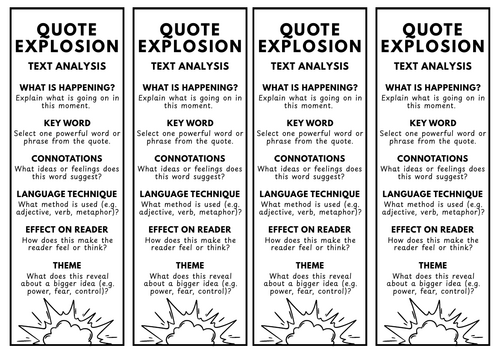
Here is how that reasoning could sound in a PEEZE paragraph:
Stevenson makes the entrance seem unsettling by describing the door as “blistered and distained.” The word “blistered” suggests damaged skin as well as peeling paint, making the building appear almost wounded; this may leave the reader uneasy about what lies behind its unwelcoming exterior.
The second sentence does more than translate “blistered” as “damaged.” It traces a connection: the word suggests injured skin; that association alters how we picture the door; our impression of the place becomes uneasy. That is word-level analysis with an effect, rather than a comment that merely repeats what the quotation says.
It also keeps its claim proportionate. The description does not prove that something violent has happened behind the door. “May leave the reader uneasy” is a defensible effect; “proves there is a murderer inside” would go beyond the evidence. In Gothic writing, uncertainty can itself be part of the effect.
Make the effect specific
An effect on the reader is not just an emotion attached to the end of a sentence. Compare these two comments about the same word:
“Blistered” makes the reader scared.
Because “blistered” can evoke injured skin, the damaged door may seem disturbingly lifelike, making the reader wary of the place it conceals.
The first names a feeling but leaves out the reasoning. The second explains what the reader might picture and why. You need not always write at that length, but the link between word, association and response should be clear.
Keep your analysis tied to the quotation’s immediate setting, too. “Blistered” might suggest damage, neglect or bodily injury; your job is to choose an association that advances your point, not to fit every possibility into one sentence. In this description, the absence of a bell or knocker strengthens the sense that the entrance is uninviting. It gives your reading of “blistered” support from the rest of the quotation.
When you write, aim for a precise chain of thought: identify the word, explain what it suggests here, then describe how that suggestion shapes the reader’s impression of the person or place. You can do this without naming a literary technique. If a technique genuinely helps explain the effect, use it—but do not let the label replace the explanation.
Conclusion
To analyse one word effectively, distinguish its literal meaning from its plausible connotations, select the association that fits the passage and question, and explain the resulting reader effect. A small detail such as “blistered” can do substantial work when you show how it changes our view of the scene.
Next, you will develop this close reading further by finding a distinct second inference—another insight that extends your argument rather than restating the first.