Recommended resources
The freely available resources this lesson will direct you to.
Hello! Welcome to the first lesson in our course on the great Japanese composers of Sega.
Given your interest in electronic music production and your technical background, I believe you'll find the hardware at the heart of these classic soundtracks fascinating. This first module, "The Sonic Palette," dissects the sound-generating hardware of the era.
Today, we'll focus on the star of the Sega Genesis/Mega Drive's sound system. Our goal is to describe the architecture and capabilities of the Yamaha YM2612 FM synthesis chip. Understanding this chip is the key to appreciating how composers like Yuzo Koshiro and Masato Nakamura crafted their iconic music. We will explore what FM synthesis is, how the YM2612 implements it, and what unique features and quirks gave the console its distinctive voice.
1. The Big Picture: Why Generate Sound in Real-Time?
Before we dive into the chip itself, it's crucial to understand the context of the 16-bit era. Modern games stream high-quality audio files, but this was impossible on a Sega Genesis cartridge, which often held only 1 or 2 megabytes for the entire game.
To understand this constraint and how developers overcame it, please watch the first part of the following video.
This is Why Sega Mega Drive/Genesis Music was Incredible
This video from The Nat Cave, titled 'This is Why Sega Mega Drive/Genesis Music was Incredible', provides excellent context on the hardware limitations of the time and introduces the concept of real-time sound generation.
Please watch from 01:22 to 03:43. Focus on the explanation of why pre-recorded music was not feasible and how sound chips were programmed to generate music 'on the fly'.
As the video explains, music wasn't stored as audio but as sequences of code. This code would instruct the console's sound hardware, in real-time, what notes to play and what timbres to use. The Sega Genesis used two sound chips for this purpose: the main Yamaha YM2612, which we're studying today, and a simpler Texas Instruments SN76489, which we'll cover in the next lesson.
2. The Core Concept: Frequency Modulation (FM) Synthesis
The YM2612 is an FM synthesizer. Given your experience with synths, you're likely familiar with subtractive synthesis, where you start with a harmonically rich waveform (like a square or saw wave) and filter out frequencies. FM synthesis works on a different principle, more akin to additive synthesis.
In its simplest form, FM synthesis uses one simple waveform, typically a sine wave, to modulate the frequency of another sine wave.
- The audible oscillator is called the Carrier.
- The modulating oscillator is called the Modulator.
By changing the frequency and amplitude of the modulator, you can introduce a vast range of new harmonic and inharmonic frequencies (called sidebands) into the carrier's output, creating timbres far more complex than a simple sine wave.
For a more detailed and technical explanation of how the YM2612 fits into the console's architecture and the basics of its FM implementation, please read the following text.
Mega Drive / Genesis Architecture | A Practical Analysis
This excerpt from 'Mega Drive / Genesis Architecture | A Practical Analysis' on copetti.org offers a concise, technical breakdown of the YM2612 and the principle of FM synthesis.
Read the section 'Yamaha YM2612'. It begins just after the 'Functionality' heading and ends before the 'Texas Instruments SN76489' section. Pay close attention to the definitions of carrier, modulator, and operator.
As the text notes, the combination of a carrier/modulator and its associated parameters is called an operator. This is the fundamental building block of sound in the YM2612.
3. The YM2612 Architecture
Now let's assemble these concepts into the full architecture of the chip.
Channels, Operators, and Algorithms
The YM2612 is defined by a few key numbers:
- 6 concurrent FM channels: It can play six different notes or sounds simultaneously.
- 4 operators per channel: Each of the six channels has four operators that can be combined to create one sound.
The "magic" of the YM2612 lies in how these four operators are combined. They aren't simply mixed together. Instead, they are arranged according to one of 8 algorithms. An algorithm is a specific configuration that dictates which operators are carriers (producing sound) and which are modulators (shaping the sound).
Have a look at this diagram, which shows the 8 algorithms and their common uses.
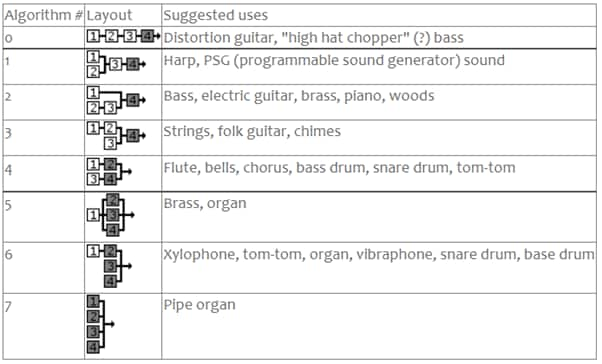
Notice how some algorithms, like #0, have a deep "stack" of modulators, leading to very complex, harmonically rich sounds. Others, like #3, have multiple carriers, allowing for layered sounds. The first operator in the stack (e.g., operator 1 in algorithms 0-6) also has a feedback loop, where it can modulate itself, which is often used to create saw-like or noisy textures.
Programming a Sound: Operator Parameters
To create a specific timbre, or "patch," a composer would set various parameters for each of the four operators in a channel. While there are many registers, the most musically important parameters are:
- Envelope Generator (AR, DR, SL, RR): Each operator has its own envelope, defining how its amplitude changes over time. It's similar to a standard ADSR envelope: Attack Rate, Decay Rate, Sustain Level, and Release Rate.
- Total Level (TL): This is the operator's peak volume or, more accurately, its attenuation level. For a modulator, TL controls the modulation depth, which dramatically affects the timbre. For a carrier, it controls the operator's volume in the final mix.
- Frequency Multiplier (MUL): This sets the operator's frequency as an integer multiple of the note's fundamental frequency. This is critical for creating harmonic or inharmonic relationships between operators. For example, setting multipliers to 1, 2, 3, and 4 can produce a rich, harmonic sound, while using fractional or high-integer multipliers can create dissonant, metallic, or bell-like timbres.
- Detune (DT): Allows for fine-tuning an operator's frequency, which is useful for creating phasing, chorus, or fattening effects.
To get a sense of the full scope of these parameters, I recommend skimming the following sections from a technical manual for a modern YM2612 emulator.
The user manual for the Aly James Lab 'FMDRIVE' VST provides an exhaustive list and explanation of the YM2612's parameters. It's a fantastic resource for a deep dive.
Skim through the sections 'THE YAMAHA YM2612 FM CHIP', 'OPERATOR CORE', 'ENVELOPE GENERATORS', and 'ALGORITHMS'. You don't need to memorize every detail, but get a feel for the level of control composers had over each operator and how algorithms and feedback are described.
4. Special Capabilities and Quirks
Beyond its core FM synthesis engine, the YM2612 had several other features that were essential to its sound and were cleverly exploited by composers.
- Stereo Panning: Each of the 6 channels could be panned hard left, hard right, or center.
- Low-Frequency Oscillator (LFO): A single, global LFO could be used to modulate the pitch (vibrato) or amplitude (tremolo) of any operator.
- Channel 6 DAC Mode: The sixth channel was special. It could be switched from a 4-operator FM channel into a Digital-to-Analog Converter (DAC) channel, allowing for the playback of low-resolution (typically 8-bit) PCM samples. This was the primary method for producing percussion sounds and voice clips. We will explore this in detail in a future lesson.
- Channel 3 "Special Mode": On this channel, the four operators' frequencies could be set independently of each other, rather than being simple multiples of a single note frequency. This allowed for the creation of highly complex, dissonant, and evolving sound effects or pads.
- The "Ladder Effect": The YM2612's built-in DAC was not perfectly linear. At low volumes, it introduced noticeable quantization noise and harmonic distortion. This flaw, often called the "ladder effect," gave the output a characteristic gritty and aggressive quality that is a huge part of the "Genesis sound." Many modern emulations specifically model this distortion. You can read a description of this in the "MD1 SEGA MEGADRIVE MODEL 1" section of the FMDRIVE manual (Resource ID
44b74, part 5).
Conclusion
This lesson has provided a technical overview of the Yamaha YM2612, the sonic engine of the Sega Genesis.
Here are the key takeaways:
- The YM2612 is a 6-channel FM synthesis chip, with 4 operators per channel.
- Sound is generated in real-time from code to save cartridge space.
- The relationship between operators is defined by one of 8 selectable algorithms, which determine the modulation structure.
- Composers shape timbres by programming parameters for each operator, such as their envelope (ADSR), volume/modulation depth (TL), and frequency relationship (MUL).
- Key capabilities include per-channel stereo panning, a global LFO, and special modes for Channel 6 (PCM/DAC samples) and Channel 3 (independent operator frequencies).
- An inherent flaw in the DAC creates the characteristic "ladder effect" distortion, a crucial part of the console's sonic identity.
You now have the foundational knowledge of the main sound chip. However, the YM2612 did not work in isolation. In our next lesson, we will explore its partner: the Texas Instruments SN76489 PSG. We'll see how this much simpler, older chip provided the foundational sounds for many early titles and was used to supplement the YM2612's output throughout the console's life.