Recommended resources
The freely available resources this lesson will direct you to.
- How Commercial Banks Really Create Money (the Money Multiplier is a MYTH).www.youtube.com
- How Banks Create Money From Nothing (Fractional Reserve Banking)www.youtube.com
- 4 Quarterly Bulletin 2014 Q1 Money in the modern economy: an introductionwww.bankofengland.co.uk
- e-money-faq-22122016_en.pdffinance.ec.europa.eu
Hello — this first module builds the foundation for the rest of the course: before tracing payment rails, cards, or stablecoin-to-card flows, you need to know which kind of money each participant is actually moving.
A customer’s account balance, a bank’s balance at the central bank, and a prepaid-wallet balance may all appear as numbers on a screen. But they are different legal and operational objects. The key is to stop asking only “where is the money?” and instead ask:
- Who issued this balance?
- Who has the claim against that issuer?
- What can this balance settle?
For partnership conversations in payments infrastructure, these questions prevent a common mistake: treating every digital balance as equivalent to “cash.”
Money as a claim on an issuer
Modern money is largely made of claims: one party’s asset is another party’s liability.
If you see EUR 1,000 in a bank account, you do not own a particular pile of notes held aside for you. You hold a claim on your bank for EUR 1,000, subject to the account terms. On the bank’s balance sheet, your account balance is a liability: the bank owes you that amount.
The same logic applies at a different level of the financial system:
- A commercial bank’s reserve balance is a claim on the central bank.
- A consumer’s bank deposit is a claim on a commercial bank.
- A customer’s e-money wallet balance is a claim on the e-money issuer.
The issuer matters because it determines risk, regulation, who may hold the balance, and how payments are ultimately settled.
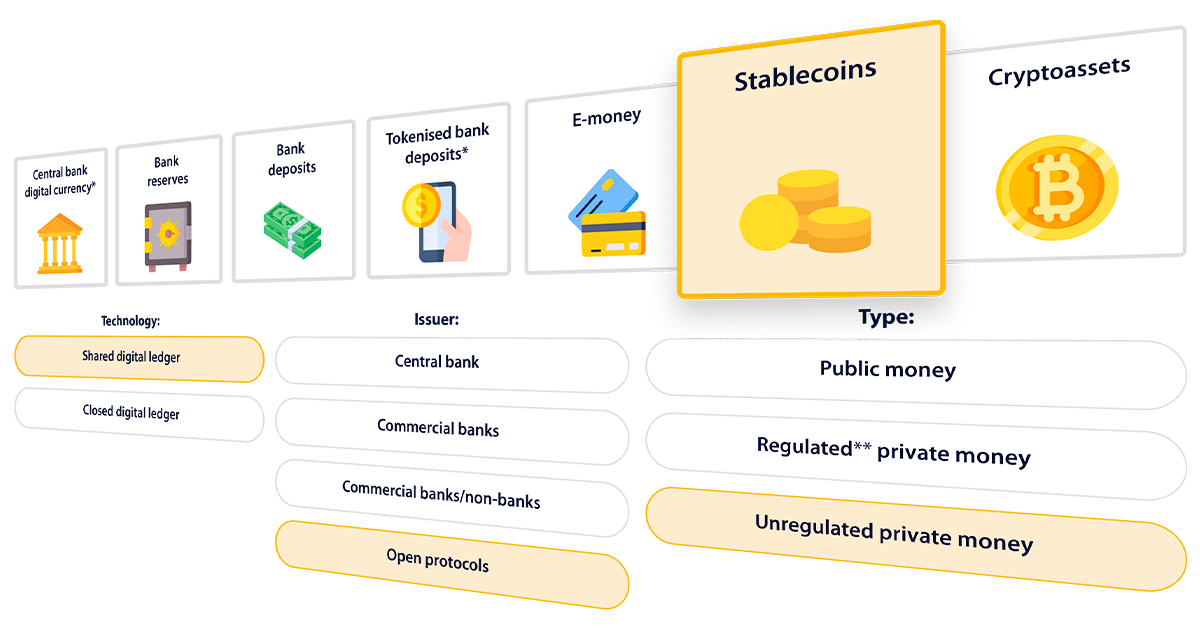
A useful way to picture the hierarchy is this:
| Form of value | Issuer | Typical holder | What the holder’s balance represents | Primary settlement use |
|---|---|---|---|---|
| Commercial bank deposit | Commercial bank | Consumers, businesses, other eligible customers | Claim on that commercial bank | Everyday retail and business payments |
| Central bank reserve | Central bank | Commercial banks and certain eligible financial institutions | Claim on the central bank | Settlement between financial institutions |
| Electronic money | Electronic money institution or bank | Consumers and businesses | Claim on the e-money issuer, issued in exchange for funds received | Payments through an e-money account, card, or wallet |
The three categories can be denominated in the same currency. A EUR balance is not necessarily the same kind of EUR balance merely because it displays “EUR.”
Commercial bank deposits: the money most customers use
For a household or business, the default form of money is usually a commercial bank deposit. Your current-account balance is the bank’s obligation to you. You can use that claim to pay another person or merchant because they, directly or through their own bank, accept it as payment.
A deposit has two important characteristics:
- It is a liability of the commercial bank and an asset of the depositor.
- It is generally payable on demand for transaction-account customers: the bank must execute a valid payment instruction or provide cash, subject to its terms, controls, and applicable law.
Commercial banks do not simply take a customer’s deposited cash, place it in a vault, and lend that exact cash onward. In simplified balance-sheet terms, when a bank makes a loan, it commonly creates two entries at the same time:
| Bank’s asset side | Bank’s liability side |
|---|---|
| New loan receivable from customer: EUR 10,000 | New deposit owed to customer: EUR 10,000 |
The borrower now owes the bank EUR 10,000 over time. At the same time, the bank owes the borrower EUR 10,000 on demand in the form of a deposit balance. That deposit is usable for payments.
This does not mean banks can create unlimited money without consequences. Lending is constrained by credit risk, capital requirements, liquidity needs, funding costs, regulation, and the bank’s ability to meet outgoing payments and withdrawals. But the sequence matters: lending creates a deposit; banks do not first need to collect an identical retail deposit and then hand it to the borrower.
How Commercial Banks Really Create Money (the Money Multiplier is a MYTH).
Watch “How Commercial Banks Really Create Money (the Money Multiplier is a MYTH)” by Money & Macro for a clear balance-sheet explanation of deposit creation and the distinct role of reserves.
Watch loan-created deposits to see the simultaneous creation of the customer’s loan obligation and the bank’s deposit obligation. Then watch real constraints, focusing on why reserves are not simply a pot of customer money that banks lend out, and why liquidity and capital nevertheless matter.
For payment purposes, deposits work in two ways:
- Within the same bank: if both payer and payee bank with Bank A, Bank A can reduce its liability to the payer and increase its liability to the payee. No interbank transfer is required.
- Across different banks: if the payer banks with Bank A and the payee banks with Bank B, the banks need a settlement asset between themselves. That asset is normally central bank money, especially reserves.
That second case is where central bank reserves enter the picture.
4 Quarterly Bulletin 2014 Q1 Money in the modern economy: an introduction
Read the Bank of England’s concise introduction for the core “who owes whom?” model. Although it uses UK examples, the issuer-and-claim logic applies directly to euro payments and other modern monetary systems.
In the section “Different types of money” on p. 8, begin where the article divides the economy into the central bank, commercial banks, and consumers. Read the initial map and identify the issuer and holder of each liability. Still on pp. 8–9, in the discussion following Figure 2, read the balance sheet explanation. Focus on the principle that every monetary balance is simultaneously one party’s asset and another party’s liability. Next, in “Bank deposits” on pp. 10–11, read the deposit discussion. Pay particular attention to the debit-card example and the explanation of lending-created deposits. Finally, locate “Central bank reserves” on p. 11 and read the reserves explanation. Notice the analogy: reserves play for banks a role broadly similar to a current account for a household or company.
Central bank reserves: money for settling between banks
Central bank reserves are electronic balances held at the central bank. In the simplified model, they are available to commercial banks, not ordinary consumers or businesses.
A reserve balance is:
- a liability of the central bank;
- an asset of the commercial bank holding it;
- a settlement asset used to discharge obligations between participating financial institutions.
A business cannot ordinarily ask its bank to “pay me in reserves.” Its bank can pay it in a commercial-bank deposit or physical cash. Likewise, a consumer cannot send reserves directly to a merchant. The consumer instructs their bank to send a payment; banks settle the resulting obligations using reserves.
Consider a simplified EUR 100 payment:
- A borrower has EUR 100 in a deposit at Bank A.
- The borrower pays EUR 100 to a merchant who banks with Bank B.
- Bank A reduces the borrower’s deposit by EUR 100.
- Bank B increases the merchant’s deposit by EUR 100.
- To settle the interbank obligation, Bank A’s reserve account is debited by EUR 100 and Bank B’s reserve account is credited by EUR 100.
The customer experiences a payment from one bank-account balance to another. The banks experience a movement of reserves between their central-bank accounts. These are different layers of the same payment.
This is why a payments product may look instantaneous to a customer while still requiring sophisticated liquidity management underneath. A bank or payment provider must ensure it can meet its settlement obligations in the appropriate settlement asset at the relevant time.
Do reserves “back” each individual bank deposit?
Not in the simple one-to-one sense. A bank does not usually maintain a separate reserve balance corresponding to every individual customer deposit. Its reserve position supports system-wide settlement needs, liquidity management, and regulatory requirements. The relationship is operationally important, but it is not “Alice’s EUR 500 deposit is stored as EUR 500 of reserves.”
For later payments lessons, retain this distinction:
- Deposits are customer money used for retail and business payments.
- Reserves are bank money used for interbank settlement.
Electronic money: payment value issued on receipt of funds
Electronic money, usually shortened to e-money, is electronically stored monetary value that represents a claim on its issuer. It is issued when the issuer receives funds and is intended for making payments. It must be accepted by someone other than the issuer itself.
This definition is important because “digital wallet” is not, by itself, a legal category. A wallet app might give a user access to:
- a commercial bank deposit;
- an e-money balance;
- a card-linked funding source;
- cryptoassets;
- or several of these at once.
You need to identify the underlying balance and the regulated entity behind it.
A typical e-money flow looks like this:
- A customer sends EUR 100 to an e-money institution, often from a bank account.
- The e-money institution issues EUR 100 of e-money to the customer’s wallet or prepaid-card account.
- The customer uses that e-money balance to make a payment.
- The institution redeems the e-money when the customer cashes out or transfers value according to the service’s functionality.
The customer’s balance is a claim on the e-money issuer, not automatically a deposit at the bank where the issuer safeguards its customer funds.
E-money versus a bank deposit
Both can support payments and can look almost identical in a mobile application. Their regulatory and economic structures differ.
| Question | Commercial bank deposit | Electronic money |
|---|---|---|
| Who commonly issues it? | A licensed credit institution or bank | An electronic money institution or a bank |
| What does the user hold? | A claim on the bank | A claim on the e-money issuer |
| How is it created? | Often through banking activities, including lending | Issued upon receipt of customer funds |
| Can the issuer use the funds to lend on its own balance sheet? | Banks may lend, subject to prudential rules and other constraints | E-money issuers are generally not permitted to use received e-money funds to grant credit |
| Main customer purpose | Holding funds, receiving money, saving and paying | Making payments and storing transaction value |
| Customer-fund protection model | Bank prudential regulation and, for eligible retail deposits, deposit-guarantee protection | Safeguarding of customer funds; this is not the same as deposit insurance |
The final row is especially important in fintech diligence. Safeguarding aims to protect relevant customer funds if an e-money issuer fails, often through segregation or insurance arrangements. It is not identical to a bank deposit guarantee, and the precise protection depends on the entity, country, product structure, and applicable law.
Read the European Commission FAQ for the core EU distinction between an e-money balance and a bank deposit. This is a 2016 explanatory document, so use it for the enduring conceptual framework rather than as current legal advice; the detailed EU regulatory framework will be covered later in the course.
Find the question “From a users perspective, what are the differences between funds in an e-money-account and in a deposit account?” Read the account comparison. Focus on two distinctions: e-money’s payment purpose and the prohibition on using received e-money funds to grant credit. Then locate the passage defining e-money under Article 2(2). Read the definition and storage forms. Note that e-money may sit on a device or be held remotely in an account; it is not limited to a physical prepaid card.
The settlement chain beneath an e-money payment
An e-money issuer can offer a smooth customer-facing payment experience without necessarily having direct access to central-bank reserves.
For example, an e-money institution may issue a prepaid card or a wallet balance. When its customer pays a merchant, the customer’s e-money balance is reduced. But the issuer and its banking partners still need to make sure that the merchant, acquirer, card scheme participants, or beneficiary bank ultimately receive the required funds through the relevant payment rail.
So there are often two layers:
| Layer | What happens |
|---|---|
| Customer-value layer | The e-money issuer reduces the customer’s e-money claim or authorizes a payment against it. |
| Financial settlement layer | The issuer, often via a safeguarding bank, sponsor bank, or payment partner, settles obligations through bank accounts and ultimately through the relevant settlement system. |
This is a useful commercial lens. A fintech may own the app, customer experience, and wallet logic, while relying on banks or other regulated partners for safeguarding, access to payment rails, settlement accounts, card issuing, or foreign exchange.
That allocation of roles is central to ecosystem partnerships. A partner proposition becomes clearer when you can state precisely:
- what the end customer holds;
- which entity owes the customer;
- where funds are safeguarded or deposited;
- who can access the payment rail;
- and which party carries liquidity and settlement responsibilities.
A practical classification habit
When assessing a fintech, wallet, neobank, or stablecoin-card proposition, first classify the fiat leg before discussing technology or tokenization.
Use this short diligence checklist:
- Balance type: Is the user’s EUR balance a bank deposit, e-money, a stablecoin, or merely a display of funds held elsewhere?
- Issuer: Which named legal entity owes the user that value?
- Customer protection: Is the relevant protection deposit guarantee, safeguarding, custody arrangements, or something else?
- Payment access: Does the provider participate directly in a payment system, or does it rely on a sponsor bank, EMI, processor, or other intermediary?
- Settlement asset: When value must move between financial institutions, what settles the obligation: reserve money, commercial-bank money at a settlement bank, or another asset?
A product can combine multiple layers. For instance, a crypto wallet may provide self-custody for on-chain assets, use an e-money account for fiat top-ups, and connect to a card program sponsored by a bank. Describing all of that simply as “a wallet” conceals the risk, regulatory, and partnership architecture that a senior partnerships role must uncover.
Key takeaways
- Commercial bank deposits are claims held by customers against commercial banks. They are the main form of money used by households and businesses for ordinary payments.
- Central bank reserves are claims held mainly by banks against the central bank. They are used to settle obligations between participating financial institutions, not by consumers at the checkout.
- Electronic money is a claim on an e-money issuer, issued on receipt of funds for payment use and accepted by third parties. It is distinct from a bank deposit even when the customer experience looks similar.
- A payment can involve several monetary layers at once: a customer spends a deposit or e-money balance, while providers and banks settle their obligations using bank accounts and, ultimately, central-bank money.
- In any payments partnership discussion, begin with issuer, customer claim, and settlement path—not with the app interface.
Next, we will separate the four stages that are often collapsed into the single word “payment”: initiation, authorization, clearing, and settlement.