Recommended resources
The freely available resources this lesson will direct you to.
Hello! Welcome to the final lesson in our module on the Integer Quantum Hall Effect and Chern Insulators.
In our last session, we derived the powerful TKNN formula, . This equation forged a profound link between a macroscopic transport measurement (the Hall conductivity) and a microscopic topological property of the bulk electronic bands (the Chern number). It provided the definitive explanation for the robust quantization observed in the Integer Quantum Hall Effect (IQHE), a phenomenon that requires a large external magnetic field to create Landau levels.
Today, we address a fascinating question that naturally follows: can a material exhibit a quantized Hall effect without any net magnetic field? The answer is a resounding yes, and the system that first illustrated this is the subject of our lesson. Our goal is to analyze the Haldane model on a honeycomb lattice, which serves as the foundational prototype for a Chern insulator, also known as a Quantum Anomalous Hall (QAH) insulator.
1. The Starting Point: Graphene and its Symmetries
The Haldane model is a clever modification of the tight-binding model for graphene. As you'll recall from our earlier work on the honeycomb lattice, the simple nearest-neighbor tight-binding model results in a band structure with gapless "Dirac points" at the K and K' corners of the Brillouin zone.
To create an insulator, we must open a gap at these points. One simple way is to make the two sublattices (A and B) inequivalent, for example, by having different atoms on each site (like in boron nitride) or by applying a staggered on-site potential. This is described by a term in the Hamiltonian:
where for sites on sublattice A and for sublattice B. This term breaks the inversion symmetry of the lattice.
However, this simple mass term preserves time-reversal (T) symmetry. As a result, while it does open a gap, the Berry curvature contributions from the K and K' valleys precisely cancel each other out. The total Chern number for the filled band is zero. This system is a trivial band insulator. To get a non-zero Chern number, we must break T-symmetry.
2. Constructing the Haldane Model: Breaking Time-Reversal Symmetry
In 1988, F. Duncan Haldane proposed a brilliant "toy model" that breaks T-symmetry in a subtle way. Instead of applying a uniform magnetic field, which would create a net magnetic flux through each unit cell, he introduced a spatially varying magnetic field that averages to zero over the unit cell but is locally non-zero.
This is implemented in a tight-binding model by adding a complex next-nearest-neighbor (NNN) hopping term.
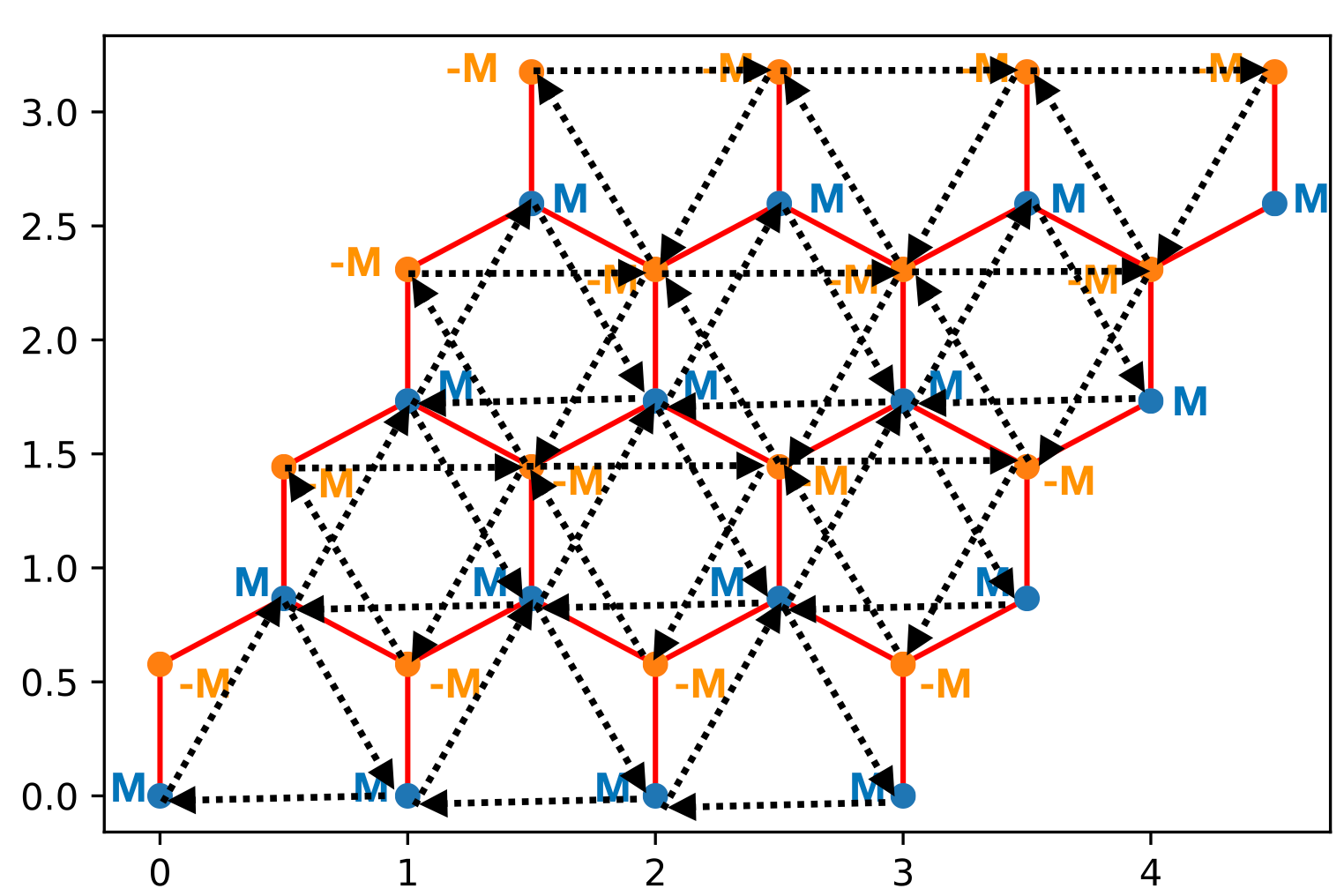
The full Hamiltonian for the Haldane model is:
The key new ingredient is the second term. The phase factor depends on the direction of the NNN hop. For example, all counter-clockwise hops acquire a phase , and all clockwise hops acquire . Since the Hamiltonian is no longer equal to its complex conjugate, T-symmetry is broken.
The following video provides an exceptionally clear, step-by-step construction of the model and its Hamiltonian.
The following segment from a lecture by the Weizmann Institute explains precisely how the Haldane model is constructed from the graphene model. It visualizes the complex NNN hopping and explains its effect on the Hamiltonian.
Please watch from 08:02 to 15:23. Pay close attention to how the complex NNN hopping is introduced, why it corresponds to a zero-net-flux magnetic field, and how this term manifests in the momentum-space Hamiltonian. The crucial takeaway is understanding how this new term acts differently on the A and B sublattices and at the K and K' points.
3. Topological Phase Diagram and the Chern Number
Now, let's analyze the consequences of this T-symmetry breaking term. As the video explained, the Haldane term effectively adds a momentum-dependent component to the mass. The full momentum-space Hamiltonian can be written in the familiar 2x2 form (ignoring a term proportional to the identity matrix). The components of the vector are:
- and come from the nearest-neighbor hopping , and are the same as in graphene.
The band gap is given by . A topological phase transition occurs when the gap closes, i.e., when for some . In the Haldane model, this happens at the K and K' points. The effective mass at these points is:
- At K:
- At K':
Notice the crucial difference: the Haldane term () has opposite signs at the two valleys.
The gap closes when either or . This happens at . These are the boundaries between different topological phases.
We can understand the phases by tracking the Chern number as we tune the staggered mass :
- Trivial Insulator (): When is very large, it dominates. The masses and have the same sign (the sign of ). The Berry curvature contributions from the two valleys have opposite signs and cancel out, giving a total Chern number .
- Topological Phase Transition (): As we decrease , we first hit a point where the gap closes at one valley (say, K). As we cross this point, changes sign.
- Chern Insulator (): Now, and have opposite signs. The Berry curvature contributions from the two valleys now add up instead of canceling! This results in a non-zero integer Chern number, . The system is a Chern insulator.
- Second Phase Transition (): Decreasing further, the gap closes at the other valley (K'), and flips its sign.
- Trivial Insulator (again): Now both masses have flipped their sign compared to the initial state. They once again have the same sign as each other, so the Chern number returns to .
The following video segment beautifully illustrates this process of gap closing and re-opening, showing how the distribution of Berry curvature changes and leads to a non-trivial topological phase.
This final segment from the Weizmann Institute lecture visualizes the phase diagram of the Haldane model. It shows how tuning the parameters causes the gap to close and reopen at the K and K' points independently, leading to a state with a non-zero Chern number.
Please watch from 15:23 to 20:10. Focus on the phase diagram and the visual representation of the Berry curvature (the red and blue coloring) in the different phases. See how crossing a critical line flips the curvature in one valley, leading to a net non-zero Chern number.
For a more detailed textual treatment that walks through the same logic using a simpler square-lattice analogue (the QWZ model) before tackling the Haldane model, you can refer to the following notes.
These lecture notes from ETH Zurich provide a very clear, step-by-step analysis of how Chern numbers change at gap-closing transitions. It first introduces a simple 2-band model (the QWZ model) to build intuition, then applies the same logic to the Haldane model.
I recommend skimming sections 4.2 ('The simplest Chern insulator') and 4.3 ('The Haldane Chern insulator'). You don't need to re-derive everything, but focus on the logic presented in Figures 4.7 and 4.10, which show how the Chern number (or Hall conductivity) changes as the mass parameter 'm' is tuned across the critical points where the gap closes.
Test your understanding!
Imagine you have a Haldane model with a fixed complex hopping such that . You then perform an experiment where you can tune the staggered potential from a large positive value down to a large negative value. Sketch the expected Hall conductivity (in units of ) as a function of .
Show answer
The phase transitions occur at .
- For , we are in a trivial phase. The masses at both valleys are positive. , so .
- At , the gap at the K point closes. When we cross this, becomes negative while is still positive. The Berry curvature contributions add up. Since the chirality of the Dirac fermion at K and K' are opposite, the change in Chern number is . The new Chern number is . Thus, for , we have .
- At , the gap at the K' point closes. When we cross this, becomes negative. The change in Chern number from the K' point is . The new Chern number is .
- For , we are back in a trivial phase. Both masses are negative. , so .
The sketch would show being zero for and dropping to a plateau at for the region .
4. Physical Consequences: The Quantum Anomalous Hall Effect
The existence of a phase with a non-zero Chern number is not just a mathematical curiosity. According to the TKNN formula, it has a direct physical consequence: a quantized Hall conductivity of at zero magnetic field. This phenomenon is called the Quantum Anomalous Hall (QAH) Effect.
Furthermore, the bulk-boundary correspondence guarantees that if the bulk has a Chern number , there must be chiral (one-way) conducting edge states at the boundary of the material. These dissipationless edge states are the physical manifestation of the non-trivial bulk topology and are responsible for carrying the quantized current.

Haldane's model was a theoretical prophecy for 25 years until 2013, when the QAH effect was experimentally observed in thin films of chromium-doped , a magnetic topological insulator. This discovery opened the door to a new field of research into topological electronics without the need for cumbersome external magnetic fields.
Conclusion
Today we have dissected one of the most important models in modern condensed matter physics. The Haldane model was the first to show that the topology of Bloch bands could be non-trivial even without Landau levels, giving rise to a quantized Hall effect driven entirely by the internal electronic structure of the material.
Key Takeaways:
- The Haldane model on a honeycomb lattice breaks time-reversal symmetry by introducing a complex next-nearest-neighbor hopping term, which corresponds to a spatially varying magnetic field with zero net flux.
- This T-breaking term acts as a momentum-dependent mass that has opposite signs at the K and K' valleys.
- By tuning a staggered sublattice potential , the system can be driven through topological phase transitions where the band gap closes at one valley at a time.
- This process leads to a topological phase, the Chern insulator, which is characterized by a non-zero integer Chern number ().
- The physical signature of a Chern insulator is the Quantum Anomalous Hall (QAH) effect—a quantized Hall conductivity at zero magnetic field, carried by chiral edge states.
Preview of the Next Lesson
The Haldane model and the IQHE both required breaking time-reversal symmetry to achieve a non-trivial topological phase. What happens if we insist on preserving T-symmetry? It turns out that topology can still play a crucial role. In the next lesson, we will begin our final module on topological matter by exploring systems that respect T-symmetry. We will see how this fundamental symmetry leads to a new kind of topological insulator, the Quantum Spin Hall insulator, which is protected by a different topological invariant, the invariant.