Recommended resources
The freely available resources this lesson will direct you to.
Hello! Welcome to your next lesson on topological matter.
In our previous lesson, we solved the quantum mechanics of a 2D electron gas in a magnetic field, discovering that its continuous energy spectrum collapses into a series of discrete, massively degenerate Landau levels. We found the energy of these levels to be and that each level can host electrons, where is the magnetic flux quantum.
Today, we will use this foundation to explain the remarkable experimental phenomenon of the Integer Quantum Hall Effect (IQHE). Our goal is to explain the origin of the precisely quantized Hall conductivity observed in these systems. We will see that this requires understanding the interplay between the sample's interior (the bulk) and its edges. This leads us to one of the most profound concepts in modern condensed matter physics: the bulk-boundary correspondence.
1. The Experimental Phenomenon: Plateaus and Zeros
The classical Hall effect, which you've likely encountered, predicts a Hall resistance that is linear in the applied magnetic field , and a longitudinal resistance that is constant. In the early 1980s, experiments on high-purity 2D electron gases at very low temperatures revealed something entirely different.
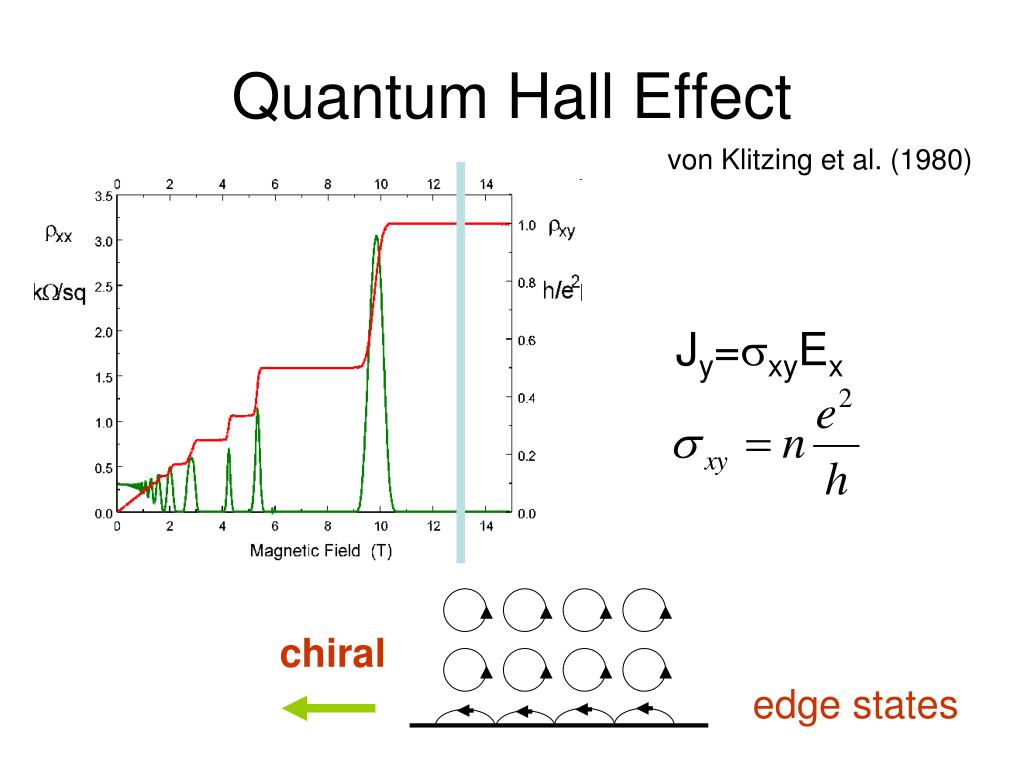
The key features are:
- Quantized Hall Plateaus: The Hall resistance is not linear but forms a series of plateaus at precisely quantized values , where is an integer, with astounding accuracy.
- Vanishing Longitudinal Resistance: On these plateaus, the longitudinal resistance drops to zero, indicating dissipationless transport.
To start, let's watch a brief review of the classical Hall effect and see how these quantum features emerge in high-mobility samples. This will also introduce the "swiss cheese" analogy for disorder, which will become very important later.
Integer and fractional quantum Hall effects: An Introduction
This video from TAUVOD provides a clear introduction to the classical Hall effect and a first look at the experimental data for the quantum Hall effect.
Please watch from 01:19 to 05:50. Pay attention to the distinction between longitudinal and Hall resistance and how the experimental data for a high-mobility sample deviates dramatically from the classical Drude model.
2. The Puzzle of the Plateaus and the Role of Disorder
Let's connect this experimental data to our picture of Landau levels. We define a crucial dimensionless quantity, the filling factor, :
The filling factor tells us how many Landau levels are filled with electrons. When is an integer, an integer number of Landau levels are completely filled, and the Fermi energy lies in the large energy gap between the highest filled level and the lowest empty one.
In this situation, the bulk of the material is an insulator, as there are no available states at to scatter into. This explains why . The Hall resistance can be calculated using the classical formula . Substituting , we get:
This correctly reproduces the quantized values! However, it presents a major puzzle:
As we vary the magnetic field , the filling factor should change continuously. Our simple model predicts quantization only at discrete values of where happens to be an integer. Why do we see wide, stable plateaus?
The answer, perhaps surprisingly, is disorder. No real sample is perfectly clean; there are always impurities and imperfections. These imperfections create a potential landscape that broadens the perfectly sharp Landau levels.
- States in the tails of these broadened levels become localized around individual impurities. Electrons in these states are trapped and do not contribute to transport.
- Only a small number of states near the center of the original Landau level remain extended throughout the sample and can carry current.
The crucial consequence is the creation of a mobility gap: a range of energies where all available states are localized. As long as the Fermi level lies within this mobility gap, the bulk remains insulating, and the transport properties remain unchanged. This pinning of the Fermi level within the mobility gap is what stabilizes the Hall plateaus over a finite range of magnetic field.
The following video provides an excellent, intuitive explanation for why the plateaus appear and how disorder is the hero of the story.
Integer and fractional quantum Hall effects: An Introduction
This segment of the TAUVOD video explains the 'plateau problem' and masterfully shows how disorder and the concept of localized vs. extended states resolve it.
Please watch from 22:18 to 30:09. Focus on the distinction between the naive prediction of quantization at single points and the experimental reality of plateaus. Then, understand how disorder creates localized states that act as a 'reservoir', allowing the Fermi level to remain in the mobility gap as the magnetic field changes.
3. The Boundary Picture: Chiral Edge States
We've established that for a Hall plateau, the bulk is an insulator with the Fermi level in a mobility gap. So where does the current flow? The answer lies at the edges of the sample.
Classically, you can imagine electrons near the edge trying to complete their cyclotron orbits. They collide with the boundary and "skip" along the edge, creating a net current.
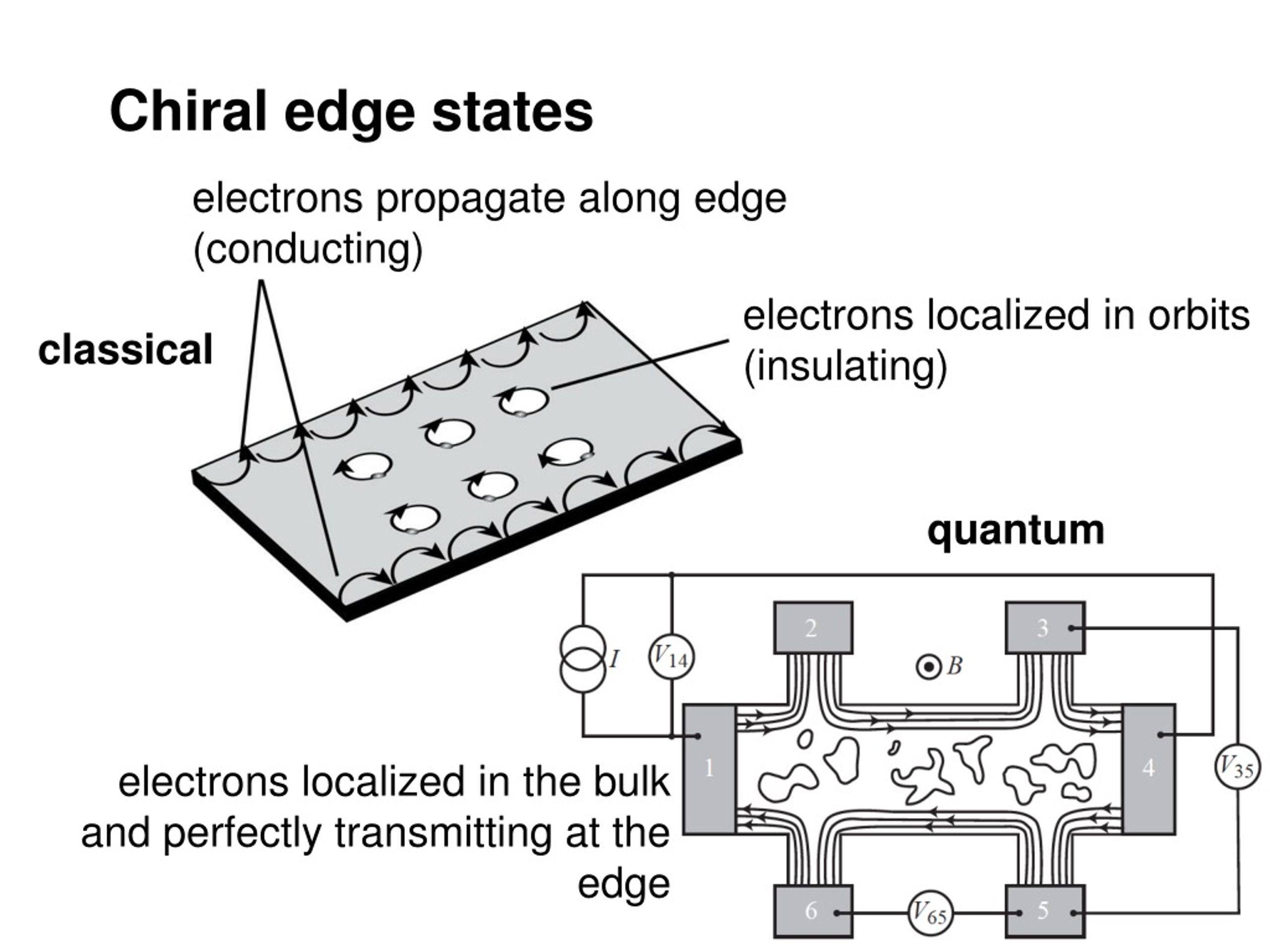
Quantum mechanically, the physical confinement of the sample creates a steep potential at the edges. This potential bends the Landau levels upwards in energy. While there is a gap in the bulk, these bent energy bands will necessarily cross the Fermi level at the edges.
This creates gapless edge states. The key properties of these states are:
- Chirality: States on opposite edges propagate in opposite directions. The direction is fixed by the magnetic field, and they cannot turn around.
- Robustness: Because left-movers and right-movers are spatially separated on opposite sides of the sample, an electron cannot backscatter (e.g., from a right-mover to a left-mover) without crossing the entire macroscopic sample. This is extremely unlikely.
This absence of backscattering is why transport is dissipationless, leading to . The Hall conductance is then perfectly quantized by the number of these chiral edge channels at the Fermi level. For filled Landau levels, there are edge channels, leading to a Hall conductance .
The following video provides a clear visualization of how the Landau levels bend at the edges to create these gapless conducting channels.
TMS21 Lecture 2. Jennifer Cano. Introduction to Topological Insulators, part 1
In this lecture by Jennifer Cano, you'll see a clear depiction of the bulk-boundary correspondence in action, showing how a gapped bulk necessitates gapless edge states.
Please watch from 04:09 to 06:26. Focus on the diagram showing how the flat Landau levels in the bulk must curve up at the sample edges, creating states that cross the Fermi energy.
4. The Bulk Picture: Topology and Laughlin's Argument
The edge state picture is powerful, but it doesn't fully explain why the quantization is so robust. The ultimate reason lies in the topology of the bulk electron wavefunctions.
Recall from our third lesson that the Hall conductivity can be expressed by the TKNN formula:
where is the Chern number, a topological invariant that is an integer for each gapped band. This formula tells us that the Hall conductivity is determined by a property of the bulk electronic structure, not the edges. For the IQHE, it can be shown that each filled Landau level has a Chern number . Therefore, if levels are filled, the total Chern number is , and .
A beautiful and powerful thought experiment by Robert Laughlin provides a more physical argument for why the bulk mandates this quantization, relying only on gauge invariance.
Imagine the 2D electron gas is bent into a cylinder. We then slowly thread one magnetic flux quantum, , through the center of the cylinder.
- Faraday's Law: The changing magnetic flux induces an electric field around the circumference of the cylinder.
- Hall Current: This electric field drives a Hall current along the length of the cylinder.
- Gauge Invariance: After inserting exactly one flux quantum, the system's Hamiltonian must return to its original state (it is equivalent to the original system via a gauge transformation). During this process, the bulk remains gapped, but the wavefunctions evolve. For the final state to be identical to the initial one, an integer number of electrons must have been transferred from one edge of the cylinder to the other.
- Quantized Conductance: By relating the total charge transferred () to the total flux inserted () and the Hall conductivity, one proves that must be an integer multiple of .
This argument is profound because it shows that quantization is a fundamental consequence of quantum mechanics in a gapped bulk, robust against details like disorder or the shape of the edges.
TMS21 Lecture 2. Jennifer Cano. Introduction to Topological Insulators, part 1
Jennifer Cano's lecture continues with a lucid explanation of Laughlin's flux insertion argument, one of the most elegant arguments in theoretical physics.
Please watch from 33:42 to 39:01. Follow the logic of how threading a single flux quantum in the Corbino/cylinder geometry necessitates the pumping of an integer number of electrons, which in turn proves the quantization of the Hall conductance.
5. Synthesis: The Bulk-Boundary Correspondence
We have now seen two perspectives:
- Boundary Picture: The quantized Hall current is carried by chiral, dissipationless edge states.
- Bulk Picture: The Hall conductance is fixed to by a topological property of the bulk wavefunctions (the Chern number), a fact robustly demonstrated by Laughlin's argument.
The deep connection between these two is the bulk-boundary correspondence. This principle states that the topological properties of the bulk dictate the existence and number of protected states at its boundary.
In the IQHE: The bulk is characterized by a topological invariant, the integer . The bulk-boundary correspondence guarantees that at an interface between this topological phase (the IQHE sample) and a trivial phase (the vacuum outside), there must be exactly gapless, chiral edge modes. The insulating bulk's topology protects the conducting edges.
To consolidate your understanding, please read the following brief document. It walks through both the edge and bulk pictures and explicitly states the correspondence.
This document from ETH Zurich provides a concise and clear written summary of the edge picture, Laughlin's argument, and the concluding bulk-edge correspondence.
Please read Section 2, 'The Edge Picture,' Section 2.3, 'The Role of Gauge Invariance' (which covers Laughlin's argument), and the short Section 4, 'Conclusion,' which ties it all together as the bulk-edge correspondence. This will reinforce the concepts from the videos in a textual format.
Test your understanding!
Imagine you have a sample exhibiting the IQHE at the plateau. A fabrication error creates a small, non-magnetic impurity (like a tiny bump) in the middle of one of the sample's edges. How would this impurity affect the measured value of ? Explain your reasoning based on the properties of the edge states.
Show answer
The measured value of would remain zero (or extremely close to it). The reason lies in the chiral nature of the edge states. On the plateau, there are two co-propagating edge channels moving in a single direction along the edge. When an electron in one of these channels encounters the impurity, it cannot simply scatter backward because there are no available states moving in the opposite direction at that edge. The states moving in the opposite direction are physically located on the other side of the sample. The electron can only scatter into another forward-moving state or go around the impurity. In either case, it continues to propagate along the edge without dissipation, and thus the longitudinal resistance remains zero. This demonstrates the topological protection of the edge states.
Conclusion
Today, we have unraveled the physics behind the Integer Quantum Hall Effect, revealing it to be the first experimental example of a topological phase of matter.
Key Takeaways:
- The IQHE is characterized by quantized plateaus in Hall resistance () and zero longitudinal resistance ().
- Disorder is essential for the formation of plateaus, creating a mobility gap of localized states that pins the Fermi level.
- The dissipationless current is carried by chiral edge states, which are robust to backscattering.
- The bulk-boundary correspondence is the central principle: the number of these protected edge states is dictated by a topological invariant (the sum of Chern numbers) of the insulating bulk.
Preview of the Next Lesson
We have now established a concrete physical system—the 2DEG in a magnetic field—where the topological Chern number has a direct physical consequence. In the next lesson, we will see that the magnetic field is not strictly necessary. We will analyze the Haldane model, a tight-binding model on a honeycomb lattice (like graphene) that realizes a quantum Hall effect at zero total magnetic field. This "Chern insulator" will serve as a beautiful theoretical bridge, connecting our analysis of Landau levels back to the more abstract lattice models of topology we began with.