Recommended resources
The freely available resources this lesson will direct you to.
Hello! Welcome back to our module on Graph Algorithms and Applications.
In the previous lesson, we implemented topological sort using Kahn's algorithm, a BFS-based approach that processes nodes by tracking their in-degrees. You saw how it systematically identifies nodes with no remaining prerequisites and adds them to a queue.
Today, we'll tackle the same problem from a different angle. Our goal is to implement topological sort on a DAG using a DFS-based approach. This method leverages the natural recursive structure of Depth-First Search to produce a valid ordering. By understanding both BFS and DFS-based solutions, you'll gain a more complete perspective on how different algorithmic strategies can solve the same problem, a key skill for evaluating trade-offs in system design.
1. The Core Idea: Post-Order Traversal
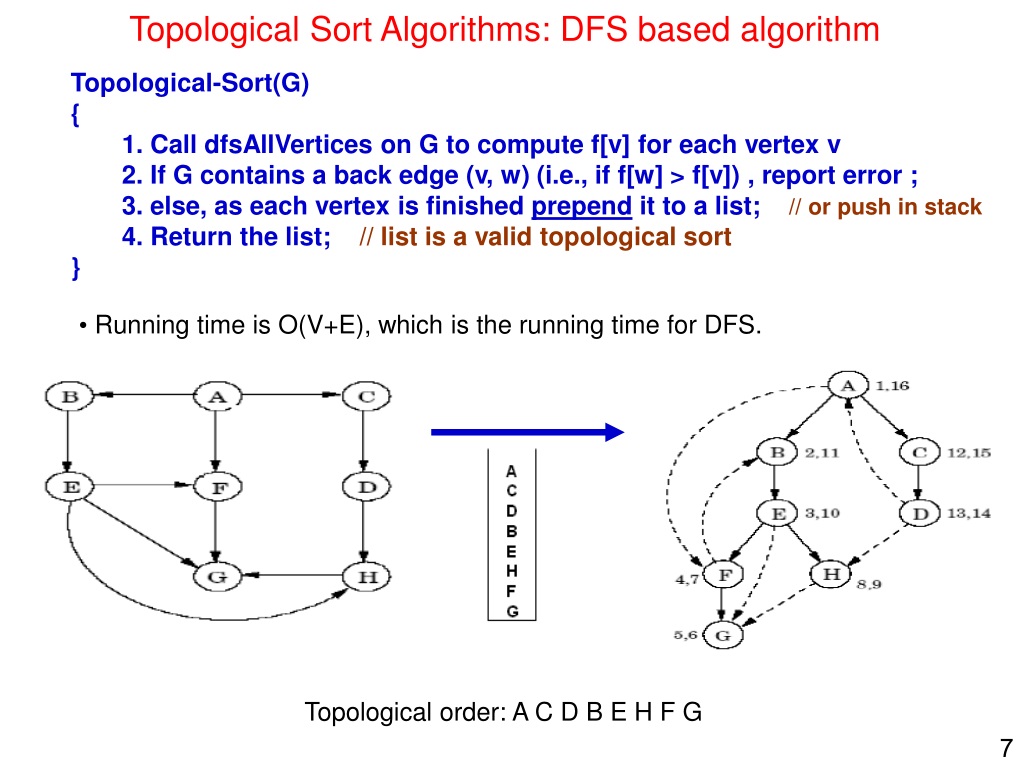
The intuition behind DFS-based topological sort is elegant. Think about what it means for a task (a node) to be "finished" in a dependency graph. A task can only be considered complete after all tasks that depend on it have been finished. In the context of a graph, a node is ready to be added to our sorted list only after we have fully explored all of its descendants.
This maps perfectly to a post-order traversal in DFS. In a recursive DFS, we visit a node, then recursively visit all its neighbors. The "post-order" step happens after all the recursive calls for its neighbors have returned.
The algorithm is as follows:
- Start a DFS from an arbitrary unvisited node.
- For the current node, recursively call DFS for all its unvisited neighbors.
- Once all neighbors have been visited (i.e., the recursive calls have returned), add the current node to the front of our result list.
- Repeat this process until all nodes in the graph have been visited.
Let's see this in action. The following video provides a clear, conceptual introduction and an animated walkthrough.
Topological Sort Algorithm | Graph Theory
This video from WilliamFiset's channel, which we've used before, provides an excellent and concise explanation of the DFS-based algorithm.
Please watch from 05:27 to 09:21. The first part introduces the simple, recursive logic. The second part is a detailed animation showing the call stack and how the topological ordering is built as the recursion unwinds. Focus on the moment a node is added to the ordering—it's always after its children in the DFS tree have been processed.
As the video illustrates, by adding each node to the result after its recursive calls complete, we ensure that for any edge , will be fully explored and added to the result before is. Since we add nodes to the front of the list (or append and then reverse), will ultimately appear before in the final ordering.
2. Implementing with Cycle Detection
The simple algorithm above assumes the graph is a DAG. In a real-world system, you can't make that assumption; you must handle invalid inputs gracefully. If the graph contains a cycle, a recursive DFS will loop forever, causing a stack overflow.
To make our implementation robust, we need to detect cycles. We can achieve this by tracking the state of each node during the DFS traversal. A node can be in one of three states:
- Unvisited: We haven't seen this node yet.
- Visiting: We are currently exploring this node's branch of the graph. It's on the current recursion call stack.
- Visited: We have finished exploring this node and all of its descendants.
A cycle is detected if, during our DFS, we encounter a node that is currently in the "visiting" state. This means we've found a back edge—an edge that leads from a node back to one of its own ancestors in the DFS tree.
The following video, which solves the "Course Schedule II" LeetCode problem, gives a fantastic walkthrough of implementing this three-state logic in Python.
Course Schedule II - Topological Sort - Leetcode 210
This NeetCode video provides a practical, code-focused explanation of DFS-based topological sort, including the crucial cycle detection logic.
Please watch from 09:29 to 16:15. Pay close attention to the use of two sets: visit (for the 'visited' state) and cycle (for the 'visiting' state). Understand how checking for a node in the cycle set is the key to detecting a cycle, and how a node is added to and removed from this set as the recursion goes down and back up.
3. Production-Quality Python Implementation
Now, let's synthesize these concepts into a complete, robust Python function. We'll use two sets to manage the node states, just as shown in the NeetCode video.
from collections import defaultdict

def dfs_topological_sort(n, edges):
    """
    Performs a topological sort on a DAG using a DFS-based approach.

    Args:
        n (int): The total number of nodes, labeled 0 to n-1.
        edges (list of lists): A list of directed edges, e.g., [[u1, v1], [u2, v2]].

    Returns:
        list: A list containing the topologically sorted nodes.
              Returns an empty list if the graph has a cycle.
    """


    # Build adjacency list
    adj_list = defaultdict(list)
    for u, v in edges:
        adj_list[u].append(v)

    topological_order = []


    # States:
    # `path` (or 'visiting'): nodes in the current recursion stack (detects cycles).
    # `visited`: nodes that have been fully explored.
    path = set()
    visited = set()

    def dfs(node):


        # Base case for cycle detection
        if node in path:
            return False # Cycle detected


        # If already fully visited, no need to explore again
        if node in visited:
            return True # Successfully visited before


        # Mark as on the current path and start exploring
        path.add(node)

        for neighbor in adj_list.get(node, []):
            if not dfs(neighbor):
                return False # Propagate cycle detection signal


        # All neighbors explored, remove from current path
        path.remove(node)


        # Mark as fully visited
        visited.add(node)


        # This is the post-order step: add to the result
        topological_order.append(node)
        return True


    # Iterate through all nodes to handle disconnected components
    for i in range(n):
        if i not in visited:
            if not dfs(i):
                return [] # Cycle detected, return empty list


    # The list is built in reverse order, so we reverse it at the end
    return topological_order[::-1]


# Example Usage:
num_nodes = 6
dependencies = [[5, 2], [5, 0], [4, 0], [4, 1], [2, 3], [3, 1]]

sorted_tasks = dfs_topological_sort(num_nodes, dependencies)

if sorted_tasks:
    print(f"Valid topological order: {sorted_tasks}")


    # Possible output: [5, 4, 2, 3, 1, 0] or [4, 5, 2, 3, 1, 0]
else:
    print("A cycle was detected in the task dependencies.")


# Example with a cycle:
cyclic_deps = [[0, 1], [1, 2], [2, 0]]
sorted_tasks_cyclic = dfs_topological_sort(3, cyclic_deps)

if not sorted_tasks_cyclic:
    print("Correctly detected a cycle.")
Code Analysis
pathset: This corresponds to thecycleset in the video. It tracks nodes on the current recursion path. A node is added upon entering itsdfscall and removed just before returning.visitedset: This tracks nodes that have been completely processed. This prevents redundant work in graphs with multiple paths to the same node or in disconnected graphs.- Return values: The
dfshelper returnsFalseto signal a cycle, which is propagated up the call stack to the main loop. This is a clean way to halt execution immediately. - Final Reverse: Because we
appendnodes in post-order, the resulting list is a valid topological sort, but in reverse. We reverse it once at the very end to get the final order.
4. Connection to Your Background: Rust & Iterative DFS
Given your strong background in Rust, it's helpful to see how this recursive logic translates. The core principles of state management (visiting, visited) and post-order processing remain identical.
Chapter 15 - Modern Data Structures and Algorithms in Rust
The book 'Modern Data Structures and Algorithms in Rust' provides a concise Rust implementation of DFS-based topological sort. This will help you map the Python concepts to a Rust context.
In this resource, find the section with the sample implementation for topological_sort_dfs. Compare its structure to our Python dfs function. Notice that this simple version uses only a visited array and a stack for the result. It doesn't include explicit cycle detection, which highlights a key difference between a textbook example and a production-ready one. In Rust, you would add a second boolean vector or a HashSet to track the recursion path, just as we did in Python.
A final point on "production quality": deep recursion can cause stack overflow errors in any language. For extremely deep graphs (e.g., a dependency chain of millions of tasks), an iterative DFS using an explicit stack is a more robust alternative. While we won't implement it here, being aware of this trade-off between recursive elegance and iterative robustness is important.
Conclusion
Today, you've added a powerful, recursive alternative for topological sorting to your toolkit.
Key Takeaways:
- DFS-based topological sort relies on a post-order traversal. A node is added to the result only after all its descendants have been fully explored.
- Robust implementation requires cycle detection. This is typically done by maintaining three node states: unvisited, visiting (on the current recursion path), and visited.
- Encountering a node in the "visiting" state indicates a back edge and thus a cycle.
- The time and space complexity are both , identical to a standard DFS traversal. The space complexity includes the recursion stack depth, which can be up to in the worst case.
Next Lesson Preview
You've now implemented topological sort using both a BFS-based (Kahn's) and a DFS-based algorithm. Which one is better? The answer, as is often the case in engineering, is "it depends." In the next lesson, we will compare the trade-offs between Kahn's algorithm and the DFS approach, discussing scenarios where one might be preferred over the other.