Recommended resources
The freely available resources this lesson will direct you to.
Hello! Welcome back to our module on Graph Algorithms and Applications.
In our last lesson, we compared Kahn's algorithm and the DFS-based approach for topological sorting. We established that both algorithms are predicated on a fundamental assumption: the graph must be a Directed Acyclic Graph (DAG). In any real-world system, from a task scheduler to a build system, you can't assume inputs will always be valid. A robust system must validate its inputs and handle malformed data gracefully.
This lesson focuses on that crucial validation step. Our goal is to implement a robust cycle detection algorithm for a directed graph to handle invalid inputs. Detecting a circular dependency (e.g., Task A depends on B, and B depends back on A) is essential for preventing infinite loops and ensuring system stability. This is directly analogous to ensuring Quality of Service (QoS) in a service like Rudi, where you must handle invalid or problematic requests without compromising the entire system.
1. The Core Challenge: Identifying "Back Edges"
At its heart, cycle detection in a directed graph using Depth-First Search (DFS) is about finding a specific type of edge: a back edge.
- A back edge is an edge that goes from a node to one of its ancestors in the DFS traversal tree. In simpler terms, it's an edge that takes you from where you are back to a node you're currently in the middle of visiting.
Let's look at a visual example.
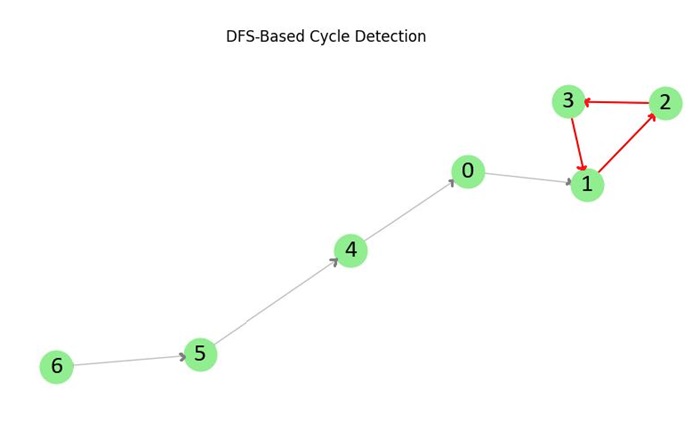
A naive approach might be to run DFS and just keep a visited set. If we encounter a node that's already in the visited set, we have a cycle, right? Not quite.
Consider the graph A -> B and A -> C. If we run DFS from A, we might visit B first. Later, when we explore C, we haven't created a cycle. Or in a more complex graph, you might have an edge from one fully explored branch to another (a "cross edge"). A simple visited set can't distinguish between a harmless edge to an already-finished node and a true back edge that forms a cycle.
To solve this, we need to track not just if a node has been visited, but also its state during the traversal.
2. The 3-State (or 3-Color) DFS Algorithm
The standard, robust solution is to categorize nodes into three states during the DFS traversal. This is often called the "3-color algorithm".
- WHITE: The node has not been visited yet. (Initial state for all nodes).
- GRAY: The node is currently being visited. It's in the current recursion stack.
- BLACK: The node and all of its descendants have been fully visited. The recursion for this node has finished.
With these states, the logic for cycle detection becomes precise:
A cycle is detected if and only if our DFS traversal from a node
uencounters an adjacent nodevthat is currently in the GRAY state.
This works because a gray node is, by definition, an ancestor in the current DFS path. An edge to a gray node is a back edge.
To learn more about the theory behind this and other edge types (like forward and cross edges), the following article provides excellent formal definitions.
Depth-First Search (DFS) - Medium
The article 'Depth-First Search (DFS)' provides a formal breakdown of different edge types in a DFS traversal and introduces the 3-state color method for cycle detection.
Please read the sections titled 'Types of edges' and 'Step A: Validation (Cycle Detection via DFS)'. Focus on understanding the definition of a Back Edge and how the 3-state (White, Grey, Black) method is used to find one. Don't worry about the pseudocode just yet; focus on the concepts.
Now, let's watch a video that visualizes this process step-by-step. It clearly shows how nodes move between the white, gray, and black sets and how a cycle is caught.
Detect Cycle in Directed Graph Algorithm
The video 'Detect Cycle in Directed Graph Algorithm' by Tushar Roy provides an excellent animated walkthrough of the 3-state DFS algorithm.
Watch from the beginning until 05:50. Pay close attention to how nodes are moved between the 'white', 'gray', and 'black' sets as the DFS progresses and what happens when the algorithm encounters a node that is already in the gray set.
3. Implementation in Python
Now let's translate this concept into production-quality Python code. Instead of using colors, we can implement the three states using two sets (or boolean arrays):
visiting: This corresponds to the GRAY set. It tracks nodes currently in the recursion stack.visited: This corresponds to the BLACK set. It tracks nodes that have been completely explored.
Any node not in visiting or visited is, by definition, WHITE.
Here is the structure of a robust implementation.

The implementation requires two parts: a main function to handle disconnected components and a recursive helper to perform the DFS.
from collections import defaultdict

def has_cycle(num_nodes: int, edges: list[list[int]]) -> bool:
    """
    Checks if a directed graph contains a cycle.

    The graph is represented by the number of nodes and a list of edges.
    Handles disconnected components by iterating through all nodes.
    """


    # 1. Build the adjacency list
    adj = defaultdict(list)
    for src, dst in edges:
        adj[src].append(dst)


    # 2. Initialize state trackers
    visited = set()   # Corresponds to BLACK set (fully explored nodes)
    visiting = set()  # Corresponds to GRAY set (nodes in current recursion path)


    # 3. Iterate through all nodes to handle disconnected graphs
    for node in range(num_nodes):
        if node not in visited:


            # If a cycle is found starting from this node, return True immediately
            if has_cycle_recursive(node, adj, visited, visiting):
                return True


    # If the loop completes, no cycles were found
    return False

def has_cycle_recursive(node: int, adj: dict, visited: set, visiting: set) -> bool:
    """
    Recursive DFS helper to detect a cycle.
    Returns True if a cycle is detected, False otherwise.
    """


    # Add the current node to the 'visiting' path
    visiting.add(node)

    for neighbor in adj[node]:


        # CASE 1: Cycle detected! The neighbor is in the current recursion path.
        if neighbor in visiting:
            return True


        # CASE 2: Neighbor has not been visited yet, recurse.
        if neighbor not in visited:
            if has_cycle_recursive(neighbor, adj, visited, visiting):


                # Propagate the 'True' result up the call stack
                return True


    # Backtrack: Remove node from the current path
    visiting.remove(node)


    # Mark node as fully visited
    visited.add(node)


    # No cycle was found from this node's path
    return False


# Example Usage:
# Graph 1: 0 -> 1 -> 2 -> 0 (has a cycle)
edges1 = [[0, 1], [1, 2], [2, 0]]
print(f"Graph 1 has cycle: {has_cycle(3, edges1)}") # Expected: True


# Graph 2: 0 -> 1, 0 -> 2 (DAG, no cycle)
edges2 = [[0, 1], [0, 2]]
print(f"Graph 2 has cycle: {has_cycle(3, edges2)}") # Expected: False
Key aspects of this implementation:
- Robustness for Disconnected Graphs: The main
has_cyclefunction iterates from0tonum_nodes - 1. This ensures that even if the graph consists of multiple separate components (e.g.,0->1and2->3), we will check all of them for cycles. - Clear State Management: The
visitingset is the key. A node is added to it when we enter its recursion and removed when we leave. This perfectly models the "recursion stack" concept.visitedacts as an optimization, preventing us from re-exploring branches we already know are acyclic. - Complexity: The time complexity is , where is the number of vertices and is the number of edges, because each node and edge is visited once. The space complexity is for the recursion stack and the state-tracking sets.
To see this logic applied to a common interview problem, watch the following video. It solves the "Course Schedule" problem on LeetCode, which is fundamentally a cycle detection problem.
Course Schedule - Graph Adjacency List - Leetcode 207
The video 'Course Schedule' from NeetCode demonstrates a Python implementation of cycle detection to solve a classic interview question.
Watch from 09:14 to 15:25. The 'visit set' he describes is equivalent to our 'visiting' set (the GRAY state). He also shows why you need to iterate through all courses to handle disconnected graphs.
The NeetCode solution uses a clever optimization: once a course's path is confirmed to be completable (acyclic), he clears its prerequisites (preMap[course] = []). This serves the same purpose as our visited (BLACK) set—it ensures that future checks on this node return immediately, avoiding redundant work. This is a great trade-off to discuss in an interview: my implementation is perhaps more explicit with its state management, while his is slightly more memory efficient by modifying the graph representation in place.
Conclusion
You are now equipped to implement a robust cycle detection algorithm, a critical component for any system that processes directed graphs. This is not just an abstract algorithmic puzzle; it's a practical necessity for building reliable software that can handle a wide range of inputs without failure.
Key Takeaways:
- Cycle detection in a directed graph is about finding a back edge—an edge from a node to one of its ancestors in the DFS path.
- A simple
visitedset is insufficient. The robust solution uses a 3-state system: unvisited (WHITE), visiting (GRAY), and fully visited (BLACK). - A cycle is found when the DFS traversal encounters a neighbor that is in the GRAY state (i.e., in the current recursion stack).
- A complete implementation must iterate through all nodes in the graph to correctly handle disconnected components.
Next Lesson Preview
In this lesson and the previous ones, we've encountered various edge cases like cycles, disconnected components, and self-loops (A -> A). While we've handled them as part of other algorithms, our next lesson will focus squarely on them. We will formally adapt graph traversal algorithms to correctly handle disconnected components and self-loops, ensuring your graph-processing code is truly production-ready.