Recommended resources
The freely available resources this lesson will direct you to.
Hello! Welcome back.
In our previous lesson, we established a foundation for writing clean, self-documenting code using type hints and dataclasses. You learned how to define robust data structures that are both clear and boilerplate-free.
Now that we know how to define what our data looks like, let's focus on how we store and access collections of it. Dictionaries are ubiquitous in Python, but not all dictionary-like objects are created equal. This lesson addresses the learning outcome: Differentiate between standard dicts, collections.OrderedDict, and collections.defaultdict for various use cases.
Mastering these tools is essential for writing efficient and "Pythonic" code. In an interview setting, choosing the right tool demonstrates a deep understanding of the language that goes beyond basic syntax.
1. dict vs. collections.OrderedDict: The Modern Landscape
A crucial fact about modern Python (3.7 and later) is that the standard dict is guaranteed to preserve insertion order. This was an implementation detail in Python 3.6 before becoming an official language feature. This naturally raises the question: if dict is ordered, why does collections.OrderedDict still exist?
To understand this, it's helpful to know the history.
python insertion-ordered dicts (beginner - intermediate) anthony explains #212
The video 'python insertion-ordered dicts' from anthonywritescode provides excellent context on how and why standard dictionaries became ordered.
Watch from the beginning to 3:44. Focus on the timeline of this change, from its proposal to its implementation in CPython, and the official guarantee in Python 3.7.
As you saw, the ordering of standard dictionaries was a side effect of an optimization for memory and speed. OrderedDict, on the other hand, was specifically designed for order-based operations. This design difference gives OrderedDict a few key capabilities that the standard dict lacks.
Key Differentiators of OrderedDict
While a standard dict is now sufficient for most cases where you just need to preserve insertion order, OrderedDict provides specialized methods and behaviors for more complex scenarios.
OrderedDict in Python is Awesome
The video 'OrderedDict in Python is Awesome' from Indently provides a clear visual demonstration of the unique features that OrderedDict offers.
Watch from 01:54 to 05:00. Pay close attention to the demonstrations of: popitem(last=False): How it can remove items from the beginning (FIFO) instead of the end (LIFO). move_to_end(): How it allows for explicit reordering of elements. Order-sensitive equality: How OrderedDict comparisons depend on the order of items, unlike standard dicts.
To solidify these concepts and analyze the trade-offs, let's turn to a detailed article.
OrderedDict vs dict in Python: The Right Tool for the Job
The article 'OrderedDict vs dict in Python' from Real Python is a comprehensive guide. We'll focus on the sections that detail the unique features and the performance implications.
Please read the following sections (about 10 minutes): "Exploring Unique Features of Python’s OrderedDict": This section recaps the methods you just saw in the video (.move_to_end(), .popitem()) and the difference in equality testing. "Considering Performance": This directly addresses the trade-offs in speed and memory that your learner profile indicated you're interested in. dict is generally faster and more memory-efficient. "Selecting the Right Dictionary for the Job": Review the summary table here. It's a great cheat sheet for comparing the two.
So, while you should default to using the standard dict, OrderedDict remains the superior tool when your logic depends on explicitly managing and reordering items or when order must be part of the equality contract.
Practical Use Case: Implementing an LRU Cache
The most compelling use case for OrderedDict is implementing a Least Recently Used (LRU) cache, a very common interview problem. An LRU cache evicts the least recently used item when the cache reaches its capacity.
Conceptually, an efficient LRU cache is built with a hash map for O(1) lookups and a doubly linked list to track recency in O(1).
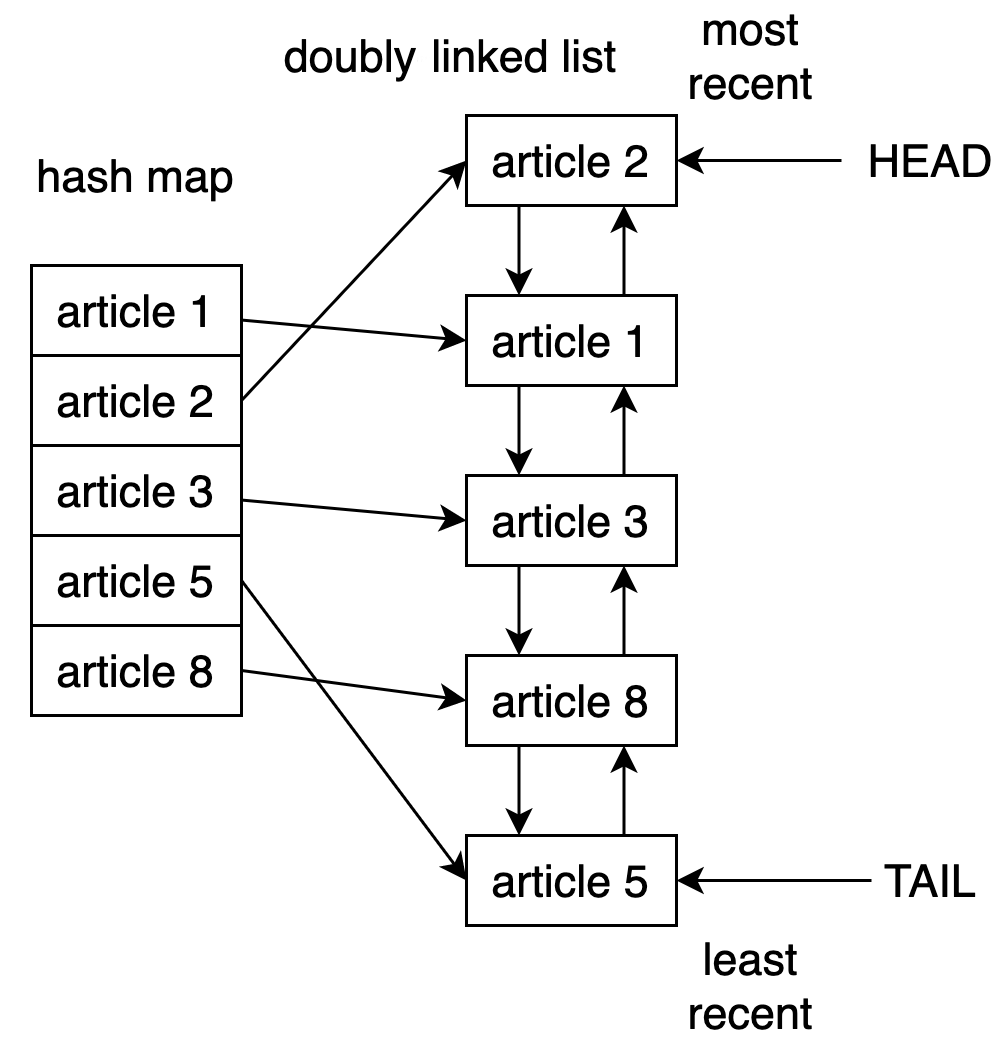
The move_to_end() and popitem(last=False) methods of OrderedDict are perfectly suited for this.
- When an item is accessed (
get), we usemove_to_end()to mark it as the most recently used. - When a new item is added (
insert) and the cache is full, we usepopitem(last=False)to evict the least recently used item from the front.
Let's see this in a real implementation.
Building a fully typed LRU Cache in Python - Justin A. Ellis
The article 'Building a fully typed LRU Cache in Python' uses OrderedDict to create an elegant and efficient cache. We will focus on the specific paragraph that justifies this choice.
Read the paragraph within the 'Building the cache class' section that begins with "As for implementation, as mentioned above...". This short paragraph is the key takeaway, as it perfectly articulates why OrderedDict is the right tool for this job.
We will implement an LRU cache from scratch later in the course, but understanding this application is the best way to appreciate the continued relevance of OrderedDict.
2. collections.defaultdict: Handling Missing Keys Elegantly
While OrderedDict specializes in managing item order, defaultdict specializes in handling missing keys. It's a subclass of dict that allows you to provide a "default factory" function.
Consider this common pattern for grouping items:
# Grouping words by their first letter
words = ['apple', 'ant', 'ball', 'bat', 'cat']
grouped = {}
for word in words:
    first_letter = word[0]
    if first_letter not in grouped:
        grouped[first_letter] = []  # Initialize with an empty list
    grouped[first_letter].append(word)


# grouped is now {'a': ['apple', 'ant'], 'b': ['ball', 'bat'], 'c': ['cat']}
This code works, but the if/else block adds boilerplate. defaultdict streamlines this significantly.
from collections import defaultdict

words = ['apple', 'ant', 'ball', 'bat', 'cat']


# Provide the `list` constructor as the default factory
grouped = defaultdict(list)

for word in words:
    first_letter = word[0]


    # If `first_letter` is not in `grouped`, `list()` is called to create
    # a new empty list, which is assigned to grouped[first_letter].
    # Then, append proceeds as normal.
    grouped[first_letter].append(word)
When you try to access a key that doesn't exist, the default_factory (in this case, the list constructor) is automatically called without arguments to create a default value. This new value is inserted into the dictionary for that key, and then returned.
Other common factories include:
defaultdict(int): Useful for frequency counters. Accessing a missing key returns0.defaultdict(set): Useful for collecting unique items per key.
Using defaultdict where appropriate is a strong signal of Python fluency.
3. Summary and Decision Guide
Choosing the right dictionary type is a matter of selecting the most precise and efficient tool for your specific problem.
| Use Case | Recommended Tool | Rationale |
|---|---|---|
| General key-value storage | dict |
The modern dict is the default. It's fast, memory-efficient, and preserves insertion order (Python 3.7+). |
| Grouping or counting items | defaultdict |
Dramatically simplifies the code for aggregating items into collections (lists, sets) or counting frequencies. |
| Implementing an LRU Cache | OrderedDict |
The .move_to_end() and .popitem(last=False) methods are tailor-made for efficient reordering and eviction logic. |
| Explicitly reordering items | OrderedDict |
If you need to move items to the front or back of a mapping as part of your core logic, OrderedDict is the only choice. |
| Order-sensitive equality | OrderedDict |
Use when two dictionaries should only be considered equal if they have the same items in the same order. |
| Backward compatibility (< 3.7) | OrderedDict |
If your code must run on older Python versions and requires guaranteed order, OrderedDict is necessary. |
Conclusion
In this lesson, you've learned to look beyond the standard dict and understand the specific roles of its powerful cousins from the collections module.
Key Takeaways:
dictis your fast and memory-efficient default choice, with guaranteed insertion order in modern Python.OrderedDictis a specialized tool for when you need explicit control over item order (move_to_end,popitem(last=False)) or order-sensitive equality checks. Its classic use case is the LRU cache.defaultdictis your go-to for simplifying code that groups, aggregates, or counts items by eliminating the need to check for key existence before initialization.
Recognizing when to use each of these demonstrates a level of proficiency that is highly valued in technical interviews.
Next Lesson
We've now covered how to define data (dataclasses) and store it in various dictionary types. Next, we'll continue our exploration of the collections module by focusing on another high-performance container: collections.deque. You'll learn how to implement efficient queue-based and sliding-window algorithms, which are common patterns in coding challenges.