Recommended resources
The freely available resources this lesson will direct you to.
- Python Tutorial: AsyncIO - Complete Guide to Asynchronous Programming with Animationswww.youtube.com
- Using Rust in Free-Threaded vs Regular Python 3.13 - David Hewittwww.youtube.com
- Async programming - Incan Documentationincan.io
- Concurrent Tasks: create_task(), gather(), and TaskGroup()agentfactory.panaversity.org
Hello! Welcome to your eighth and final lesson in the "Production-Quality Python for Interviews" module.
In our last lesson, we focused on building resilient software through robust error handling, covering input validation with Pydantic, creating custom exception hierarchies, and managing resources safely. These skills are crucial for writing code that can withstand the unpredictability of production environments.
Today, we'll bridge your deep expertise in Rust and Tokio with the world of Python concurrency. This lesson addresses the learning outcome: Map concurrency patterns from Rust/Tokio (e.g., channels, mutexes) to their Python equivalents in threading and asyncio.
Given your experience building Rudi, you're intimately familiar with high-performance, concurrent systems. This lesson will feel less like learning new concepts and more like translating familiar ones into a new syntax, while paying close attention to the fundamental differences in how Python and Rust approach concurrency. We will cover:
- The Global Interpreter Lock (GIL) and its impact on Python concurrency.
- Mapping primitives from Rust to Python's
threadingmodule. - Mapping Tokio patterns to Python's
asynciolibrary. - A framework for choosing the right concurrency model in Python.
1. The Global Interpreter Lock (GIL): Python's Concurrency Caveat
The most significant difference between concurrency in Rust and Python is the Global Interpreter Lock (GIL). The GIL is a mutex that protects access to Python objects, preventing multiple native threads from executing Python bytecode at the same time within a single process.
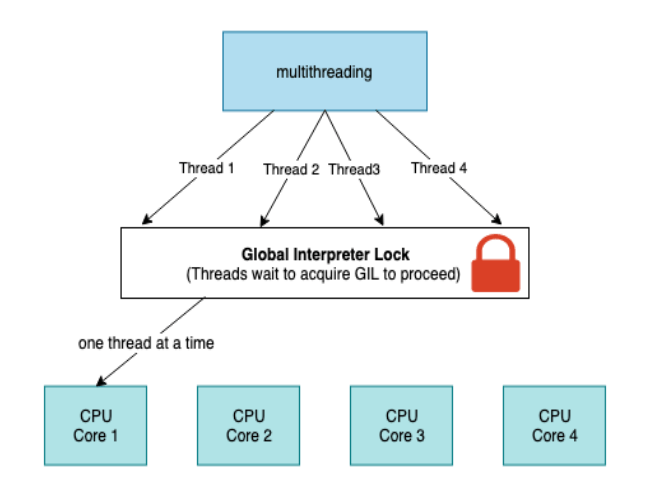
This means that even on a multi-core processor, only one thread can be executing Python code at any given moment. For CPU-bound tasks, this makes Python's threading model unable to achieve true parallelism, a stark contrast to Rust's fearless concurrency.
This video from PyCon US provides an excellent explanation of the GIL and how it relates to the concurrency challenges that Rust is designed to solve at the language level.
Using Rust in Free-Threaded vs Regular Python 3.13 - David Hewitt
The speaker, David Hewitt, explains the GIL and the data race challenges it introduces, which will resonate with your understanding of Rust's safety guarantees.
Watch the following two clips: The GIL Explained (01:08 - 04:23): This part visually explains how the GIL forces threads to take turns and introduces the concept of data races, which are a primary concern in multi-threaded programming. Rust's Solution (04:23 - 05:21): This clip introduces Rust's core principle of 'aliasing XOR mutability' (shared data cannot be modified). This is the foundation of Rust's compile-time safety and provides a conceptual anchor for how to think about safety in Python's more manual concurrency models.
The GIL's existence leads to three distinct concurrency models in Python:

asyncio: Cooperative multitasking on a single thread. Ideal for I/O-bound tasks. This is the closest model to Tokio.threading: Pre-emptive multitasking managed by the OS. Due to the GIL, it's best for I/O-bound tasks or offloading blocking calls, not for parallelizing CPU-bound Python code.multiprocessing: True parallelism by spawning multiple processes, each with its own Python interpreter and memory (and thus, its own GIL). This is the solution for CPU-bound tasks.
2. Mapping to threading: When You Need OS Threads
While asyncio is often preferred for I/O concurrency, you might use threading to integrate blocking libraries into an application or for legacy codebases.
Mutex: std::sync::Mutex vs threading.Lock
In Rust, you protect shared state by wrapping it in a Mutex: let data = Mutex::new(0);. The lock is intrinsically tied to the data.
In Python, the lock is a separate object. You manually acquire it to protect a critical section.
Rust Pattern:
use std::sync::{Arc, Mutex};
use std::thread;

let counter = Arc::new(Mutex::new(0));
let mut handles = vec![];

for _ in 0..10 {
    let counter = Arc::clone(&counter);
    let handle = thread::spawn(move || {
        let mut num = counter.lock().unwrap();
        *num += 1;
    });
    handles.push(handle);
}
// ... join handles ...
Python threading Equivalent:
import threading

counter = 0
lock = threading.Lock()
threads = []

def worker():
    global counter
    with lock:  # `with` statement ensures the lock is always released
        counter += 1

for _ in range(10):
    t = threading.Thread(target=worker)
    threads.append(t)
    t.start()

for t in threads:
    t.join()
The key takeaway is the philosophical difference:
- Rust: The
Mutex<T>owns the data. The type system enforces that you cannot accessTwithout acquiring the lock. - Python: The
threading.Lockis a standalone primitive. You, the developer, are responsible for acquiring and releasing it around any access to the shared data. Thewithstatement is the standard, safest way to do this.
3. Mapping to asyncio: The Tokio Analogy
asyncio is Python's framework for writing single-threaded concurrent code using coroutines, an event loop, and tasks. Its architecture is conceptually very similar to Tokio's.
- Tokio Runtime ->
asyncioEvent Loop (asyncio.run()) - Rust
async fn-> Pythonasync def(Coroutines) - Rust
await-> Pythonawait tokio::spawn->asyncio.create_task
Let's dive into a comprehensive video guide on asyncio. It's long, but we'll focus on the sections most relevant to mapping your Tokio knowledge.
Python Tutorial: AsyncIO - Complete Guide to Asynchronous Programming with Animations
Corey Schafer's 'AsyncIO - Complete Guide' is a fantastic resource. We'll use it to cover the fundamentals and see how to correctly achieve concurrency, which mirrors how you'd spawn tasks in Tokio.
Please watch the following segments: Core Concepts (03:03 - 13:53): This section introduces the building blocks: the event loop, coroutines, tasks, and futures. This directly maps to Tokio's runtime, async functions, and spawned tasks. create_task for Concurrency (25:46 - 32:07): This is a critical section. It visually demonstrates the difference between await my_coro() (sequential) and asyncio.create_task(my_coro()) (concurrent), which is the key to unlocking parallel I/O operations, just like tokio::spawn. Running Blocking Code (47:12 - 55:33): This explains how to handle synchronous, blocking code within an async application using asyncio.to_thread. This is Python's equivalent to Tokio's spawn_blocking function, used to prevent blocking the event loop. Managing Many Tasks (55:33 - 01:07:22): This part introduces asyncio.gather and asyncio.TaskGroup, which are utilities for managing groups of tasks, similar to patterns you might use with FuturesUnordered or join_all in Rust.
Now let's map the specific primitives you've used. This resource, documentation for a language called Incan, is uniquely helpful because it's a Python-like language built on Tokio, and it explicitly compares its Rust-inspired primitives to their asyncio counterparts.
Async programming - Incan Documentation
The Incan documentation provides direct, high-quality comparisons between Rust/Tokio patterns and Python/asyncio, which is perfect for this lesson.
Read the sections 'Channels' and 'Synchronization Primitives'. These sections are extremely relevant to your background. Focus on: The comparison between MPSC channels and asyncio.Queue, especially the notes on ownership semantics and channel closing. The discussion of oneshot channels for request-response patterns. The table comparing Incan/Rust primitives (Mutex[T], RwLock[T]) to their asyncio equivalents, highlighting the 'wrapped value' vs. 'separate lock' distinction.
Let's summarize these mappings.
Channels: tokio::sync::mpsc and oneshot vs. asyncio.Queue
Your experience with MPSC/oneshot channels in Rudi is a perfect parallel.
-
Rust MPSC Pattern (
tokio::sync::mpsc):let (tx, mut rx) = mpsc::channel(32); let tx2 = tx.clone(); tokio::spawn(async move { tx.send("message").await; }); tokio::spawn(async move { tx2.send("another").await; }); while let Some(message) = rx.recv().await { // ... } // Loop exits when all `tx` senders are dropped. -
Python
asyncio.QueueEquivalent:import asyncio async def producer(queue, n): await queue.put(f"message {n}") print(f"Produced {n}") async def consumer(queue): while True: item = await queue.get() if item is None: # Sentinel value to signal completion break print(f"Consumed {item}") queue.task_done() async def main(): queue = asyncio.Queue() producers = [asyncio.create_task(producer(queue, i)) for i in range(2)] consumer_task = asyncio.create_task(consumer(queue)) await asyncio.gather(*producers) await queue.put(None) # Signal the consumer to stop await consumer_task asyncio.run(main())
Key Differences:
- Ownership: Rust gives you a distinct sender (
tx) and receiver (rx).txcan be cloned. Python'sasyncio.Queueis a single object passed around to both producers and consumers. - Closing: In Rust, the receiver's
recv()returnsNoneautomatically when all senders are dropped. In Python, you must manually signal completion, often by sending a specialNonevalue (a "sentinel"). - Backpressure: Both support bounded buffers that apply backpressure (
await tx.send()andawait queue.put()will block if the queue is full).
- Rust
oneshotChannel: Used for a single value transfer, perfect for getting a result back from a spawned task. - Python
asyncio.Future/Task: Theasyncio.Taskobject, which is a type ofFuture, serves this purpose naturally. When youawaita task, you are waiting for its single result.async def compute(): await asyncio.sleep(1) return 42 task = asyncio.create_task(compute())
# ... do other work
result = await task # equivalent to `await rx` in a oneshot channel
print(result) # 42
```
Locks and Semaphores
The mapping here is straightforward.
tokio::sync::Mutex->asyncio.Locktokio::sync::RwLock-> No directasyncioequivalent. You typically use a simpleLockfor both reads and writes. This is a key trade-off:asynciolacks a built-in primitive for read-heavy workloads that Rust provides.tokio::sync::Semaphore->asyncio.Semaphore
The usage pattern with async with is the same for both asyncio.Lock and asyncio.Semaphore.
import asyncio


# Limiting concurrent access to a resource
semaphore = asyncio.Semaphore(3)

async def access_resource(worker_id):
    async with semaphore:
        print(f"Worker {worker_id} acquired semaphore")
        await asyncio.sleep(1) # Simulate work
    print(f"Worker {worker_id} released semaphore")


# You would then use asyncio.gather or TaskGroup to run many instances
# of access_resource concurrently.
This pattern is ideal for implementing rate limiting or managing connection pools, concepts directly relevant to the systems you build.
Conclusion
You have successfully mapped your strong understanding of Rust's advanced concurrency model to Python's ecosystem. This is a significant step, as it allows you to reason about performance and safety in Python with the same rigor you apply in Rust, while being mindful of the GIL's constraints.
Key Takeaways:
- The GIL is the most critical difference, making
threadingunsuitable for parallelizing CPU-bound Python code and elevatingmultiprocessingas the tool for that job. asynciois Python's analogue to Tokio, providing a powerful single-threaded model for I/O-bound concurrency.- Rust
Mutex<T>vs. PythonLock: Rust's "lock-owns-data" model provides compile-time safety, while Python's "separate lock object" requires developer discipline, best enforced with thewithstatement. - Rust MPSC Channel vs.
asyncio.Queue: While they solve the same problem (producer-consumer), they differ in ownership and channel-closing semantics. Rust's model is arguably safer and more explicit. tokio::spawn_blockingmaps directly toasyncio.to_thread, a crucial pattern for preventing the event loop from being blocked by synchronous code.
Next Lesson
This lesson concludes the "Production-Quality Python for Interviews" module. You've honed your skills in writing idiomatic, efficient, and robust Python code, drawing parallels to your systems programming background.
Our next module, "Implementing Core Data Structures", starts with a foundational interview topic. The first lesson is: Implement a hash map from scratch using chaining for collision resolution. This will be a practical, hands-on exercise where you'll build this fundamental data structure from the ground up, a classic test of software engineering fundamentals.