Recommended resources
The freely available resources this lesson will direct you to.
Hello! In the previous lesson, you used verb tense to show when an action happens. This time, the question is which thing does the noun mean? A small word can change the answer: “I sent a draft” introduces one draft, while “I sent the draft” points to a draft the reader can identify.
This lesson will help you choose a, an, the, or no article with singular, plural, and noncount nouns. That choice matters in articles, emails, and other professional writing because it helps readers distinguish a general idea from a particular item. Allow about 40 minutes, including the video and readings.
First, identify the kind of noun
A count noun names something English treats as separate items: one article, two articles; one suggestion, three suggestions. A noncount noun names something English ordinarily treats as a substance, category, or undivided idea: information, advice, feedback, research, water. You can give two suggestions, but you would normally give some advice, not two advices.
This distinction sets an important limit: a and an go with singular count nouns, not plurals or noncount nouns. Compare “an article,” “articles,” and “information.” A singular count noun also normally needs some determiner in an ordinary sentence: write “I drafted an article,” “I drafted the article,” or “I drafted my article,” not “I drafted article.”
A noun’s category is not always obvious from its meaning. Research may involve many studies, yet it is usually noncount in general English. If you need to count, name a countable unit: “a study,” “three studies,” or “a piece of information.” Some words also change category with their meaning: paper is noncount as a material, but a paper can be a written work. Check the meaning you intend, not just the word.
Then ask what the reader can identify
The most useful article question is: Can the reader tell exactly which one or ones I mean? Watch the first part of this video for the contrast between introducing something and referring back to it. You can stop before its later list of special-case rules.
A, An, The & Zero Article | How to correctly use articles in English
“A, An, The & Zero Article,” from Arnel’s Everyday English, demonstrates the core choices in context.
Watch a and an for singular nouns and sound. Then watch known references for the difference between a new item and one the reader can identify. Finish with plural nouns and no article. Focus on how the intended meaning changes the choice.
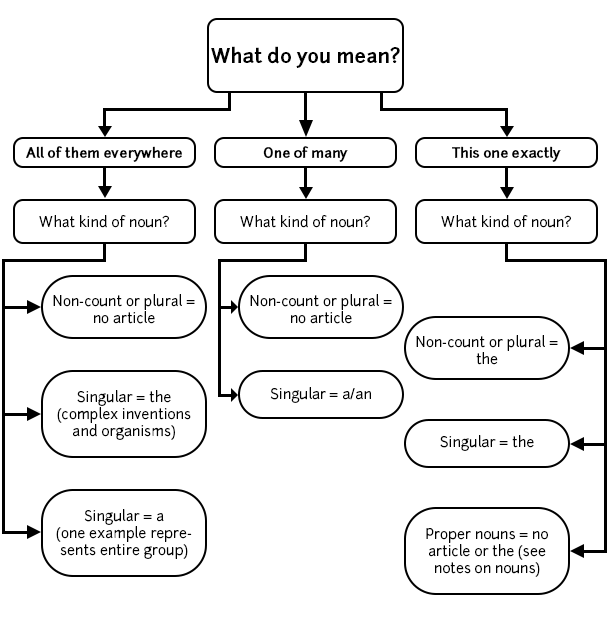
The Writing Center’s Articles handout gives you a way to make that decision while editing. Its three questions are: Am I talking about a category in general, one or some without an identified exact choice, or this particular one?
Read the basic rules in “Articles” from The Writing Center to connect article choice with both meaning and noun type.
In “Basic rules” and “Basic questions,” read the two questions. In “When you mean ‘all of them everywhere,’” follow the examples of general noncount, plural, and singular nouns. In “When you mean ‘one of many,’” begin where the text says an exact identity may not matter; read the noun choices through the umbrella and visa examples.
Here is the pattern in writing-related sentences:
| What you mean | Singular count | Plural count | Noncount |
|---|---|---|---|
| A category in general | An editor checks drafts. | Editors check drafts. | Feedback can improve a draft. |
| One or some, not identified exactly | I contacted an editor. | I contacted editors. | I received feedback. |
| Particular, identifiable one or ones | The editor replied. | The editors replied. | The feedback addressed the opening. |
The last row works when context identifies the person, group, or material. For example, “I contacted an editor. The editor replied” first introduces someone, then refers to that same person. First mention is a helpful clue, not an absolute rule: you can write “the editor assigned to this article” on first mention because the description identifies which editor you mean.
For general statements, plural and noncount nouns usually take no article: “Writers need clear briefs” and “Feedback takes time to apply.” A singular count noun can also represent a whole category—“A writer needs a clear brief”—but it still needs a or an. The handout also describes a more specialized general use of the with some singular nouns, such as “the computer” as an invention. For everyday professional prose, a plural such as “Computers changed writing” is often the simpler general form.
Specific does not mean singular
The can identify a singular item, a particular group, or a particular amount of noncount material. Compare “Writers need feedback” with “The writers on this project need feedback.” The first refers to writers generally; the second identifies a group. Likewise, “Feedback helps” is general, while “The feedback on the introduction was useful” identifies particular feedback.
Read the handout’s definite-reference examples and its notes on noncount nouns. Notice especially that a word can be noncount even when the real-world things it describes could be divided into smaller parts.
Return to “Articles” for its explanation of identifiable references and common noncount nouns.
In “When you mean ‘this one exactly,’” read definite references, stopping after the explicit second-mention example; focus on how context lets a reader identify a noun. Then, under “Some notes about nouns” and its “Uncountable nouns” subsection, read noncount categories through the contrast between instruction and instructions.
Noncount does not mean “never use the.” “I need information” does not identify particular information; “I need the information in your brief” does. It does mean that a/an cannot directly modify the noncount meaning. For one item, choose a countable unit: “a piece of advice,” “a piece of feedback,” or “a research project.”
Another useful boundary: articles generally do not sit beside another determiner for the same noun. Write “my draft” or “the draft,” not “the my draft.” Most names also take no article, though some names have established forms with the. Those are worth checking individually rather than letting them complicate the main rule.
Choose a or an by sound, then check the whole phrase
Once you have decided on an indefinite singular count noun, choose between a and an by the next spoken sound, not simply the next written letter. Write “an editor” and “an experienced editor,” but “a writer” and “a useful guide.” Useful begins with a consonant “y” sound. An adjective can therefore change the choice even when the noun stays the same: “a draft,” but “an early draft.”
Cambridge’s grammar guide gives examples of this sound rule and a compact review of count and noncount nouns.
A/an and the - English Grammar Today - Cambridge Dictionary
Use Cambridge Dictionary’s guide to check the sound rule and the limits on a/an with different noun types.
Under “When do we use a and when do we use an?”, read the sound examples; notice a university but an hour. Under “When do we use articles?” and “A/an and the with types of nouns,” read the “Countable nouns” examples from singular to plural. Continue through “Uncountable nouns,” from rice to measures, to see how a countable container or unit can express a quantity.
When proofreading, you can make an article decision in three passes:
- Find the noun and its meaning. Is it singular count (draft), plural count (drafts), or noncount (feedback)?
- Check identification. Does the reader know which one or ones you mean? If so, the may fit. If not, a singular count noun generally needs a/an; a plural or noncount noun may need no article.
- Check the words around it. Is there already my, this, or some? If you chose a/an, what is the next spoken sound?
Consider an edit in context:
“I sent article to editor. The writers often need the feedback, so I included an advice and three examples.”
If the article and editor are both being introduced, and the second sentence makes a general point, a suitable revision is:
“I sent an article to an editor. Writers often need feedback, so I included a piece of advice and three examples.”
The revision supplies determiners for two singular count nouns, removes the from two general references, and puts a before the countable unit piece rather than directly before noncount advice. A different context could justify “the editor” or “the feedback”; accuracy depends on what the reader can identify.
Articles do two jobs at once: they reflect the kind of noun you are using and whether you mean a general category, an unidentified item, or an identifiable one. Use a/an for an indefinite singular count noun, the for an identifiable reference of any noun type, and often no article for general or unidentified plural and noncount nouns. When a choice feels uncertain, checking noun countability and the surrounding context is more reliable than guessing from the noun alone.
Next, you’ll look at prepositions and common word combinations—another area where a grammatically possible choice may not be the most natural one in professional prose.