Recommended resources
The freely available resources this lesson will direct you to.
- Why Your Positioning Sucks And How to Fix it (w/ April Dunford)www.youtube.com
- How To Write A Positioning Statement (Brand Template + Example)www.youtube.com
- How to Write Market Positioning Statements – eCornell #IMPACTecornell-impact.cornell.edu
- A Buyer-Centric Approach to Competitive Positioningaprildunford.substack.com
Hello. In the previous lesson, you built an interview guide to distinguish why a lending institution adopted an agent workflow, what value it has observed, and what still needs verification. Now you can turn that evidence into one positioning statement: a precise account of whom the offering is for, why it matters, and why that buyer should consider it instead of continuing with traditional collection operations.
Allow about 40 minutes for the short video and readings, then for drafting a statement. The goal is not a polished slogan. It is an internal reference you can use to keep sales and marketing explanations consistent—and to spot claims that outrun your evidence.
Begin with what the buyer would do instead
A positioning statement cannot differentiate agent workflows in the abstract. It must differentiate them from an alternative the buyer recognizes. For many lending institutions, that alternative is not another software vendor. It is continuing to allocate cases to collectors, execute follow-up through existing staff-led processes, and manage the associated handoffs and exceptions.
That does not make traditional operations a weak or foolish choice. Staff bring judgment, established controls, and knowledge of difficult cases. The question is narrower: Which work is your ideal customer asking people to do today that your agent workflow can handle differently—and what worthwhile change follows?
Watch April Dunford’s discussion in Why Your Positioning Sucks And How to Fix It, hosted by Metadata.io. Her useful starting question is what the buyer would choose if your offering were unavailable.
Why Your Positioning Sucks And How to Fix it (w/ April Dunford)
April Dunford explains the elements of positioning and why competitive alternatives should be identified before writing the message.
Watch five components for the relationship among alternatives, capabilities, value, customer fit, and category. Then watch the starting point and the status quo. Focus on why “continue the current manual process” can be a more important comparison than a named competitor.
Use what you established earlier about your ideal customer profile. “Lending institutions” is a market, but it is probably too broad to carry a sharp position. A more useful description names an operational condition: for example, a high volume of routine, policy-eligible cases that consumes collector capacity. That condition is illustrative, not an assertion about your customers; retain it only if your customer evidence supports it.
Be equally specific about the current approach. “Traditional collections” may mean staff personally handling each follow-up step, but a particular prospect may already use rules, dialers, or other automation. Comparing your workflow with a purely manual operation when the buyer has already automated parts of it will weaken your credibility. Describe the steps and handoffs that actually remain staff-led in the accounts you want to win.
Build a statement, not a slogan
A positioning statement holds several decisions together: the target customer, its need, the relevant alternative, your differentiated benefit, and a reason to believe that benefit. The HubSpot template below is a compact visual reminder of the audience, differentiator, and proof you need to specify.
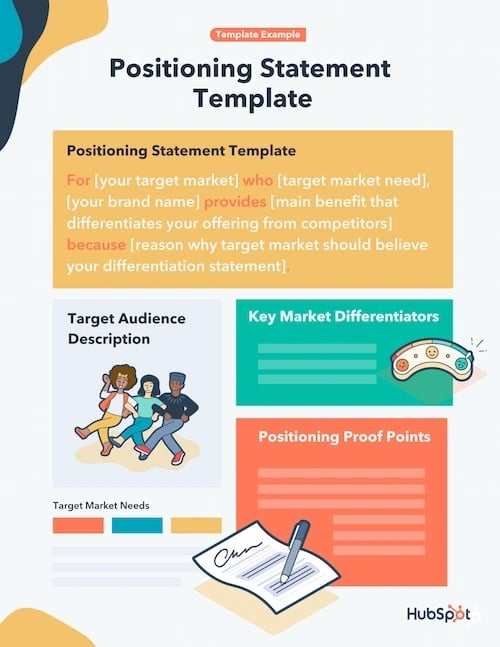
Read the short eCornell guide for a second formulation and criteria for judging the result.
How to Write Market Positioning Statements – eCornell #IMPACT
Read eCornell’s guide to see how a positioning statement connects a target market and competitive frame to a meaningful difference and a reason to believe it.
In “Guidelines for Good Positioning Statements,” read the six criteria, from the first to the last numbered item. Then, in “Template for Writing a Positioning Statement,” read the template and definitions, beginning with the introductory sentence and ending with the definition of “reason to believe.” Focus on the distinction between a benefit that matters to buyers and the evidence that makes it credible.
A template helps you check for missing components; it cannot decide what belongs in the blanks. In particular, “agent workflows” describes an approach, not yet a buyer benefit. The benefit depends on what those agents do that the buyer’s present operation does not do as readily. Handling approved routine steps might let collectors spend less time on repetitive work. Routing exceptions to staff might preserve human attention where judgment is needed. Either is a candidate for positioning only if it reflects the actual product and matters to the target accounts.
The “because” portion deserves care. A product capability can support a claim about how the workflow operates. It does not, by itself, prove a claim about lower cost or better recovery. Your interview notes from the last lesson provide a useful discipline here: keep a customer’s reported improvement separate from a result verified against a defined baseline.
Connect the difference to a defensible promise
April Dunford’s A Buyer-Centric Approach to Competitive Positioning adds an important test for positioning against the status quo: a buyer needs a reason to change and confidence that the change is manageable.
A Buyer-Centric Approach to Competitive Positioning
Read April Dunford’s discussion of positioning against the status quo. It helps distinguish the value of changing collections operations from the effort and risk a buyer associates with making that change.
Under “How to position against the Status Quo,” read both bullets, starting with value and change. The passage begins by explaining why a prospect must see value unavailable today and ends with ways to ease adoption. As you read, consider which adoption concern appeared in your customer interviews; do not assume that a claim of improved efficiency alone resolves it.
You do not need to fit an implementation plan into one sentence. But if the buyer’s central concern is losing oversight, “more automation” may sound like a drawback rather than a benefit. A more credible difference may be which approved steps the agents handle and which exceptions remain with staff, provided that is how your workflow actually functions.
Here is a hypothetical set of inputs. None is a claim about your product or customers:
| Component | Illustrative input |
|---|---|
| Best-fit account | A lender with enough routine, policy-eligible cases that staff-led follow-up strains collector capacity |
| Current alternative | Collectors handle those routine steps individually within the existing process |
| Different approach | Software agents handle approved steps and present exceptions for staff review |
| Buyer-relevant benefit | More eligible cases covered per staff hour, while staff retain exception decisions |
| Reason to believe | Documented queue-level coverage and staff-hour records from a comparable deployment |
If that deployment evidence existed and supported the comparison, the inputs could yield this illustrative positioning statement:
For lenders whose routine, policy-eligible collections cases consume collector capacity, [Offering] is an agent-workflow alternative to staff-led follow-up. It handles approved routine steps and brings exceptions to collectors, helping teams cover more eligible cases per staff hour while keeping exception decisions with people. Documented queue-level coverage and staff-hour records from a comparable deployment support that difference.
Notice what the statement does not say. It does not claim to replace collectors, guarantee compliance, improve recovery for every portfolio, or produce a percentage return without a measured baseline. It names the work that changes and leaves room for human judgment. Its proof also has a scope: comparable queue-level records, not a general impression that automation saves time.
If you cannot yet verify the staff-hour benefit, do not keep that outcome merely because it completes the sentence. Make a narrower statement about the workflow you can demonstrate, and mark the productivity result as a claim to validate. Conversely, if customers have verified a different benefit—such as more consistent handling of eligible cases—let that evidence challenge your first choice of positioning.
Test whether your draft will guide a real conversation
A workable statement should help a head of operations or head of collections recognize both the present constraint and the proposed difference. Read your draft as though that leader could interrupt after each phrase. Could they reasonably say, “That is not how our current operation works,” “Our existing tools do that,” or “How do you know it improves the result?” If so, revise the underlying claim rather than searching for stronger adjectives.
Three checks are especially useful:
- Fit: Does the opening identify accounts where the problem is pronounced, rather than every lender that has a collections function? Your earlier ideal customer profile and adoption interviews should determine the answer.
- Contrast: Would the statement still sound distinctive if “agent workflow” were replaced by “collections software”? If so, specify the operational difference—and check whether the buyer’s current tools already provide it.
- Proof: Does the reason to believe support the particular benefit stated? A workflow demonstration can show how exceptions are routed; it cannot establish a reduction in operating cost. A customer report can identify a promising outcome; a financial claim needs appropriate records and a baseline.
This is an internal positioning statement, so precision matters more than making every phrase suitable for a website. Keep one primary position anchored in your best-fit accounts. You can later express its implications differently for an operations leader focused on capacity and a collections leader focused on case handling, without inventing two conflicting accounts of what the product does.
What to carry forward
Strong positioning names a specific best-fit buyer, a recognizable current alternative, a meaningful operational difference, and evidence proportionate to the benefit claimed. For agent workflows in collections, the hardest—and most valuable—move is often replacing a broad claim about automation with a precise comparison of how eligible work and exceptions are handled today versus with the product.
In the next lesson, you will turn this positioning statement into a message hierarchy: the buyer’s problem, the differentiated approach, supporting evidence, and business outcome. That will make the core position easier to use in conversations without asking one sentence to do every job.