Recommended resources
The freely available resources this lesson will direct you to.
Welcome to your first lesson. Your goal is to one day purchase and rewild a piece of land in the UK, a long-term vision that requires a solid foundation in both the practical and theoretical aspects of ecological recovery.
This course is designed to provide you with that foundation. We will begin with the core principles of ecology and rewilding, then move through the practical steps of finding, acquiring, and planning a project, before finally considering its long-term stewardship.
Today’s lesson starts at the very beginning by addressing a crucial question: What exactly is rewilding? You will learn to define it clearly and, just as importantly, distinguish it from other common approaches like traditional conservation, ecological restoration, and conventional land management. Establishing this clarity now will be essential for making informed decisions at every stage of your future project.
1. What is Rewilding?
The term "rewilding" can feel ambiguous, but at its heart, it's a progressive approach to environmental recovery. It's about stepping back to let nature take the lead, restoring natural processes, and allowing ecosystems to create their own dynamic, self-sustaining landscapes.
Perhaps the best way to understand rewilding is through one of the UK's most famous examples: the Knepp Estate in West Sussex.
The story of Knepp: A rewilding success | Field Studies
To see what rewilding looks like in practice, please watch this short introductory segment from the Natural History Museum's video on the Knepp Estate. It explains the motivation behind the project—transforming unprofitable farmland into a thriving ecosystem—and contrasts its 'hands-off' approach with traditional conservation.
Watch the video from the beginning until 03:27. Pay close attention to why the project started and how the narrator explicitly contrasts the methods used at Knepp with 'traditional methods of conservation management'.
As the video shows, rewilding at Knepp began by ending intensive farming and allowing natural processes to take over. The results have been a spectacular increase in biodiversity, with rare species returning and the entire ecosystem beginning to function on its own terms.
This leads us to a more formal definition. Rewilding is guided by a few core principles:
- It is process-led, not outcome-led. The goal is to restore natural processes—like grazing by large herbivores, predation, and the natural flow of rivers—and then let the ecosystem develop as it will. The final outcome is not predetermined.
- It works at a large scale. Rewilding aims to create large, connected, and resilient ecosystems, rather than managing small, isolated nature reserves.
- It creates self-regulating ecosystems. The ultimate aim is to reduce or eliminate the need for ongoing human management, allowing nature to find its own equilibrium.
While the concept has evolved, an early, influential definition of large-scale rewilding was based on the "3 Cs": Cores, Corridors, and Carnivores. This framework envisions large, protected core wild areas, linked by wildlife corridors, with top predators (carnivores) reintroduced to regulate the ecosystem from the top down. While the reintroduction of large carnivores like wolves is not currently feasible in most of the UK, the principles of creating core habitats and connecting them remain central to rewilding here.
2. Rewilding vs. Traditional Conservation
The video on Knepp touched on the difference between rewilding and traditional conservation. This is a crucial distinction. For decades, conservation in the UK has done vital work protecting specific species and maintaining valuable habitats, often ones that require active management like coppiced woodlands or hay meadows.
Rewilding does not seek to replace this but complements it. Rewilding Britain, a leading charity, provides a clear explanation of how the two approaches differ.
Please read this article from Rewilding Britain. It explains why rewilding is considered a complementary approach to conservation and outlines seven key ways in which the two concepts differ.
Start at the heading 'A complementary approach' and read to the end of the article. Focus on the core argument that rewilding 'explodes the holding pattern' of traditional conservation and note the seven specific differences listed.
To summarise the key distinctions:
| Feature | Traditional Conservation | Rewilding |
|---|---|---|
| Goal | Target-led: Aims to protect or maintain a specific habitat (e.g., a chalk grassland) or species (e.g., the dormouse). | Process-led: Aims to restore natural ecosystem functions and see what emerges. |
| Human Role | Active Management: Often requires constant intervention (e.g., scrub clearance, controlled grazing) to maintain the desired state. | Minimal Intervention: Aims for a self-sustaining system where nature manages itself. |
| Outcome | Predictable & Stable: Seeks to keep a habitat in a specific, stable condition defined by classification systems. | Unpredictable & Dynamic: Embraces change and uncertainty as the ecosystem evolves. |
| Scale | Often focuses on smaller, designated sites (nature reserves). | Focuses on large, landscape-scale areas with connectivity. |
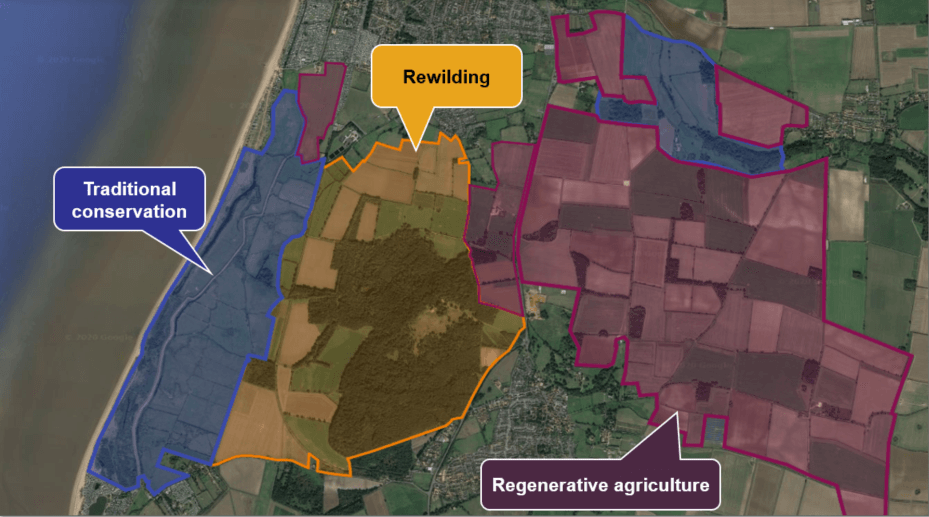
The image below, from the Wild Ken Hill project in Norfolk, visually illustrates how these different land uses can exist side-by-side.
3. Rewilding vs. Ecological Restoration
Another term you will frequently encounter is "ecological restoration." While it sounds similar, its philosophy and goals are quite different from rewilding.
Ecological restoration aims to return a degraded ecosystem to a specific, historically-documented state. It is like repairing a complex machine to its original factory settings. It uses a historical benchmark as its target.

Rewilding, by contrast, is forward-looking. It does not aim to recreate a past version of the landscape. Instead, it accepts that the climate and environment have changed, and focuses on creating resilient ecosystems for the future, whatever they may look like.
This article provides a concise summary of the key differences.
Back to nature - restore or rewild?
This article clearly separates rewilding from restoration. Please read the following section to understand the fundamental differences in their approach.
Please read the section titled 'Rewilding-v-restoration'. Focus on the four bullet points that directly contrast the two approaches.
In short, the key difference is the reference point:
- Restoration looks to the past, aiming to recreate a specific historical ecosystem.
- Rewilding looks to the future, aiming to create a novel, functioning ecosystem that is resilient to future changes.
4. Rewilding vs. Traditional Land Management
Finally, the simplest distinction is between rewilding and traditional land management, such as intensive agriculture or commercial forestry.
- Traditional Land Management: The primary goal is production. The landscape is managed to maximize a specific output, whether it's crops, livestock, or timber. This usually involves high inputs (fertilisers, pesticides), low biodiversity, and a simplified ecosystem structure.
- Rewilding: The primary goal is ecological autonomy. The landscape is managed to maximize natural processes, biodiversity, and resilience. Economic outputs, if any (e.g., from low-intensity meat sales or ecotourism), are a by-product of a healthy ecosystem, not the main driver.
The story of Knepp, which started by abandoning unprofitable intensive farming, is a perfect example of this shift in priority from production to ecological function.
Conclusion
You should now have a clear understanding of what makes rewilding a distinct approach to land management.
Key Takeaways:
- Rewilding is a forward-looking approach that focuses on restoring natural processes to create a self-regulating, dynamic ecosystem with minimal human intervention.
- It differs from traditional conservation, which is often target-led, seeking to preserve specific species or habitats through active management.
- It differs from ecological restoration, which is backward-looking, aiming to return a habitat to a specific historical baseline.
- It differs from traditional land management, where the primary goal is economic production, not ecological health.
Understanding these distinctions is the first step on your journey. It provides the intellectual framework needed to evaluate land, set goals for your project, and communicate your vision.
In our next lesson, we will delve into the primary engine of change in any rewilding project: ecological succession. This is the natural, often predictable, sequence of changes in plant and animal communities over time, and understanding it is fundamental to realising your long-term vision for the land.