Recommended resources
The freely available resources this lesson will direct you to.
- How to pass your AWS Solutions Architect Associate Exam | Real Exam Questions & Strategieswww.youtube.com
- Non-Functional Requirements - FULL guide with REAL Exampleswww.youtube.com
- Definitions - AWS Well-Architected Frameworkdocs.aws.amazon.com
- AWS Certified Solutions Architect Associate Exam - SAA-C03 Study Pathtutorialsdojo.com

Welcome. This course begins with the decision that comes before choosing an AWS service: deciding what the architecture must accomplish. Your experience running servers and networks gives you a useful starting point, but SAA-C03 scenarios often hide the decisive requirement in a short phrase such as “during an Availability Zone failure” or “at the lowest cost.”
In this lesson, you will learn to extract availability, security, performance, and cost constraints from a scenario before evaluating solutions. That habit will support both exam questions and your later single-VPC and multi-Region designs.
Start with requirements, not a service diagram
A functional requirement describes what a system does: accept an order, store a file, or authenticate a user. A non-functional requirement describes the conditions under which it must do that work: remain available during a failure, protect customer data, respond within a time limit, or stay within a budget.
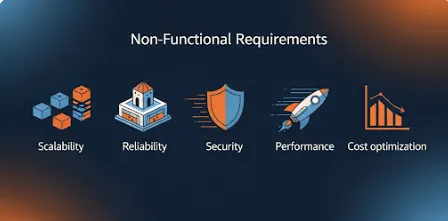
The distinction matters because the same function can be delivered by very different architectures. “Host an ordering application” does not tell you whether a single server is sufficient. “Continue accepting orders if one Availability Zone fails” changes the design space immediately.
Non-Functional Requirements - FULL guide with REAL Examples
Watch “Non-Functional Requirements - FULL guide with REAL Examples” from Win The cloud for an example of gathering architectural constraints before selecting technology.
Start with the distinction between functional and non-functional requirements. In the reliability discussion, watch availability choices; notice that the required level depends on which functions the business must keep running. Then watch cost considerations for why expected demand and ongoing maintenance affect the architecture. Treat the examples as questions to ask, not default specifications for every workload.
On an exam, the stakeholder discussion has already been compressed into the question stem. Your job is to recover its constraints. In a real design, you would also identify what the stem leaves unanswered.
Read through four lenses
The AWS Well-Architected Framework gives these qualities precise names. Its reliability pillar includes a workload performing correctly when expected; performance efficiency concerns meeting system requirements efficiently as demand changes. Security and cost optimization are distinct considerations, not afterthoughts once the application works.
Definitions - AWS Well-Architected Framework
Read the AWS Well-Architected Framework definitions to establish the meaning of the four qualities you will extract from scenarios.
In Table 1, read the full table from “Operational excellence” through “Sustainability,” concentrating on the Security, Reliability, Performance efficiency, and Cost optimization rows; the Security row is a useful place to orient yourself. Then, in the closing discussion beneath the definitions, read the trade-off paragraph. Focus on how business context sets priorities without making required security controls optional.
Here is what to look for when translating scenario language into constraints:
| Lens | What to extract |
|---|---|
| Availability | Which function must keep working, during which failure, and for how long can it be interrupted? “Survive one Availability Zone failure” is more informative than “highly available.” |
| Security | What must be protected, from whom, and under what access or compliance rules? Separate data access, network exposure, and encryption requirements. |
| Performance | What response time, throughput, or capacity is required, under what load and from where? A latency target without a load condition is incomplete. |
| Cost | Is there a spending ceiling, or is the task to minimize cost among designs that meet the other requirements? Include ongoing operation and data movement, not just initial deployment. |
These lenses interact. Placing capacity in multiple Availability Zones may improve fault tolerance and increase expense. Restricting network access can affect which connectivity paths are available. A trade-off is not permission to violate a hard requirement: “most cost-effective” means the least costly acceptable design, not simply the cheapest design.
Notice also that availability is narrower than a general claim of “reliability.” An uptime target, tolerance of an Availability Zone failure, and tolerance of data loss are related but separate statements. Do not silently turn one into the others. Later in the course, you will give recovery time and recoverable data loss their own explicit objectives.
Extract the constraint before considering the answer choices
SAA-C03 questions usually provide a workload, some context, and a request for the “best” solution. A useful first pass is to state what the workload does. On the second pass, mark every phrase that limits a valid answer.
How to pass your AWS Solutions Architect Associate Exam | Real Exam Questions & Strategies
Watch “How to pass your AWS Solutions Architect Associate Exam | Real Exam Questions & Strategies” from Digital Cloud Training for examples of reading requirements before judging proposed AWS solutions.
Watch scenario framing, then private connectivity. In the latter example, distinguish the requirement to upload securely from assumptions you might add about how every private-subnet workload must connect. Finally, watch competing constraints and note how high availability, low latency, and cost must be considered together rather than one at a time.
A compact extraction method is:
- Name the essential function. What must users or systems still be able to do?
- Record explicit constraints in the scenario’s words. Preserve qualifiers such as “during an Availability Zone failure,” “only,” “less than,” and “without internet access.”
- Classify each constraint. A phrase can belong to more than one lens: “serve global users with low latency at minimum cost” has both performance and cost implications.
- Separate hard conditions from preferences. “Must remain private” is a condition. “Minimize cost” usually ranks the solutions that already satisfy the conditions.
- Mark unknowns instead of inventing them. If no response-time threshold is supplied, do not assume one. If the exam asks for the most cost-effective option, compare the options against the constraints actually given.
Service names in a scenario are often context, not the requirement itself. For example, “an application on EC2 uploads objects to S3” tells you what is deployed. “Its instances must not have internet access” restricts the acceptable connectivity design. Equally, being in a private subnet alone does not prove that outbound internet access is forbidden; read the exact wording.
Worked example: an ordering workload
Consider this condensed architecture brief:
An ordering application is moving from an on-premises environment to AWS. Customers must still be able to place orders if one Availability Zone fails. The database must accept connections only from the application tier, and order data must be encrypted in transit and at rest. At a peak of 2,000 concurrent users, the API’s 95th-percentile response time must remain below 300 milliseconds. The monthly infrastructure budget is capped at USD 1,800; within that cap, minimize ongoing cost.
The first sentence supplies context. The rest determines whether a proposed design is acceptable.
| Scenario wording | Extracted constraint | Status |
|---|---|---|
| “still be able to place orders if one Availability Zone fails” | Availability: the order-placement function must continue despite one AZ failing. Check every component needed to complete an order, not just the web servers. | Hard |
| “database must accept connections only from the application tier” | Security: database connectivity is restricted by source. | Hard |
| “order data must be encrypted in transit and at rest” | Security: both transmission and storage need protection. | Hard |
| “95th-percentile response time … below 300 milliseconds” at “2,000 concurrent users” | Performance: the specified latency must hold at the specified peak load; an average response time is not an equivalent measure. | Hard |
| “monthly infrastructure budget is capped at USD 1,800” | Cost: a proposed design must fit the stated ceiling, subject to validating an estimate. | Hard |
| “within that cap, minimize ongoing cost” | Cost: among designs meeting the other conditions, prefer the lower-cost one. | Preference |
This reading catches mistakes that a service-first approach misses. Duplicating only the application servers across AZs is not enough if a dependency required to place an order remains a single-AZ failure point. A database open to arbitrary network sources fails the stated security condition even if it performs well. A design tested only at light load has not demonstrated the stated performance target.
It also exposes questions a real architect would need to resolve. Does “still be able to place orders” permit a brief failover interruption? What happens to transactions acknowledged just before a failure? What measurement window defines the latency target? Which usage and data-transfer assumptions underpin the USD 1,800 estimate? The exam may provide enough information to choose among its options without answering all of these. Outside the exam, they belong in the requirements record rather than in unspoken assumptions.
Your system administration experience is useful here: an HA label on a compute tier never proved that the complete application could survive a failure. The constraint applies to the end-to-end function, including its dependencies.
Keep a short constraint ledger
Under exam time pressure, you need not build a formal requirements document. A one-line ledger is enough to keep priorities visible:
Function: place orders. Must: operate through one-AZ failure; restrict database access; encrypt order data; meet p95 latency at peak; stay under budget. Optimize: ongoing cost. Unknown: permitted failover interruption and data-loss tolerance.
That ledger prevents two common reading errors. First, a vague adjective such as “high-performing” can distract from a measurable target elsewhere in the stem. Second, an attractive qualifier such as “least cost” can make a cheaper but non-compliant option seem viable. Evaluate the whole requirement set before ranking solutions.
Key takeaways
Extract constraints before selecting services. For each scenario, identify the essential function, the explicit availability and security conditions, the performance target under its stated load, and whether cost is a ceiling or an optimization preference. Keep missing information separate from stated facts, and apply requirements to the complete workload rather than one component.
Next, you will use all six AWS Well-Architected pillars to evaluate a proposed solution. Today’s four-lens reading provides the requirements that evaluation must respect.