Recommended resources
The freely available resources this lesson will direct you to.
Bonjour!
In our last lesson, we explored how subordinating conjunctions like parce que and si connect clauses to express relationships of cause, time, condition, and purpose. We saw how they build a logical structure in a sentence.
Today, we'll learn another way to connect ideas: using relative clauses. Our focus will be on the two most common relative pronouns, qui and que. The goal of this lesson is to learn how to form these clauses by recognizing simple patterns in examples. This will make your sentences more fluid and sophisticated, moving you away from simple, repetitive statements. For instance, instead of saying "J'ai lu un livre. Le livre est fascinant." (I read a book. The book is fascinating.), you'll be able to say "J'ai lu un livre qui est fascinant." (I read a book that is fascinating.).
What are Relative Pronouns For?
At their core, relative pronouns like qui and que are connectors. They link a main clause to a secondary one (a relative clause) that gives more information about a noun. Their main job is to avoid repeating that noun.
Let's begin by reading a short text that illustrates this core function.
How to use relative pronouns in French?
This article from Mango Languages clearly shows how relative pronouns help combine two short sentences into a single, more elegant one. This is the fundamental reason we use them.
Please read the first section, titled 'What is a relative pronoun in French?'. Pay close attention to the example of combining 'I am reading a book' and 'The book is interesting' to see the role of 'that' in English.
As you saw, the goal is efficiency and flow. French uses this structure constantly, and unlike in English, the relative pronoun (qui or que) can never be omitted. The main challenge is knowing which one to choose.
The Key Difference: qui vs. que
The choice between qui and que depends on the role the pronoun plays in the clause it introduces. Is it the subject (the one doing the action) or the object (the one receiving the action)?
Since you prefer learning through patterns, here is the most effective way to decide: look at the word that comes immediately after qui or que.
Let's watch a video that explains this pattern-based approach with clear examples.
Practise your French Relative Pronouns "Qui vs Que"
The 'Learn French With Alexa' channel provides a very structured explanation. This video will walk you through the core patterns for using 'qui' and 'que'.
Please watch these two key segments: The rule for 'qui' (00:28 - 03:22): Notice in all the examples, qui is immediately followed by a verb. (e.g., la fille qui parle..., le train qui part...) The rule for 'que' (03:22 - 05:44): Here, you'll see que is followed by a subject (usually a pronoun like je, tu, nous or a name). (e.g., le livre que j'ai acheté..., les pommes que nous mangeons...)
Summarizing the Pattern
The video makes the pattern very clear. Let's formalize it:
-
Use
quiwhen it is the subject of the verb.- Pattern: Noun +
qui+ verb... quiperforms the action of the verb that follows it.- Example: J'aime la chanson qui passe à la radio. (I like the song that is playing on the radio.)
- What is playing? The song (
la chanson). Soquireplacesla chansonas the subject of the verbpasse.
- What is playing? The song (
- Pattern: Noun +
-
Use
quewhen it is the direct object of the verb.- Pattern: Noun +
que+ subject + verb... quereceives the action of the verb.- Example: J'aime la chanson que tu écoutes. (I like the song that you are listening to.)
- What are you listening to? The song (
la chanson).tuis the subject doing the listening, and the song (que) is the object being listened to.
- What are you listening to? The song (
- Pattern: Noun +
This visual summary provides another clear look at this structure.
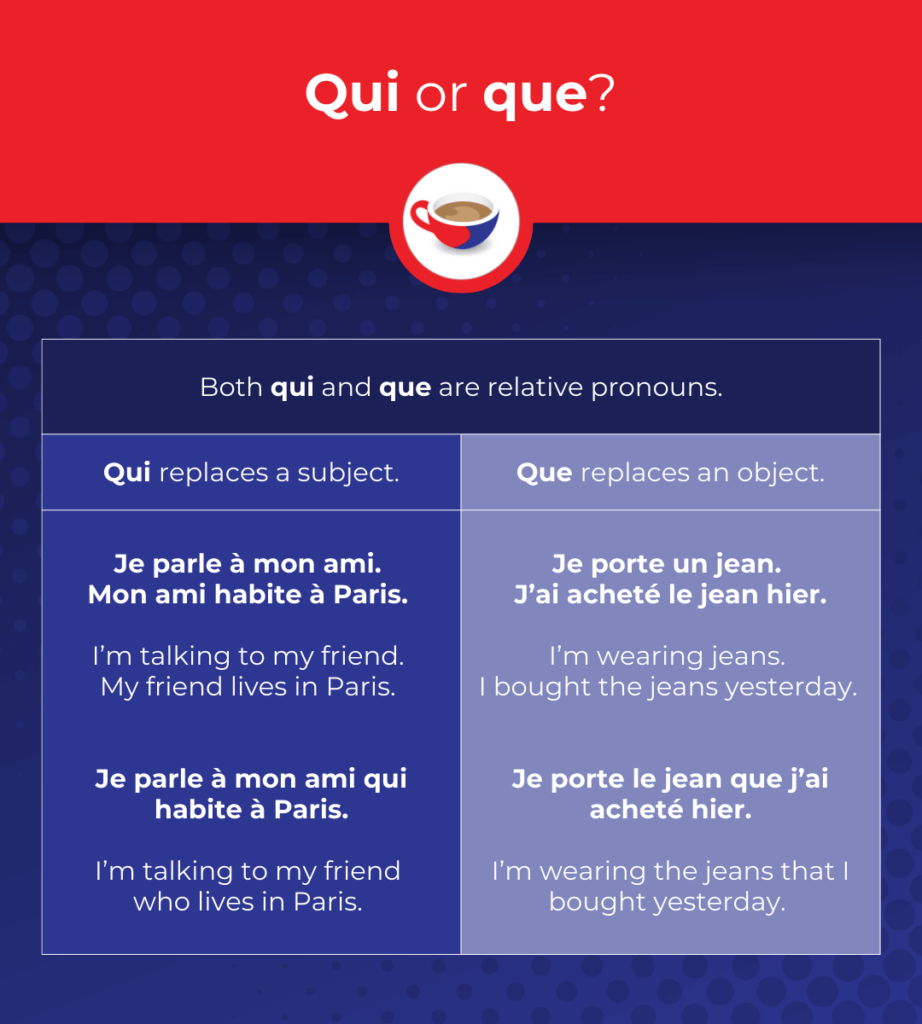
An Important Detail: Contractions
There is one small but crucial difference in how qui and que behave before a vowel (a, e, i, o, u) or a silent 'h'.
quecontracts toqu'.- *Le film **qu'*il a vu. (The film that he saw.)
quinever contracts.- Le film qui est sorti hier. (The film that came out yesterday.) NOT:
qu'est
- Le film qui est sorti hier. (The film that came out yesterday.) NOT:
Let's Practice
Now, let's try to apply this pattern. Choose qui or que to complete each sentence. Think about the word immediately following the blank.
- L'homme ___ attend le bus est mon voisin. (The man who is waiting for the bus is my neighbor.)
- Voici le gâteau ___ j'ai préparé pour toi. (Here is the cake that I prepared for you.)
- Ce sont les livres ___ ont changé ma vie. (These are the books that changed my life.)
- La décision ___ tu as prise est la bonne. (The decision that you made is the right one.)
- J'ai une amie ___ habite en Italie. (I have a friend who lives in Italy.)
Answers:
qui(followed by the verbattend)que(followed by the subjectj')qui(followed by the verbont)que(followed by the subjecttu- becomesqu'in a full sentence: La décision **qu'**tu as prise...)qui(followed by the verbhabite)
Conclusion
Excellent work today! You've learned how to connect ideas in a new way, making your French more expressive and natural. By focusing on a simple, observable pattern, you can confidently choose between qui and que.
Key Takeaways:
- Relative pronouns
quiandquelink a main clause to a relative clause, adding information about a noun and avoiding repetition. - The choice between them depends on the grammatical role they play (subject vs. object).
- The most practical way to decide is to look at the following word:
- Use
quiif it's followed by a verb. - Use
queif it's followed by a subject (noun or pronoun).
- Use
- Remember that
quecontracts toqu'before a vowel, butquinever does.
Preview of the Next Lesson:
We've just scratched the surface of relative pronouns. In our next lesson, we'll add two more powerful tools to our collection: où and dont. You'll learn how où can refer to a place or a time (meaning "where" or "when") and how dont can express possession or replace phrases with de (meaning "whose" or "of which").