Recommended resources
The freely available resources this lesson will direct you to.
Hello! Welcome to your first lesson.
Given your goal of learning about Sega's composers, we're diving straight into a fascinating and highly technical aspect of their craft: sound design. While the course is structured to build from hardware fundamentals, your background suggests you'll be comfortable jumping directly into the practical art of synthesis.
This lesson addresses the learning outcome: Deconstruct 2-3 contrasting FM-synthesized drum patches from Genesis soundtracks and explain the operator configurations that produce their percussive characteristics.
We will explore how composers on the Sega Genesis, limited to the Yamaha YM2612 chip, sculpted percussive sounds not from samples, but from pure sine waves using Frequency Modulation (FM) synthesis. We'll break down the core components of an FM patch—operators, algorithms, and envelopes—and apply this knowledge to build and understand two classic drum sounds: a kick and a snare.
Your experience with wave physics and numerical modeling will be advantageous here, as FM synthesis is fundamentally about the complex interactions that arise from modulating the phase of one waveform with another.
1. The Toolkit for FM Percussion
Percussive sounds are typically characterized by two main features:
- A very fast, sharp initial transient (the "hit").
- A timbre that is often complex and inharmonic, followed by a rapid decay.
The YM2612 provides a powerful, if constrained, toolkit to create these characteristics. Before we deconstruct specific patches, let's get familiar with the essential parameters.
I'd like you to read through the following resource. It's a technical document, but it provides the ground truth for how the YM2612 operates.
Sega Genesis Technical Manual - YM2612 section
This is an excerpt from a technical manual for the Yamaha YM2612. It details the chip's architecture and the specific registers composers used to control it. This will give us the precise vocabulary needed for our deconstruction.
Please read the sections titled 'A little bit about operators', 'Envelope specification', 'Register 30H+ - detune & multiple', and 'Register B0H+ - feedback; algorithm'. Focus on understanding the definitions of: Operators and Algorithms: How are operators arranged and what do 'carriers' (slots) and 'modulators' do? Envelope Parameters: Specifically Attack Rate (AR), First Decay Rate (D1R), and Total Level (TL). Frequency Multiple (MUL): How this parameter affects an operator's pitch. Feedback: What is unique about Operator 1?
To summarize and reinforce those concepts:
- Operators: The four sine wave generators per channel. Some are carriers (audible outputs), and some are modulators (invisible, but alter the timbre of carriers).
- Algorithms: The eight possible configurations that determine which operators modulate which, and which are carriers.
- Envelopes: The shape of an operator's amplitude over time. For percussion, a very fast Attack Rate (AR) and Decay Rate (D1R) are critical for creating a sharp, punchy sound.
- Total Level (TL): An operator's peak amplitude. For a modulator, this is equivalent to modulation depth or index. For a carrier, it's volume.
- Multiple (MUL): Sets an operator's frequency as a multiple of the channel's base frequency. Using non-integer or high ratios is key to creating the inharmonic spectra of many percussive sounds.
- Feedback (FB): A special loop on Operator 1 that allows it to modulate itself. At high levels, this produces a chaotic, noise-like signal, essential for sounds like snares and cymbals.
Now, let's see how these tools are used in practice.
2. Deconstruction 1: The FM Kick Drum
An effective kick drum sound requires two components: a sharp, high-frequency "click" (the beater hitting the drum skin) and a low-frequency, decaying "boom" (the resonance of the drum shell). In FM synthesis, this is typically achieved with a simple modulator-carrier pair.
- The carrier operator produces the audible "boom." It's a low-frequency sine wave with a decaying envelope.
- The modulator operator produces the "click." It has a very fast, sharp envelope and a higher frequency. It modulates the carrier's frequency for only a few milliseconds, creating a rapid downward pitch sweep at the sound's inception.
The following video demonstrates the creation of a kick drum in DefleMask, a modern tracker that faithfully emulates the Genesis hardware.
DefleMask Instrument Tutorial - Sega Genesis / Megadrive FM Sound (part 1 of 3)
This segment from a DefleMask tutorial by debuglive demonstrates the creation of a classic FM kick drum from scratch.
Please watch the section from 00:33:20 to 00:34:45. Pay close attention to how the creator manipulates the envelopes and levels of the two operators to achieve the final sound.
Analysis of the Kick Drum Patch
Let's break down what you just saw using our technical vocabulary:
- Algorithm Selection: The creator likely used a simple algorithm where one operator modulates another, which then outputs to the sound mixer (e.g., Algorithm 2, 4, or 5).
- Carrier Operator (The "Boom"):
- MUL: Set to a low value (e.g., 1 or 0.5) to produce a low fundamental pitch.
- Envelope: A fast
ARand a moderately fastD1Rto create the decaying body of the kick. TheTLis set to a high value (low attenuation) to make it audible.
- Modulator Operator (The "Click"):
- MUL: Set to a higher value (e.g., 4, 5, or higher) to create a bright, clicky transient.
- Envelope: This is the crucial part. The
ARandD1Rare set to their fastest possible values. TheTL(modulation depth) is carefully tuned. Too low, and the click is inaudible; too high, and the sound becomes overly distorted and metallic. The envelope is so fast that the modulation only occurs at the very beginning of the note. This creates the perception of a pitch envelope, where the sound starts high and instantly drops to the carrier's fundamental frequency.
This elegant two-operator interaction perfectly simulates the physics of a beater strike and subsequent resonance.
3. Deconstruction 2: The FM Snare Drum
A snare drum's sound is fundamentally different. It's primarily composed of noise (the "snares" rattling) combined with a quick tonal "thump" from the drum's body. On the YM2612, the noise component is the most challenging and interesting part.
As we learned, the key to generating noise is the feedback parameter on Operator 1. By setting the feedback value to its maximum (7), the operator's output becomes a chaotic, harsh, noise-like waveform.
Let's watch this being done.
DefleMask Instrument Tutorial - Sega Genesis / Megadrive FM Sound (part 1 of 3)
In this clip from the same tutorial, the creator crafts a percussive hi-hat. The technique is nearly identical to that used for an FM snare, as both are based on generating and shaping noise.
Please watch from 00:31:50 to 00:33:00. Observe the immediate change in timbre when the 'feedback' parameter is increased on Operator 1.
Analysis of the Snare/Hi-Hat Patch
Here are two common approaches to building a snare sound from this noise source:
Approach A: Single Noisy Carrier
- Algorithm Selection: Use an algorithm where Operator 1 is a carrier (e.g., Algorithm 7, which is pure additive synthesis).
- Operator 1 (The "Snare"):
- Feedback: Set to 7 (maximum) to generate the noise.
- Envelope: A very fast
ARandD1Rto create a sharp "tsss" sound.RR(Release Rate) is also set very high so the sound cuts off abruptly. - MUL: The multiplier will affect the "pitch" or "color" of the noise. Higher values result in brighter, tinnier noise.
Approach B: Noisy Modulator + Tonal Carrier
This is a more sophisticated approach that combines the noise and body components.
- Algorithm Selection: Use an algorithm where Operator 1 modulates another operator (e.g., Algorithm 0 or 4).
- Operator 1 (The "Snare" Modulator):
- Feedback: Set to 7.
- Envelope: Very fast
ARandD1R. - TL: This now controls how much of the "snare" noise is mixed into the sound.
- Operator 2 (The "Body" Carrier):
- Envelope: A slightly slower decay than the modulator to give the snare some body.
- MUL: A low-to-mid value to provide the tonal "thump" of the drum shell.
The final sound is a blend of the carrier's tone and the harsh, complex spectrum imparted by the noisy modulator. Composers would finely tune the TL and envelope parameters of all operators to balance the "thump" and the "rattle" of the snare.
4. Summary and Synthesis
We've seen that with just a few sine wave operators, composers could create two radically different percussive sounds. The image below shows a modern VST plugin that emulates the YM2612. It helps visualize all the parameters we've discussed.
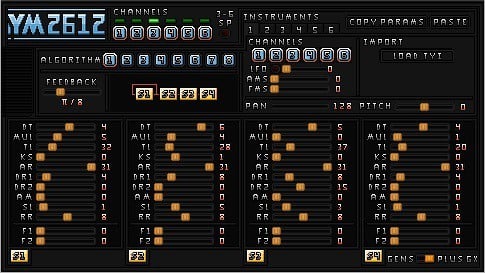
The core distinction lies in the sound source:
- Kick Drum (Tonal Percussion): A pitched sine wave (carrier) is given a percussive character by a fast pitch envelope, created by a second operator (modulator) with an extremely short, sharp amplitude envelope.
- Snare Drum (Noisy Percussion): A noise source is generated by pushing Operator 1's feedback loop into a chaotic state. This noise is then shaped by its own envelope or used to modulate another operator, which acts as a filter.
Based on these deconstructions, what would you say are the two most critical parameters for distinguishing a tonal percussive sound (like a kick) from a noisy one (like a snare) on the YM2612?
Conclusion
In this lesson, we've deconstructed the fundamental techniques for synthesizing drums on the Sega Genesis.
Key Takeaways:
- FM-synthesized percussion is built from the ground up by manipulating sine wave operators.
- The sharp transient of a drum hit is created using extremely fast Attack and Decay Rates on the operator envelopes.
- Tonal percussion (like kick drums) typically uses a simple modulator-carrier pair to create a rapid pitch-sweep effect.
- Noisy percussion (like snares and hi-hats) is made possible by overdriving Operator 1's feedback loop to generate a complex, noise-like signal.
- The choice of Algorithm and the Multiple (MUL) and Total Level (TL) of each operator are used to further shape the final timbre.
This method of synthesis gave Genesis music its distinctive, punchy, and often metallic percussive character.
Preview of the Next Lesson:
The YM2612 had another trick up its sleeve. Channel 6 could be switched from an FM voice into a simple Digital-to-Analog Converter (DAC), allowing for the playback of short, low-fidelity audio samples. In our next lesson, we will explore this capability and analyze the technical and creative trade-offs between using FM-synthesized percussion and DAC-based sampled drums.