Recommended resources
The freely available resources this lesson will direct you to.
- GCSE Physics - Power & Work Done - Equations | Calculations (2026/27 exams)www.youtube.com
- Physics How to calculate Energy transfer, time and Power using triangular formulawww.youtube.com
- Energy, work and power - IGCSE Physics - BBC Bitesizewww.bbc.co.uk
- 16.11 Energy in Waves: Intensity - College Physics 2e | OpenStaxopenstax.org
Hello! This module is about calculating energy transfer in two situations: when an object changes temperature and when a wave carries energy. The same question connects them: how much energy is transferred, and how quickly?
In this lesson, you’ll use a wave’s power and travel time to calculate its energy transfer. You’ll then compare that transfer rate with the rate at which water gains energy while warming. Allow about 35–40 minutes to watch the short video, follow the worked calculations, and check what each answer means.
Power tells you how quickly energy is transferred
Imagine a light wave delivers 12 joules of energy to a surface every second. In one second it delivers 12 joules; in ten seconds, 120 joules. The amount delivered depends on how long the transfer continues. The rate of delivery is its power.
Power is energy transferred per unit time:
Here is power in watts (W), is energy transferred in joules (J), and is time in seconds (s). One watt means one joule transferred each second. A 12 W wave therefore transfers 12 J each second through the surface where that power is measured.
GCSE Physics - Power & Work Done - Equations | Calculations (2026/27 exams)
Watch “GCSE Physics - Power & Work Done - Equations | Calculations” from Cognito for the meaning of power, its units, and the rearrangement used in this lesson.
Watch power defined for energy transferred per unit time, then the units. In the lamp comparison, notice why the lamp transferring more total energy is not necessarily the more powerful one. Finally, watch finding energy; focus on converting minutes to seconds before multiplying.
The video uses electrical devices, but the equation does not depend on how energy is transferred. It applies just as well to energy carried by light, sound, or another wave.
Calculating the energy a wave carries
Rearrange the definition of power by multiplying both sides by time:
The units confirm the result:
For example, suppose a wave delivers 8 W to a detector for 2 minutes. First convert the time: 2 minutes is 120 seconds. Then calculate:
The detector receives 960 J during that interval. Multiplying 8 by 2 and reporting 16 J would be wrong: watts describe joules per second, not joules per minute.
The formula image below provides a visual reminder of the three related calculations. When you need energy, multiply power by time; when you need the rate, divide energy by time. Use s (lowercase) as the unit symbol for seconds.
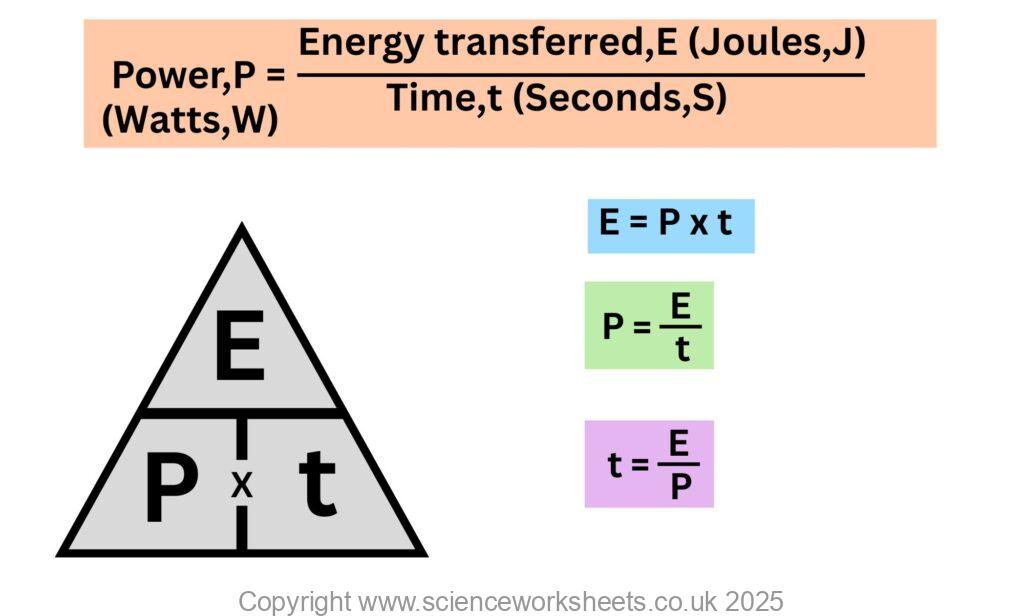
You can also rearrange the relationship to find how long a transfer takes:
For instance, at a steady 8 W, transferring 960 J takes s. All three forms express the same relationship; choose the one that matches the unknown quantity.
Which wave power does the number describe?
A wave can leave a source, pass through a surface, and reach a receiver. Those descriptions do not automatically refer to the same amount of energy. If a lamp emits light in many directions but a small detector intercepts only some of it, use the power reaching the detector to calculate energy reaching the detector. The lamp’s total emitted power would answer a different question.
Likewise, energy arriving at a surface need not all be absorbed: some light may be reflected. When interpreting a calculation, name both the location and the transfer you mean—such as “energy carried across the detector’s surface” or “energy absorbed by the water.”
The simple multiplication works directly when power stays constant. If power varies, the power used in this equation must be the average over the stated time interval. For example, 4 W for the first 10 s and 8 W for the next 10 s transfers J in 20 s. Its average transfer rate is W—not 8 W for the entire interval.
Comparing a wave with a heating process
A temperature change gives another way to find an energy transfer. If an object of mass and specific heat capacity changes temperature by , the energy associated with that change is
Here is in joules, is in kilograms, and tells you how many joules are needed to raise 1 kg of the material by one degree Celsius. For water, we can use approximately . A temperature change of 5 °C is also a change of 5 K, so either temperature-change unit works when paired with the corresponding units for .
This equation finds an amount of energy, not a rate. To compare heating with a wave, you also need the time taken:
Consider two measured transfers:
- A wave delivers 12 W to a receiver for 5 minutes.
- Separately, 0.10 kg of water warms by 5 °C in 20 s. Assume the temperature rise accounts for the energy gained by the water.
For the wave, convert 5 minutes to 300 seconds:
For the water, first find the energy gained:
Then divide by the 20 s heating time:
The wave transfers more energy overall in these observations: 3600 J versus 2100 J. Yet the water gains energy at a faster rate: 105 W versus 12 W, or times the wave’s measured rate. There is no contradiction—the wave transfer continues for much longer.
That distinction is the heart of a fair comparison. Joules compare totals; watts compare rates. You may compare two powers directly even when the measured intervals differ. To compare totals, account for how long each transfer lasted.
Heating and waves are not necessarily unrelated physical processes. Absorbed light, for example, can warm water. The equations answer different measurement questions: uses a measured transfer rate and duration, while uses a measured temperature change. Do not assume energy arriving as a wave all becomes the water’s measured temperature gain unless the situation says so.
A reliable calculation routine
For a wave problem, identify which transfer its stated power describes, convert the time to seconds, and use . Report the answer in joules. If the power is not steady, use the average power for the interval or calculate the energy for each steady-power interval and add the results.
For a comparison with warming, calculate first, using kilograms and a compatible value of . Divide by the heating time in seconds to obtain watts. Finally, state separately which process transfers more energy and which has the greater rate. Keeping those two conclusions separate prevents the most common interpretation error.
Key takeaways
A wave carrying power for time transfers energy , provided is constant or is the average power for that interval. Watts measure joules per second, so time must be in seconds when using watts to obtain joules. To compare a wave with a warming object, calculate the object’s energy gain with , then divide by its heating time. A larger total energy transfer does not necessarily mean a faster transfer.
This completes the module’s two calculation methods. Together, they let you move between an observed temperature change, an amount of energy, and the rate at which that energy is transferred.