Recommended resources
The freely available resources this lesson will direct you to.
Welcome back. Last lesson established the key distinction between training and inference: training changes a model’s parameters, while inference uses fixed parameters to generate an answer from the current prompt.
That distinction explains an important limitation of LLMs. A model can be articulate and broadly knowledgeable, yet still lack the exact fact a user needs — especially if it is new, private, or specific to a narrow domain. In this lesson, you will learn why those gaps exist and why they create a need for externally supplied evidence, which RAG will provide later in the course.
An LLM’s knowledge is a snapshot, not a live information service
An LLM is trained on a very large collection of text over a period of time. During that process, its parameters learn patterns that help it continue text, answer questions, summarize, write code, and perform many other language tasks.
But once training ends, those parameters are fixed during normal use. The model does not automatically:
- read newly published documents,
- inspect your company’s latest policy,
- query an internal database,
- observe what changed five minutes ago, or
- verify a claim against an authoritative source.
A useful model is:
The trained model is a snapshot of patterns learned from past data.
The prompt is the information available for this particular request.
Suppose a company changes its return policy today:
Revised return policy, June 2026:
Customers may return unopened items within 45 days of delivery.
If that policy was written after the model’s training period, the base model cannot know it merely because it is now publicly available. Without being given the policy or being connected to a tool that can retrieve it, the model has no direct way to inspect it.
Even information that existed before training is not guaranteed to be available reliably. Training data is incomplete, filtered, uneven in quality, and too vast for the model to retain as a precise, traceable library of every source document.
Is RAG Still Needed? Choosing the Best Approach for LLMs
Watch “Is RAG Still Needed? Choosing the Best Approach for LLMs” from IBM Technology for a concise statement of the three gaps that matter most: recent events, confidential data, and internal documentation.
Watch the opening. Notice the phrase “locked in the past,” but interpret it carefully: it does not mean every old fact is perfectly remembered. It means the model has no built-in awareness of events or documents that become available after training.
Why “current” knowledge is difficult
Current information can fail in several different ways:
| Type of change | Example | Why a base LLM may fail |
|---|---|---|
| A new event | A product launches today | It occurred after training. |
| A changed fact | A regulation is amended | The model may produce an older version. |
| A moving value | Inventory, exchange rates, flight times | The value can change continually. |
| A corrected source | A scientific result is revised | Training may contain the earlier claim, conflicting reports, or neither source. |
The danger is that the model may answer in a polished, confident style even when the relevant fact is stale. Fluency is evidence that the model can generate plausible language; it is not proof that the answer reflects the latest authoritative information.
Private information is not part of the model’s normal view
Now consider a different question:
“How many vacation days do I have remaining?”
The answer may exist in an employer’s HR system, but it depends on data specific to one person: employment history, approved leave, local policy, and perhaps a manager’s decision. A general LLM normally has no authorized connection to those records.
This is more than a training-date problem. Private information is commonly protected precisely because it should not be placed in a broadly accessible training corpus. Examples include:
- customer support tickets,
- employee records,
- medical files,
- contracts,
- internal engineering documentation,
- proprietary source code,
- draft financial results.
A model may know general language about vacation policies, but that is different from knowing your organization’s policy or your personal balance.
There is an important security nuance here. You should not assume that any given model’s training data is a safe, complete, or auditable record of what it has or has not encountered. In a well-designed application, private information should instead be provided through an explicit, controlled path with appropriate permissions. The application decides which documents or records a particular user is allowed to retrieve; the LLM should receive only the authorized material needed for the request.
So the practical question is not:
“Could the model possibly have seen something similar during training?”
It is:
“Does this request provide authorized, relevant evidence from the actual source of truth?”
Specialized knowledge can be present, yet still unreliable for a specific question
“Specialized” does not mean that an LLM knows nothing about a field. A capable model may explain many concepts in medicine, law, engineering, finance, or software development. The limitation is more precise:
General training does not guarantee dependable knowledge of a particular organization’s terminology, documents, versioned procedures, or niche facts.
Consider an internal question such as:
“Which calibration procedure applies to model XR-17 after firmware version 4.2?”
This question may depend on a recently revised internal service manual. Even if the model understands calibration, firmware, and maintenance manuals in general, it may lack:
- Coverage — the XR-17 manual may never have been in the training data.
- Specificity — the manual may contain a small but critical exception.
- Version awareness — it may know an older procedure but not the procedure for version 4.2.
- Source fidelity — it cannot necessarily tell you which official document supports its answer.
- Organizational meaning — labels such as “XR-17,” “tier-two release,” or “exception class B” may have meanings only inside one organization.
An LLM’s learned parameters are not a neatly indexed filing system containing one authoritative answer per topic. They are a distributed, compressed representation of patterns from training. This lets the model generalize impressively, but it is not the same as opening the current manual, locating the relevant paragraph, and quoting it.
A model can generate an answer without having evidence
When a question arrives, an LLM is designed to continue the prompt with likely tokens. Unless the prompt includes reliable source material or the application gives the model access to a retrieval tool, the model must rely on:
- its learned patterns from training,
- general reasoning from the wording of the question,
- assumptions suggested by common cases,
- and any information already present in the conversation.
That can produce three very different outcomes:
| Situation | Possible model behavior | Reliability |
|---|---|---|
| The model has strong, stable general knowledge | Gives a correct explanation | Often useful, but still not automatically sourced |
| The model has partial or outdated knowledge | Gives an answer that mixes accurate and obsolete details | Risky for changing facts |
| The model lacks the needed information | Produces a plausible-sounding guess | Potentially misleading |
For example, a user might ask:
“What is the current approval threshold for purchases in our company?”
A model could produce a reasonable generic response such as, “Purchases above a certain amount usually require manager approval.” But this does not establish the actual threshold in that company. The exact number could be different by department, country, contract type, or policy revision.
This distinction is central:
- A general explanation may be useful without a private source.
- A precise organizational claim needs supporting evidence from that organization.
- A current factual claim needs evidence current enough for the decision being made.
What is Retrieval-Augmented Generation (RAG)?
Watch the relevant portion of “What is Retrieval-Augmented Generation (RAG)?” from IBM Technology. It illustrates how an answer can be both confident and outdated when it comes from remembered information alone.
Begin with the stale-information example, which contrasts a confident memory with a current, cited fact. Then watch the model-only answer to see the same problem framed as an LLM response. Focus on the difference between sounding certain and having verifiable support.
Spotting a knowledge gap before trusting an answer
At this stage, do not assume that every answer without a citation is false. Many stable, general questions can be answered well from a model’s learned knowledge.
Instead, treat the following as signals that external evidence is needed:
- The question includes words such as current, latest, today, remaining, or in effect.
- The answer depends on a specific policy, contract, manual, account, or database record.
- The topic has versions, exceptions, regional variations, or rapidly changing details.
- The user asks what a particular organization, product, customer, or employee record says.
- The cost of an incorrect answer is high, such as in legal, medical, safety, financial, or compliance work.
- The answer makes an exact claim but cannot identify the source that supports it.
A helpful habit is to ask:
What source would I need to inspect to verify this answer?
If the answer is “the latest policy,” “the customer’s account,” “the current documentation,” or “a proprietary design specification,” then a base LLM’s internal knowledge should not be treated as sufficient evidence.
Why ordinary prompting cannot fill the gap
Prompting can improve how an LLM communicates. For example, you can ask it to be concise, explain uncertainty, use a table, or state assumptions. But prompting alone cannot give the model access to a document it has never received.
Compare these two prompts:
What is our company’s current parental-leave policy?
Using the policy excerpt below, explain the current parental-leave policy.
[authorized policy excerpt supplied here]
The second prompt gives the model evidence it can use in the present request. The first only asks it to rely on its learned parameters and whatever context is already in the conversation.
Fine-tuning is also not the ideal response to every knowledge gap. Fine-tuning changes model parameters and can help with behavior, style, and repeated task patterns. But updating a model whenever a policy changes would be costly, slow, and difficult to verify. It also does not naturally provide a citation showing which current document supports an answer.
The practical alternative is to retrieve the relevant source material at request time and supply it to the LLM as context.
Glossary - Claude Platform Docs
Read Anthropic’s concise glossary entry on RAG to connect the knowledge-gap problem with the basic idea of supplying external evidence at runtime.
In the “RAG (Retrieval augmented generation)” entry, read the complete entry. It begins immediately after the “Pretraining” entry and ends before “RLHF.” Focus on the distinction between what is in the model’s training data and what is retrieved and placed into its context for one request.
The bridge to RAG: provide evidence at the moment of the question
RAG, short for retrieval-augmented generation, addresses these limitations by giving an LLM relevant external information during inference.
The key idea is simple:
- Keep current, private, or specialized documents in an external knowledge source.
- When a user asks a question, find the passages relevant to that question.
- Put those passages into the LLM’s prompt alongside the user’s question.
- Instruct the model to answer using that supplied evidence.
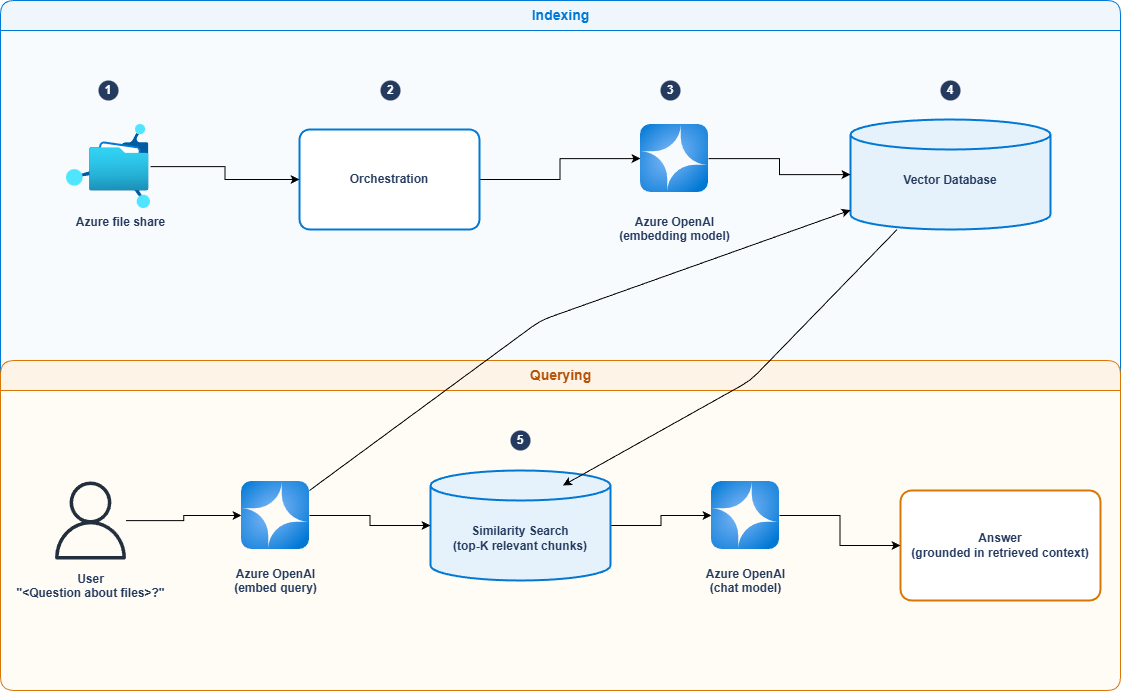
For now, focus on the boundary shown in the diagram:
- The vector database and source documents are external to the LLM.
- The retrieved chunks become temporary context for a single answer.
- The LLM still generates the wording token by token, but it can base that wording on current, authorized source material.
RAG does not make an answer automatically correct. The documents may be outdated, the system may retrieve the wrong passages, or the model may fail to follow the evidence. But it creates a much stronger basis for answering questions that a model’s fixed training knowledge cannot reliably cover.
Key takeaways
An LLM may lack needed information because:
- Its trained knowledge is based on past data and is not automatically updated after training.
- It normally has no authorized access to private systems, personal records, internal documentation, or proprietary code.
- Its general training may not cover a niche domain, a specific document version, or an organization’s internal terminology.
- Its parameters represent learned patterns, not a current, searchable, source-linked database.
- A fluent or confident answer is not the same as an answer supported by evidence.
RAG is designed to address these gaps by retrieving relevant external sources and supplying them in the prompt at inference time, without retraining the model.
Next, you will use this understanding to recognize an ungrounded claim: a statement that may sound persuasive but is not supported by evidence available to the model for that answer.