Recommended resources
The freely available resources this lesson will direct you to.
Introduction
In our last lesson, we delved into Ludwig von Mises's powerful economic calculation problem. We saw his argument that a centrally planned socialist economy is bound to fail because, by eliminating private property and markets for the means of production, it destroys the price system. Without prices, a planner has no way to calculate costs or rationally decide whether to use steel to build a bridge or a tractor. They are, in Mises's words, "groping in the dark."
Today, we build directly on that foundation by exploring the work of Mises's student, the Nobel laureate Friedrich Hayek. Hayek developed a related but distinct argument known as the knowledge problem. He argued that even if a central planner were a benevolent genius with a supercomputer that could solve the calculation problem, they would still fail. Why? Because the necessary information for a functioning economy isn't the kind of data that can be fed into a computer in the first place. Your learning goal is to understand this crucial insight: why centralized planners cannot possibly acquire and use the vast, dispersed knowledge that is automatically coordinated by market prices.
The Problem of Dispersed Knowledge
Hayek's central argument, laid out in his famous 1945 essay "The Use of Knowledge in Society," begins with a simple question: what is the economic problem a society must solve? He argued that it is not merely a technical problem of allocating "given" resources. The real problem is that the "data" is never "given" to a single mind.
To get a clear overview of Hayek's thinking, let's begin with a video that summarizes his main points.
Hayek on the Use of Knowledge in Society
This video from Marginal Revolution University, "Hayek on the Use of Knowledge in Society," provides an excellent introduction to the core concepts of his most famous essay.
Please watch the first three and a half minutes, which cover: Hayek's key idea: that crucial economic knowledge is fundamentally dispersed among countless individuals. The tin market example: a demonstration of how the price system communicates information and allows people to adapt without knowing the specific details of a market disruption.
As the video explains, the economic problem is one of adapting to constant change. To do this effectively requires using knowledge that is not, and cannot be, held by any single person or committee. It exists only as "dispersed bits of incomplete and frequently contradictory knowledge which all the separate individuals possess."
Two Kinds of Knowledge
When we think of "knowledge," we often think of scientific or technical knowledge—the kind you find in textbooks and can be taught in a classroom. Hayek agreed this is important, but he argued that society tends to undervalue another, equally vital type of knowledge.
Let's read a key passage from Hayek's original essay to understand this distinction.
The Use of Knowledge in Society - FEE.org
In this excerpt from his seminal essay, Hayek himself lays out the core of his argument.
First, read the section that begins "The peculiar character of the problem" to understand how Hayek frames the fundamental economic challenge. Next, read the section that distinguishes between different types of knowledge, starting from "Today it is almost heresy to suggest". Pay close attention to what he calls the "knowledge of the particular circumstances of time and place."
Hayek emphasizes that the knowledge of a shipper who knows about a half-empty cargo ship, an estate agent who knows of a temporary opportunity, or a factory manager who knows a particular machine is currently idle, is just as socially useful as the knowledge of a research scientist. This "knowledge of time and place" has several key features:
- Local: It's about specific conditions here and now.
- Fleeting: It can become obsolete in an instant.
- Contextual: Its value depends entirely on the immediate situation.
Furthermore, much of this knowledge is tacit—it's more like "know-how" than "know-that." Think of an experienced chef who just "knows" how much spice to add, or a skilled mechanic who can diagnose an engine problem by its sound. This is knowledge gained through experience that people possess but often cannot fully articulate. As the philosopher Michael Polanyi famously said, "we know more than we can tell." A central planner can't gather this knowledge through surveys or reports, because the individuals themselves often can't write it down.
Centralized vs. Decentralized Networks
The nature of this knowledge creates an insurmountable problem for a central planner. A planned economy is a centralized network. All information must flow from the periphery (individuals) to the center (the planning board) to be processed, after which commands flow back out.
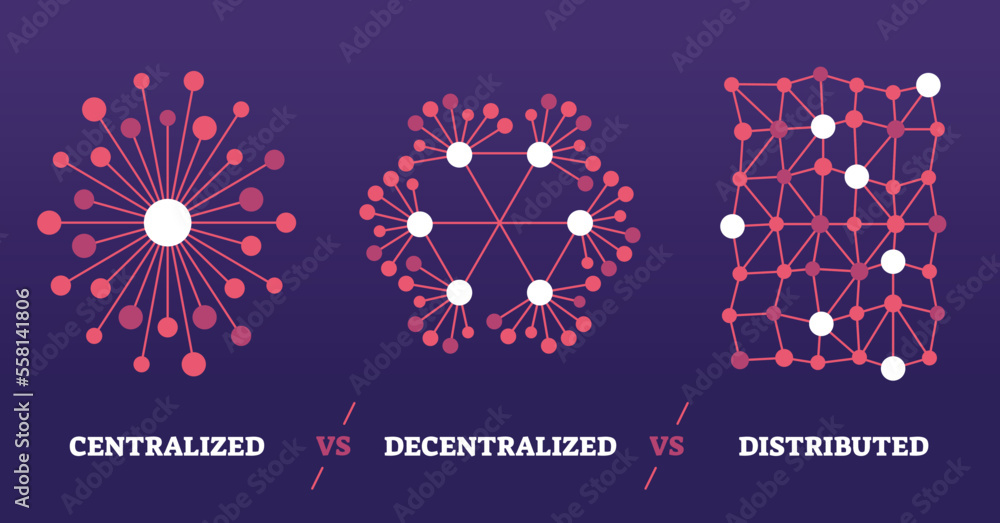
This centralized structure is fundamentally unsuited for processing dispersed, fleeting, and tacit knowledge. By the time local information is collected, sent up the chain of command, integrated into a massive plan, and a decision is sent back down, the original circumstances have already changed. The opportunity is lost.
The Price System: A "Marvel" of Communication
If knowledge can't be centralized, how does a society coordinate the economic actions of millions of people, each acting on their own limited, local knowledge? Hayek's answer is his most celebrated insight: the price system.
Hayek described the price system as a mechanism for communicating information—a kind of vast, society-wide telecommunications network. Crucially, it works by abstracting away all the complex details and transmitting only the most essential information in a simple, usable format: a price.
Let's return to Hayek's famous tin example.
The Use of Knowledge in Society - FEE.org
This is the most famous part of Hayek's essay, where he explains the communicative function of prices.
Read the section describing the tin market, from "Assume that somewhere in the world". Notice how individuals only need to know that the price has changed, not the reason for the change.
The marvel here is the economy of knowledge. The can manufacturer doesn't need to know about the flooded mine in Malaysia or the new electronics factory in Korea. All of that complex, dispersed information about the changing supply and demand for tin is condensed into a single number: the price. This price acts as a signal.
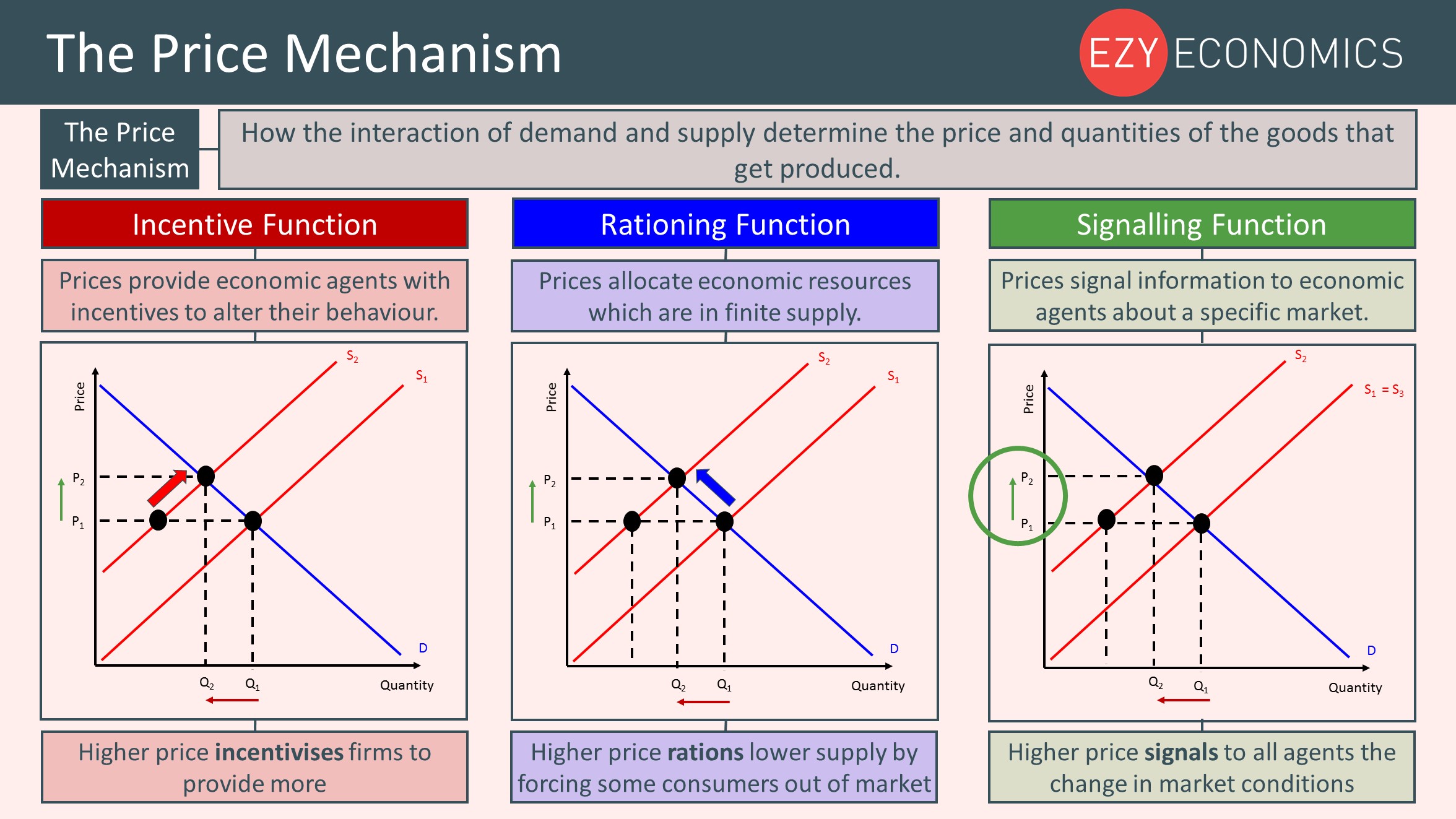
A higher price sends a signal to users of tin: "Tin is now more scarce relative to the desires of others. Conserve it. Find substitutes." It also sends a signal to producers: "Society values tin more highly. Produce more of it." As economists Alex Tabarrok and Tyler Cowen put it, "A price is a signal wrapped in an incentive." It not only tells people what to do, it gives them a direct incentive to do it.
Let's watch one more short video that explains this with a different, everyday example.
Essential Hayek: Knowledge and Prices
This video from The Fraser Institute, titled "Essential Hayek: Knowledge and Prices," provides another clear illustration of the price system in action.
Watch the section from the coffee example. Notice how Sarah, the coffee drinker, acts as if she knew about the bad weather in Colombia, even though all she knows is that the price of her favorite coffee went up.
Sarah the coffee drinker, the can manufacturer, and the tin producer all contribute to solving the problem of tin scarcity, not because a planner told them to, but because they are responding to the signal conveyed by a changing price. This is how a market economy creates a "spontaneous order"—a complex and coordinated pattern that arises from the independent actions of individuals, without being consciously designed by anyone.
Conclusion
Hayek’s knowledge problem provides a profound challenge to the idea of central economic planning, one that is distinct from Mises's calculation problem. While Mises showed that a planner cannot calculate, Hayek showed that a planner cannot know.
Let's summarize the key takeaways:
- Dispersed Knowledge: Economically useful knowledge is not concentrated; it is spread across millions of individuals as local, fleeting, and often tacit "knowledge of the particular circumstances of time and place."
- The Planner's Blindness: A central planning authority cannot gather and process this dispersed knowledge. The information becomes obsolete before it can be used, and much of it is in a form that cannot be easily transmitted.
- Prices as Signals: The free market's price system solves this problem by acting as a giant communication network. Prices summarize vast amounts of information about supply and demand into a single, actionable signal.
- Economy of Knowledge: Individuals don't need to know why a price has changed; they only need to know the price itself to be guided toward making economically rational decisions, coordinating their actions with millions of unseen strangers.
Hayek showed us the immense informational power of a decentralized market and the profound informational limits of a centralized state. But his argument applies mainly to comprehensive central planning. What about more limited government interventions? Do governments face similar knowledge problems when they try to regulate industries, set minimum wages, or provide public services? In our next lesson, we will explore public choice theory, which applies economic reasoning to the actions of politicians and bureaucrats, introducing the concept of "government failure."