Recommended resources
The freely available resources this lesson will direct you to.
- Market research with ChatGPTwww.youtube.com
- Evaluating Sources & Fact Checking: Crash Course Scientific Thinking #6www.youtube.com
- Verifying What You Find & Use - Using Generative AI To Do Research - LibGuides at York Universityresearchguides.library.yorku.ca
- Verifying and Citing Generative AI - Generative AI Tools for Students - Research at Boston Universitylibrary.bu.edu
Hello! Last lesson, you checked whether each source was strong enough for the claim you wanted to make. Generative AI adds a useful research assistant—but also another place where a claim can lose its connection to the original evidence.
In this final lesson of the portfolio-setup module, you will use AI to speed up document triage and drafting without asking a recruiter to trust the AI. The goal is a case study where you can trace any important sentence back to a disclosure, reproduce any calculation, and explain what you personally checked. Allow about 40 minutes, including a short addition to your case folder.
Give AI a job it can do—and keep the evidence elsewhere
Suppose you have several annual reports and want to understand why a company’s margins changed. AI can suggest search terms, identify potentially relevant notes, organize competing explanations, or edit a paragraph for clarity. None of those tasks makes its answer evidence that margins changed because of a particular factor.
The distinction is between discovery, analysis, and proof. AI may help you discover a passage. You must read the passage to establish what the company reported. If you then infer a cause, the argument and its limitations are yours to defend.
This short product demonstration shows the appeal of AI-assisted market research. Watch it for the workflow, not as evidence that every generated citation is correct.
Watch “Market research with ChatGPT” from OpenAI to see how a bounded research request can specify a decision, comparison criteria, and desired output.
In the research request, notice the explicit market-entry decision and requested factors. Then watch the reported output for its references and summary. Treat those references as leads to inspect, not as automatic verification; the video is a product demonstration.
For your first company brief, a bounded prompt is more useful than “Write an investment report.” For example:
“Using only the public disclosures I provide, identify passages that discuss changes in operating margin over the last three reported years. Return a table with document title, fiscal period, page or section, a short passage, and whether the passage states a result, management’s explanation, or a future expectation. Write ‘not found’ where evidence is absent. Do not infer a cause.”
Even if the response supplies page numbers and quotations, open the documents yourself. Check that the page exists, the quoted words are present, the period and entity match, and the model has not turned “management expects” into “the company achieved.”
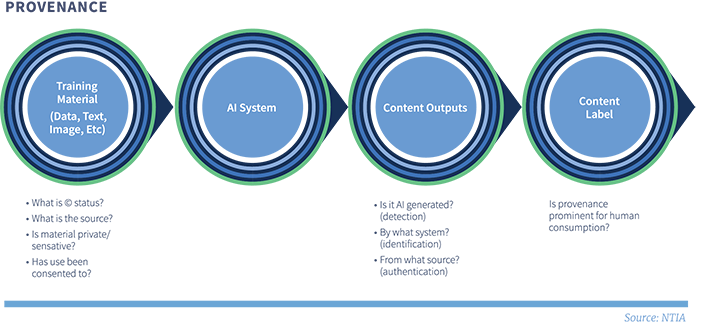
The provenance diagram below shows why a label on an AI output is only part of the picture. Its stages concern training material, the AI system, content outputs, and content labels. Your case study needs an additional, practical record: which published company evidence supports your particular claim. Knowing that text came from an AI system does not establish that the text is true.
Build a trail a second person can follow
York University Libraries recommends checking AI claims against other sources, verifying AI-supplied citations, and keeping a prompt log. Read the three relevant rows of its guidance, concentrating on the actions you can transfer to company research rather than its library-specific search tools.
Verifying What You Find & Use - Using Generative AI To Do Research - LibGuides at York University
Read “Verifying What You Find & Use” from York University Libraries for a compact verification and record-keeping routine.
In the strategies table, start with the row “Compare and verify: Check AI claims against other sources.” Read the verification advice; the remainder of that row gives academic-library search examples. Next, in “Check citations for hallucinations (fake, incorrect or partially incorrect citations),” read the citation checks. Finish with the “Keep a log of the prompts you use” row: read the log guidance.
A practical audit trail in a company folder has four connected parts:
- Source register: the original document’s URL, publication and access dates, exact page or section, and what it can support. You began this in the previous lessons.
- Claim ledger: the exact wording you intend to publish, the source IDs and locators behind it, any calculation or interpretation involved, and its verification status.
- Calculation file: a spreadsheet or script containing inputs, units, periods, formulas, and checks—not numbers copied from an AI answer.
- AI-use log: enough detail to reconstruct what you asked AI to do, what material you gave it, what you used, and how you checked it.
Think of these as separate responsibilities, not four copies of the report. The source register describes documents; the claim ledger explains why particular sentences are defensible. A reviewer should be able to start at a chart or report sentence, find its claim-ledger entry, inspect the cited disclosure, and reproduce a material number.
For a quick first release, two small files alongside your existing sources/source_register.csv are sufficient:
research/claim_ledger.csv— suggested columns:claim_id,published_wording,claim_type,source_ids_and_locators,calculation_reference,verification_note,status,checked_date,report_location.research/ai_log.md— record the date, tool and version if known, task, prompt or a faithful sanitized summary, input source IDs, what output you retained, and the human checks performed.
Use statuses such as verified, qualified, unresolved, and rejected. “Verified” means you completed the specified checks; it is not a claim that the underlying disclosure is infallible. Do not publish private chat transcripts, credentials, restricted documents, or unnecessary copies of copyrighted reports merely to demonstrate diligence. Public links, precise locators, concise notes, and reproducible calculations usually serve the purpose better.
Verify numbers, wording, and citations separately
AI mistakes are not limited to invented sources. It may cite a real report but attach the wrong figure, compare consolidated revenue with standalone revenue, or calculate correctly from the wrong periods. That is why a working hyperlink is only the beginning of a citation check.
Consider an entirely hypothetical company whose consolidated revenue, in the same currency units, is 100 in the first year, 120 in the second, and 126 in the third. An AI draft says, “Revenue growth accelerated to 20% in the latest year.” The reports might be real and the three figures might be copied correctly, yet the sentence is still wrong:
Growth slowed from 20% to 5%. Before publishing even that corrected sentence, you would confirm the source figures, fiscal periods, units, and consolidated basis. In your ledger, the sentence would cite the historical disclosures and a cell range in your calculation workbook. An AI-generated figure or formula is a suggestion to test, not a model input with independent authority.
Use a three-part check for each material AI-assisted claim:
- Evidence: Locate the original passage or table. Does it say what the draft claims, for the same company, period, and reporting basis? If an AI-provided citation cannot be found or does not support the sentence, do not cite it.
- Calculation: Enter sourced inputs into your own workbook, inspect the formula and units, and perform a separate reasonableness or manual check on important outputs. Keep assumptions visibly distinct from reported figures.
- Interpretation: Ask whether the conclusion goes beyond observation. “Margin increased” may be measurable; “pricing power caused the increase” needs evidence that distinguishes pricing from cost, mix, or accounting effects.
The same discipline will matter later in DCF and M&A work. An AI suggestion for a discount rate, synergy, or transaction multiple is an assumption or lead until you establish its definition and support. A beautifully formatted model will not repair an unverified input.
AI can help draft prose once the ledger is sound. Give it verified findings and ask for a concise paragraph that preserves qualifications—for example, “Draft from these claim IDs only; retain ‘management stated’ where appropriate; flag any sentence requiring evidence not supplied.” Then compare every sentence with the ledger. Remove persuasive additions that appeared during editing, especially unsupported superlatives, causal claims, and confident forecasts.
A short methodology note in your finished case might say:
“Generative AI assisted with research organization and language editing. Material factual claims were checked against the cited original sources; calculations were performed and checked in the accompanying workbook. AI output was not treated as a primary source.”
Only make that statement if it describes what you actually did. The AI-use log provides the more detailed internal record; the report gives readers a concise, honest disclosure.
Add this to your first case today
Spend 15 minutes making the method usable, rather than designing an elaborate governance system:
- Create
research/claim_ledger.csvandresearch/ai_log.mdin the company folder. - Take one material claim from the three rows you audited last lesson. Copy its proposed report wording into the ledger, link its source-register ID and precise locator, and mark whether it is a reported fact, calculation, management assertion, or your interpretation.
- Use AI for one narrow task—such as suggesting an outline from your verified notes or identifying questions to investigate. Log the task and inputs. Check anything you retain against the original material.
- Record the verification result. If a figure, quotation, or interpretation remains uncertain, mark it unresolved and keep it out of the published conclusion for now.
A good output is modest: one claim that can be traced and defended, plus an honest record of where AI helped. You can repeat this pattern as the brief grows. If you work in 30-minute sessions, stop after the first three steps and complete the source check in the next session; do not publish an unchecked draft simply because it reads well.
Takeaway
Use generative AI to find possibilities, organize material, and improve expression. Keep factual authority with inspectable sources, numerical authority with reproducible calculations, and responsibility for the final judgment with you. The source register, claim ledger, calculation file, and brief AI log make that division visible to both you and a future interviewer.
With the portfolio’s research safeguards in place, the next module begins the first company-research sprint: turning a broad interest in a company into a decision-oriented research question that your evidence can actually answer.